Key points
- Valium is one of the oldest and longest-acting benzodiazepines.
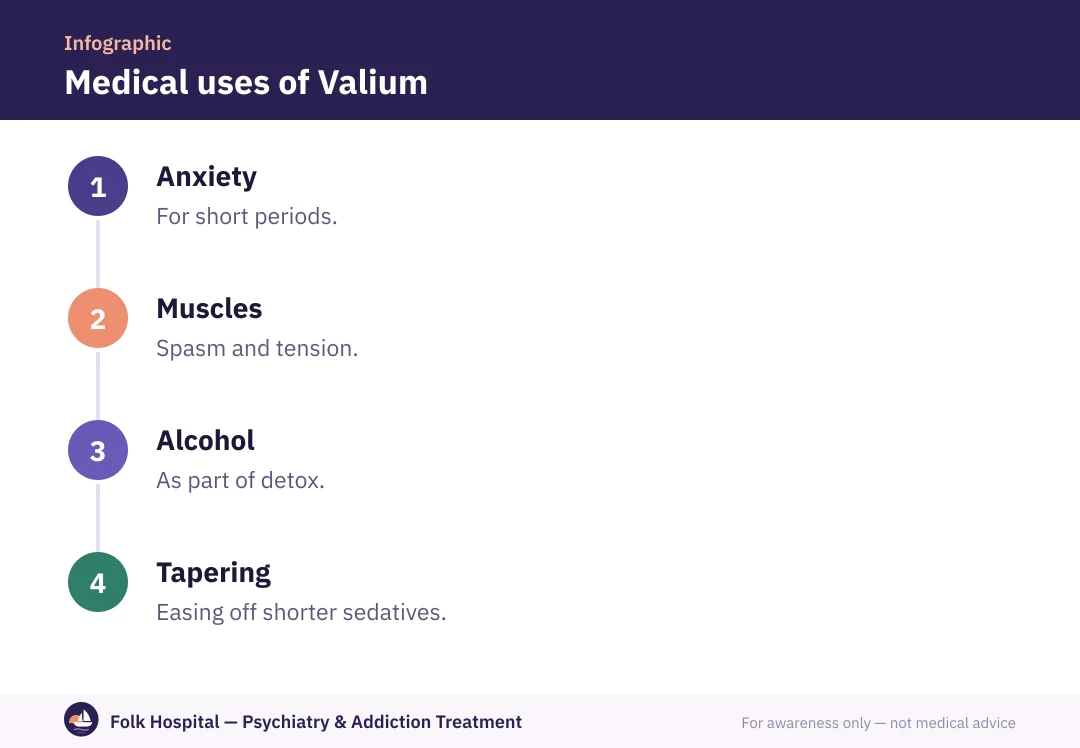
- It's used for anxiety, muscle spasms and alcohol detox.
- It stays long in the body and builds up with daily use.
Valium (diazepam) has been known for decades; its long action makes it useful in certain cases, but it causes dependence with long-term use.
01Key facts
| Item | Details |
|---|---|
| Class | Long-acting benzodiazepine |
| Common forms and names | Tablets and injections |
| How it's used | By mouth or injection |
| Does it show on a standard test? | Usually yes, on the benzodiazepine panel |
| Risk of dependence | Moderate to high with long-term use |
02How does it affect the brain and body?
It boosts GABA's calming effect, reducing anxiety and relaxing muscles, and because its by-products last long its effect can build up, especially in older people.
03The main risks
- Dependence and long withdrawal.
- Daytime drowsiness and build-up.
- Falls and accidents.
- Slowed breathing when mixed.
Call an ambulance on 123 immediately for
- Deep drowsiness or slow breathing with other substances.
- Seizures after stopping suddenly.
What to do right nowAmbulance: 123
04What to read next
The harms of ValiumValium withdrawalHow long Valium stays in the bodyTreating Valium dependenceSedatives
؟Frequently asked questions
Why is Valium used in alcohol detox?
Because it calms the overactive nervous system and prevents seizures, and its long action makes tapering smoother, under medical supervision.
Is it suitable for older people?
It needs caution because it builds up in them.
Sources and references
- Prescription Medicines — research topic — National Institute on Drug Abuse (NIDA)

Written byDr. Mahmoud ElsawyConsultant in psychiatry and addiction treatment
A psychiatrist specialising in addiction and mental illness in adults and adolescents, with a focus on dual diagnosis.
For awareness only — not a substitute for medical advice. Editorial policy · View profile