01When does alcohol become a problem that needs treatment?
Not everyone who drinks needs treatment, but drinking becomes a disorder when a person loses control of it and carries on despite harm. Key signs include:
Signs of alcohol use disorder
- Drinking more, or for longer, than intended.
- Failed attempts to cut down or stop.
- Morning shaking, sweating or anxiety that settles with a drink.
- Neglecting work or family because of drinking or recovering from it.
- Drinking in dangerous situations such as driving.
- Carrying on despite clear health or family problems.
Read about the signs of alcohol addiction and its causes.
02What are the stages of treatment?
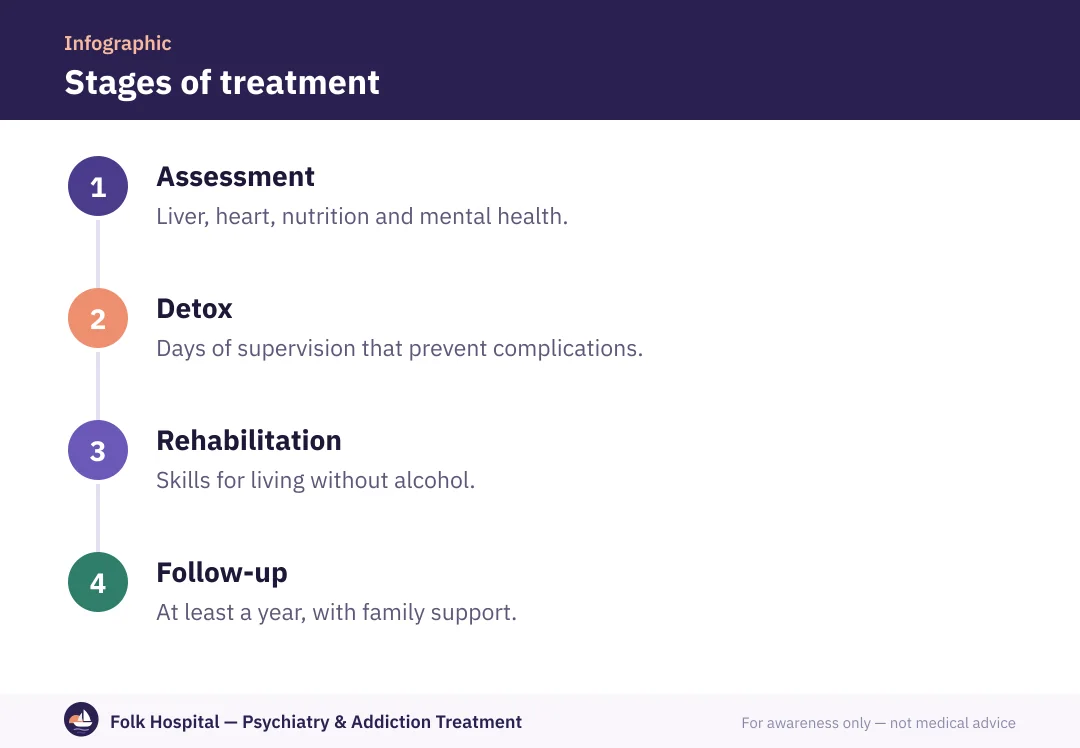
- Assessmentliver and blood tests, and an evaluation of how severe the dependence is and the risk of withdrawal.
- Detoxmedicines that calm the nervous system and prevent seizures, plus vitamins to protect the brain.
- Rehabilitationcognitive behavioural therapy, handling triggers and learning to sleep without alcohol.
- Follow-upsessions and support groups, with medicines that support abstinence when needed.
03Assessment: why it matters so much with alcohol
Alcohol touches almost every system in the body, so the assessment covers:
- How much and how the person drinks, and when they last drank, to predict the timing of withdrawal.
- Any history of seizures or delirium in previous attempts to stop, the most important predictor of withdrawal risk.
- Liver function, blood count and salts, because low potassium and magnesium are common.
- Heart and blood pressure.
- Nutrition and vitamin deficiencies, especially vitamin B1.
- Other substances, because mixing alcohol with sedatives or opioids is very dangerous.
- Mental state: depression, anxiety and suicidal thoughts are common with alcohol.
04Alcohol detox: how is it done safely?
| Time after the last drink | What can happen |
|---|---|
| 6–24 hours | Tremor, sweating, anxiety, nausea, insomnia, racing heart |
| 12–48 hours | Possible seizures in some patients |
| 48–72 hours | In severe cases: delirium tremens with confusion, hallucinations, fever and unstable blood pressure |
| After 5–7 days | Acute symptoms ease, though insomnia and anxiety may continue |
To prevent these complications, the doctor uses sedative medicines at calculated doses reduced daily, and scores symptoms with a validated scale such as CIWA-Ar to give medicine according to need. Thiamine (vitamin B1) is given before any sugary fluids, because deficiency can cause Wernicke's encephalopathy, which damages memory, balance and eye movements. Read about alcohol withdrawal and our detox programme.
- Seizures or loss of consciousness.
- Severe confusion, hallucinations or not knowing where or when they are.
- High temperature or a very fast heart rate.
- Vomiting blood or black stools.
Call an ambulance on 123 immediately.
Ambulance: 12305Medicines that support abstinence
After detox, the doctor may add a medicine to help maintain abstinence. Options approved in medical guidelines include:
Medicines that reduce cravings and relapse
- Naltrexone reduces the reward of drinking and the urge to drink.
- Acamprosate helps the brain settle after stopping and reduces return to drinking.
- The doctor chooses according to liver and kidney function.
A deterrent medicine
- Disulfiram causes very unpleasant symptoms if the person drinks.
- Suits people with strong motivation and family supervision.
- Needs a heart and liver assessment before starting.
These medicines help but don't replace psychological rehabilitation, and are used on prescription with follow-up.
06Psychological rehabilitation
- Cognitive behavioural therapy: breaking the link between alcohol and relaxation, sleep or social occasions.
- Motivational interviewing: because many people swing between "I'm in control" and "I can't stop".
- Sleeping without alcohol, because insomnia is one of the strongest relapse triggers.
- The 12-step programme and support groups, among the oldest and most widespread forms of support for people recovering from alcohol.
- Treating co-existing depression and anxiety, once it's clear they're not simply effects of drinking.
- Family therapy, especially when drinking has damaged a marriage or children. See our family programme.
07Counterfeit alcohol and methanol poisoning
A deadly risk
Counterfeit drinks or those of unknown origin may contain methanol, which is toxic even in small amounts. Symptoms can be delayed by hours, then headache, vomiting, confusion and blurred or reduced vision appear, and it can cause blindness or death. Any suspicion of poisoning needs emergency care immediately. Read about methanol poisoning.
08The body's recovery after stopping alcohol
- Liver: fatty liver improves greatly within weeks to months; advanced cirrhosis doesn't reverse, but abstinence halts its progress.
- Sleep: disturbed in the first weeks, then gradually improves.
- Blood pressure and heart: improve with abstinence.
- Memory and concentration: improve over months.
Read about the harms of alcohol.
09Can treatment be done as an outpatient?
In mild cases with no history of seizures or serious illness, it may be possible with supervision, close follow-up and a supportive person at home. Heavy daily drinking, previous seizures or delirium, mixing alcohol with sedatives, or severe physical or mental illness usually need detox in hospital, followed by residential care or outpatient care depending on the case.
10Advice for families
- Don't talk to him while he's under the influence; choose a calm moment in the morning.
- Don't pour away or hide bottles in a daily battle; focus on getting an assessment.
- Don't encourage him to stop suddenly alone if he drinks heavily every day, because of withdrawal risk.
- If there's violence, your safety and the children's come first. Read how to deal with someone addicted to alcohol.
؟Frequently asked questions
How long does alcohol addiction treatment take?
Detox usually takes five days to a week, rehabilitation four to twelve weeks, and follow-up at least a year. The exact length depends on the assessment.
Is alcohol withdrawal really dangerous?
Yes. In heavy daily drinkers, stopping suddenly can cause seizures or delirium tremens with confusion and hallucinations, which can be life-threatening without treatment. So detox is done under supervision.
Are there medicines that help people stop drinking?
Yes. Approved medicines reduce cravings or help maintain abstinence, and another causes unpleasant symptoms if the person drinks. The doctor chooses according to liver health, the goal and the patient's wishes.
Can alcohol addiction be treated as an outpatient?
In mild cases with no history of seizures, delirium or serious illness, and with a supportive person at home, it may be possible with supervision and daily follow-up. Heavy daily drinking usually needs detox in hospital.
Does the liver recover after stopping alcohol?
Fatty liver improves greatly within weeks to months of abstinence, and alcoholic hepatitis may also improve; advanced cirrhosis doesn't reverse, but abstinence stops it getting worse.
Is cutting down enough instead of stopping completely?
For some mild cases, structured cutting down may be a first goal, but with severe dependence, liver disease or relapses, complete abstinence is the safe goal.
My husband drinks and refuses treatment. What can I do?
Start with family counselling, avoid talking while he's drunk, and learn the signs of dangerous withdrawal and poisoning. If there's violence, your safety and the children's come first.
What is methanol poisoning?
Poisoning by a type of alcohol found in counterfeit or home-made drinks. It can cause blurred vision, blindness or death, and needs emergency care immediately even if symptoms are delayed by hours.
Sources and references
- Alcohol-use disorders: diagnosis, assessment and management (CG115) — National Institute for Health and Care Excellence (NICE)
- Alcohol — fact sheet — World Health Organization
- Alcohol — research topic — National Institute on Drug Abuse (NIDA)
- Treatment Approaches for Drug Addiction — DrugFacts — National Institute on Drug Abuse (NIDA)
- Drug misuse in over 16s: psychosocial interventions (CG51) — National Institute for Health and Care Excellence (NICE)

A psychiatrist specialising in addiction and mental illness in adults and adolescents, with a focus on dual diagnosis.
For awareness only — not a substitute for medical advice. Editorial policy · View profile