01Overview
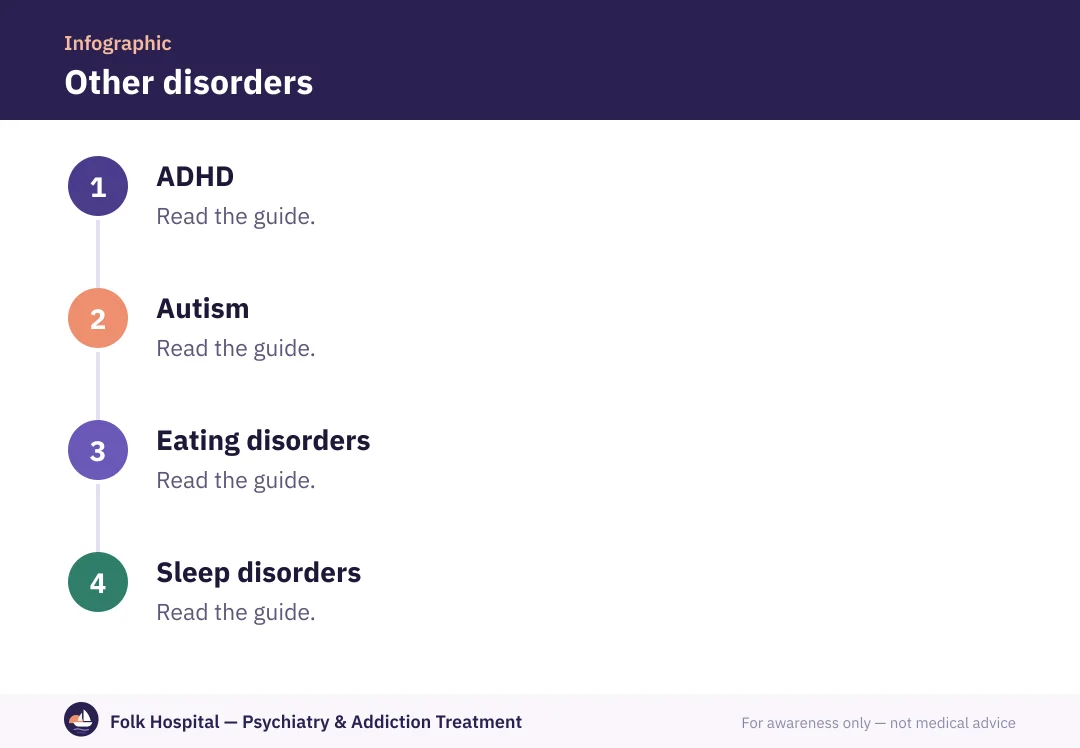
| Group | Examples |
|---|---|
| Neurodevelopmental | ADHD, autism, Tourette |
| Eating | Eating disorders |
| Sleep | Insomnia, sleep disorders |
| Dissociative | Dissociative identity, depersonalisation |
| Somatic | Psychosomatic disorders, hysteria |
| Impulse control | Kleptomania, gambling |
| Obsessive-compulsive | OCD, hoarding, body dysmorphia |
02What they share
- Full assessmentto rule out physical causes.
- Accurate diagnosisbecause symptoms overlap.
- Tailored treatmentpsychological and medical as needed.
- Family involvementespecially with children.
Read also: behavioural addictions, types of mental illness.
؟Frequently asked questions
What are the other disorders?
Developmental, eating, sleep, dissociative, somatic, impulse-control disorders and addiction.
Does ADHD continue into adulthood?
Yes for many, often as distraction and impulsivity.
How is ADHD linked to addiction?
Impulsivity and poor regulation raise the risk of substance use; treatment lowers it.
Are sleep disorders psychological?
Some are psychological and some physical, and they often overlap with anxiety and depression.
What are dissociative disorders?
Disruptions in memory, identity or sense of self, often after trauma.
Is kleptomania an addiction?
It's an impulse-control disorder resembling addiction in its urgent drive.
Sources and references
- Mental disorders — fact sheet — World Health Organization
- Attention-Deficit/Hyperactivity Disorder — National Institute of Mental Health (NIMH)
- Sleep Disorders — U.S. National Library of Medicine — MedlinePlus

Written byDr. Mahmoud ElsawyConsultant in psychiatry and addiction treatment
A psychiatrist specialising in addiction and mental illness in adults and adolescents, with a focus on dual diagnosis.
For awareness only — not a substitute for medical advice. Editorial policy · View profile