01Where does the family start?
Start with understanding before confrontation: learn the signs, read about the substance or condition, then choose the time to talk. Don't wait for the person to accept treatment before getting help for yourself; the family programme is designed for exactly this.
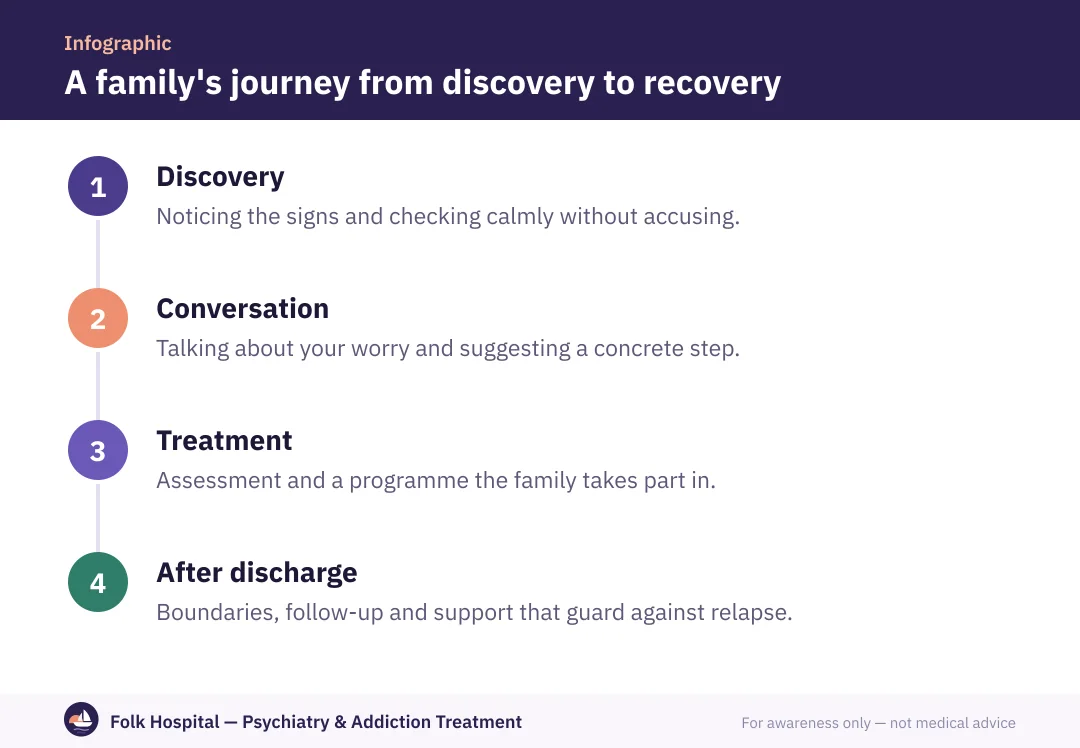
02Choose your situation
| Situation | Start here |
|---|---|
| I suspect someone is using | The signs of drug use and what an addict looks like |
| I'm sure and want to talk to them | How to convince an addict to get treatment and how an addict thinks |
| My husband is using | My husband is an addict and addiction and marriage |
| The father is using and the children are affected | An addicted father |
| My child is a teenager | Teenagers and drugs and psychological changes in teenagers |
| They've left rehab | After rehab |
| My relative is mentally ill | Caring for a mentally ill relative |
| I want to protect my children | Preventing addiction |
03Principles that apply in every case
- Safety firstdon't tolerate violence, and know the emergency numbers.
- Conversation instead of conflicttalk about concern and facts, not accusations.
- Clear boundariesno funding use and no covering up problems.
- A specific stepan assessment or a call, not general promises.
- Support for yourselfthe family needs care too.
- Ambulance 123, police 122, the mental health hotline 08008880700, and the Fund for Drug Control and Treatment of Addiction 16023.
؟Frequently asked questions
Can the family start before the person accepts treatment?
Yes, and it's one of the most helpful things. Family counselling teaches you how to respond in ways that make acceptance more likely.
Can someone with addiction be admitted against their will?
Where there's danger to themselves or others, Egypt's Mental Health Care Law allows it under medical safeguards. Talk to us and we'll explain your situation.
Is the family the cause of addiction?
Addiction has many genetic, psychological and social causes, and families blaming themselves doesn't help. But the family can be a strong part of treatment.
How do I protect the rest of the family?
With clear boundaries, protecting money and children, not tolerating violence, and seeking support for everyone at home.
Is family counselling confidential?
Yes. Sessions are confidential, and the family can start them without the person knowing at first.
Sources and references
- Drugs, Brains, and Behavior: The Science of Addiction — National Institute on Drug Abuse (NIDA)
- Treatment Approaches for Drug Addiction — DrugFacts — National Institute on Drug Abuse (NIDA)
- Parents & Educators — National Institute on Drug Abuse (NIDA)
- International Standards on Drug Use Prevention — United Nations Office on Drugs and Crime (UNODC)
- قانون رقم 182 لسنة 1960 في شأن مكافحة المخدرات (النص وفق آخر تعديل) — Egyptian law text

A specialist in psychological rehabilitation, behaviour modification and relapse prevention, with over 15 years in addiction programmes.
For awareness only — not a substitute for medical advice. Editorial policy · View profile