01Why do people with addiction refuse treatment?
Refusal usually isn't just stubbornness, but a mix of denial («I'm in control»), fear of withdrawal or exposure, shame, and reliance on the substance as a way of coping. Understanding this helps you talk without clashing. Read about how an addict thinks.
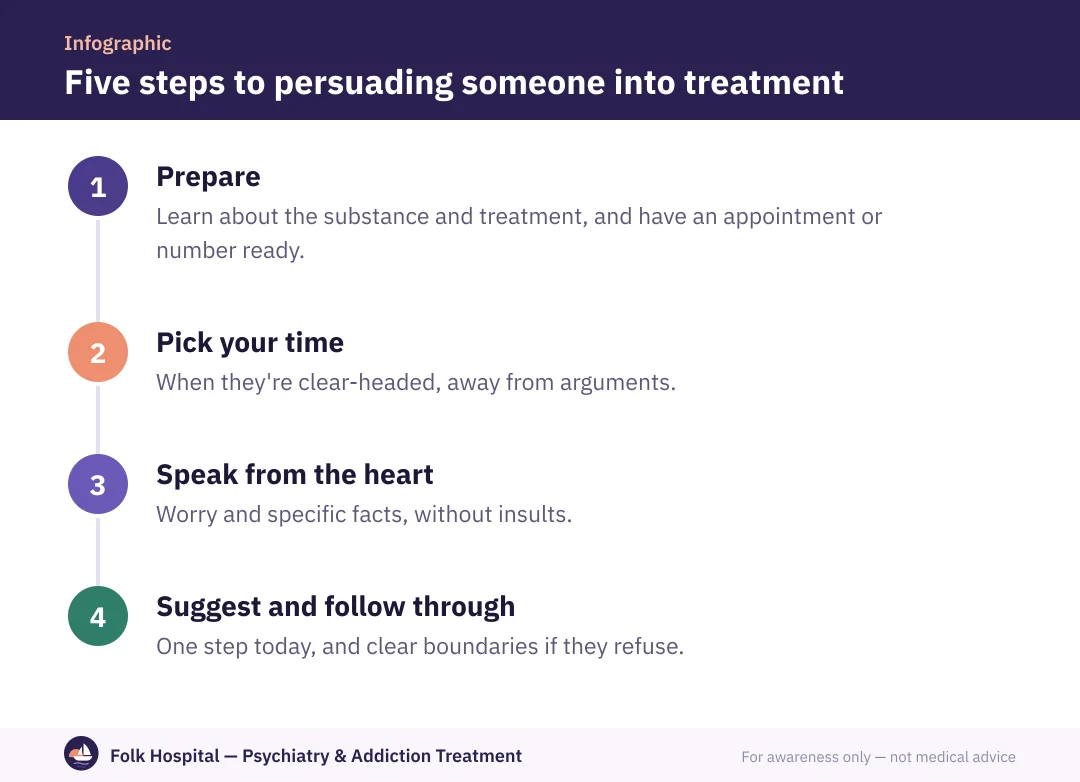
02Before the conversation
- Choose the timewhen they're sober, not right after a problem or while using.
- Choose the placequiet and private, away from the children.
- Prepare the factsspecific situations with dates instead of general accusations.
- Prepare the stepa doctor's number or an assessment appointment ready.
- Agree with the familyone message and one set of boundaries.
03During the conversation
What increases refusal
What increases acceptance
- «You're an addict and a failure» | «I'm worried about you»
- General accusations | «On Thursday you came home late and not yourself»
- A long lecture | Listening to what they say
- Demanding a promise to stop now | Suggesting one assessment or call
- A threat that won't be carried out | Clear boundaries that will be applied
04If they refuse
- Don't end things in anger; say the door is open.
- Apply the boundaries you announced: no cash, no covering up problems.
- Start family counselling yourself; it raises the chances they'll accept later.
- Try again at a suitable time.
05A structured family intervention
When individual attempts fail, a specialist can organise a family intervention: a planned meeting where family members express concern with specific events, with a treatment plan ready.
06The legal framework
General information
Law 182 of 1960 provides that no criminal case is brought against someone who voluntarily applies to the competent committee for treatment, and allows relatives to request their treatment. In dangerous situations the Mental Health Care Law allows treatment under safeguards. This isn't legal advice. Read about involuntary admission and drugs and Egyptian law.
- Overdose, violence or suicidal thoughts: call an ambulance on 123 immediately. Read about the signs of overdose.
؟Frequently asked questions
What if they flatly refuse?
Don't treat it as the end. Keep your boundaries, try again at another time and start family counselling yourself. In dangerous situations treatment without consent is possible under the law.
Does threatening to throw them out help?
Threats that aren't carried out do harm. Clear boundaries, calmly stated and actually applied, do help.
Will an addict seek treatment once they hit rock bottom?
Waiting for «rock bottom» can mean serious complications or an overdose. Early intervention is better, and treatment works even if motivation isn't complete at the start.
Does the law protect an addict who comes forward for treatment?
Egyptian Law 182 of 1960 provides that no criminal case is brought against someone who voluntarily applies to the competent committee for treatment, under conditions. This is general information, not legal advice.
Who is best placed to talk to them?
The person closest to them and calmest, not necessarily the oldest. More than one family member can attend, as long as it doesn't become a trial.
Sources and references
- Treatment Approaches for Drug Addiction — DrugFacts — National Institute on Drug Abuse (NIDA)
- Drugs, Brains, and Behavior: The Science of Addiction — National Institute on Drug Abuse (NIDA)
- Drug addiction: getting help — NHS (UK)
- قانون رقم 182 لسنة 1960 في شأن مكافحة المخدرات (النص وفق آخر تعديل) — Egyptian law text

A specialist in psychological rehabilitation, behaviour modification and relapse prevention, with over 15 years in addiction programmes.
For awareness only — not a substitute for medical advice. Editorial policy · View profile