01Questions before deciding
| Question | What to look for |
|---|---|
| How long since he stopped? | A long enough stable period, not a few weeks |
| Is he still in follow-up? | Regular sessions or support groups |
| Has his lifestyle changed? | New friends, stable work, distance from places of use |
| Does he talk honestly about his past? | Openness without downplaying or hiding |
| How does he handle pressure? | Healthy ways instead of escape |
| Is there a co-existing mental disorder? | Regular treatment if there is |
02Signs of stable recovery
- Enough time without usetested by daily life and its pressures.
- Commitment to follow-upwithout you having to enforce it.
- Responsibilitywork, financial commitments and healthy relationships.
- Transparencyno secrets about money, the phone or whereabouts.
- A relapse planhe knows its signs and what to do.
03Signs that call for caution
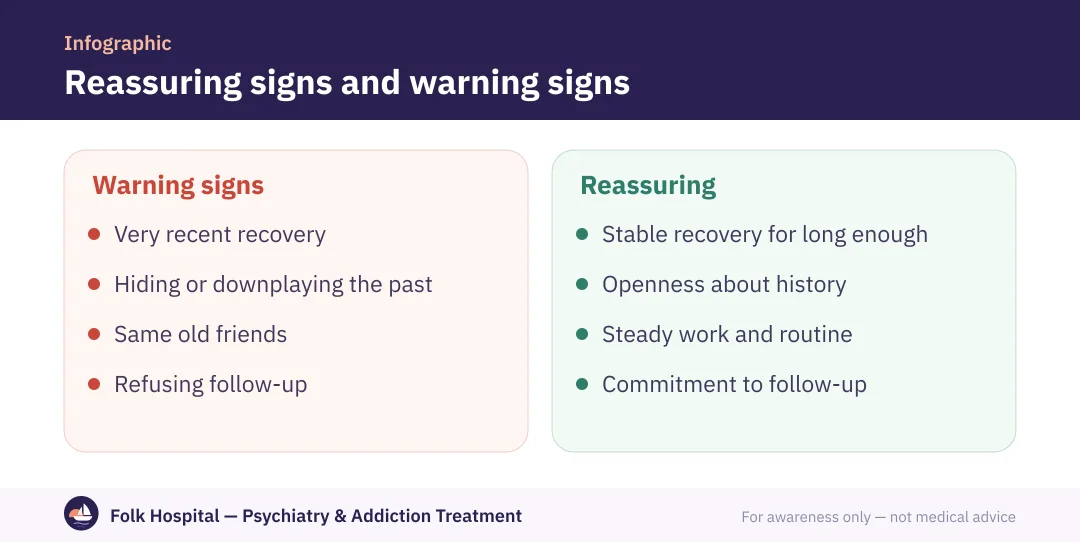
Worrying signs
Reassuring signs
- «I'm done and don't need follow-up» | «Follow-up is part of my life»
- The same old friends | Supportive friends
- Anger when asked about the past | Calm, open talk
- Debts and financial secrecy | Clarity and transparency
04A useful step
A joint consultation before marriage helps both talk clearly about worries, expectations and the relapse plan. Read after rehab, addiction and marriage and relapse.
؟Frequently asked questions
How many years of recovery make marriage safe?
There's no magic number, but many specialists see at least a year of stable recovery with ongoing follow-up as a reasonable start. Stability of life and commitment matter most.
Should I ask for a drug test before marriage?
It can be agreed openly and respectfully as part of transparency, but it doesn't replace assessing lifestyle and commitment to follow-up.
Does relapse after marriage mean the end of the relationship?
Not necessarily. What matters is quick honesty, a return to treatment and a plan agreed in advance.
Should I tell my family about his past?
It's a joint decision. Honesty with influential people can protect the relationship later, while respecting his privacy.
Sources and references
- Treatment Approaches for Drug Addiction — DrugFacts — National Institute on Drug Abuse (NIDA)
- Drugs, Brains, and Behavior: The Science of Addiction — National Institute on Drug Abuse (NIDA)
- Drug addiction: getting help — NHS (UK)

A specialist in psychological rehabilitation, behaviour modification and relapse prevention, with over 15 years in addiction programmes.
For awareness only — not a substitute for medical advice. Editorial policy · View profile