01Normal and worrying
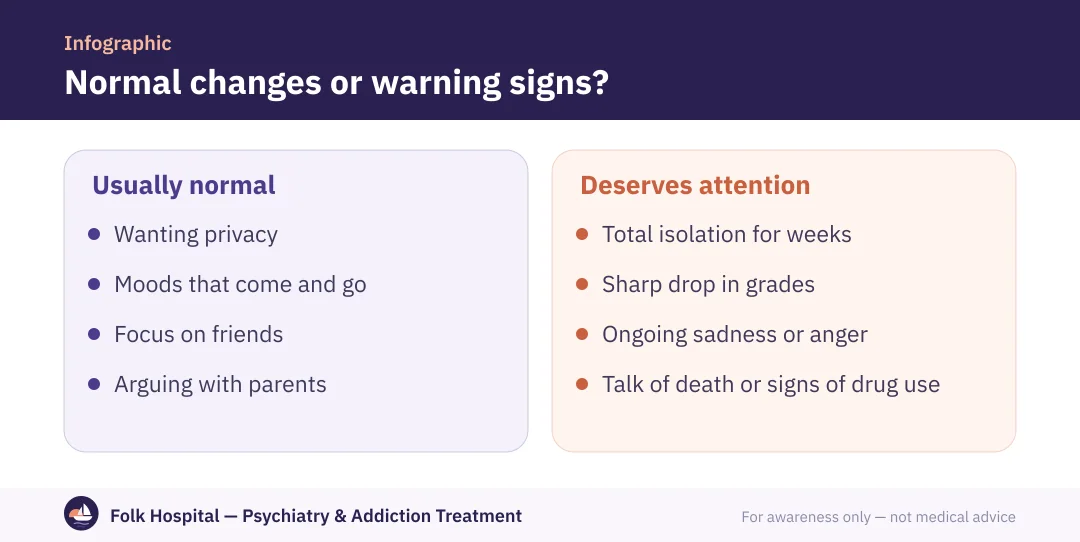
Usually normal changes
Worth attention and assessment
- Wanting privacy and independence | Complete withdrawal from family and friends
- Passing mood swings | Sadness or anger lasting weeks
- Great interest in friends | Suddenly dropping old friends for suspicious new ones
- Arguments about rules | Violence, breaking things or running away
- A slight dip at school | A sharp drop or repeated absence
- Interest in appearance | Severe worry about weight and food
02Signs that need assessment
| Sign | What it may point to |
|---|---|
| Sadness and loss of interest | Depression |
| Worry, avoidance and fear | Anxiety or social anxiety |
| Changes in eating and weight | Eating disorders |
| Distraction and impulsivity | ADHD |
| Secrecy and missing money | Drug use |
| Late nights and isolation with screens | Gaming addiction or phone overuse |
03How to reach out
- Choose ordinary momentsin the car or during a shared activity, not an interrogation.
- Listen more than you talkwithout interrupting or judging.
- Acknowledge their feelings«It looks like this has been a hard time for you».
- Offer helpa doctor or therapist as support, not punishment.
- Keep boundariessupport doesn't mean no rules.
- Talk of death, suicide or self-harm.
- Signs of deliberate wounds.
- Drug use with risky behaviour.
The mental health hotline 08008880700, or ambulance 123.
Ambulance: 123Read about teenagers and drugs and preventing addiction.
؟Frequently asked questions
My son never talks to me. Is that normal?
Teenagers naturally share less with parents, but a complete cut-off with sadness or other changes deserves a calm attempt to reach out, and a consultation if it continues.
When is irritability worrying?
When it's severe and lasts weeks, or comes with isolation, slipping at school, drug use or violence.
Is staying up late normal in adolescence?
The body clock shifts later in adolescence, but constant late nights with exhaustion and decline may be linked to screens, depression or drug use.
How do I get them to see a psychiatrist without refusing?
Present it as help with sleep, stress or studying, not as punishment or stigma, and let them help choose the appointment.
Sources and references
- Depression — National Institute of Mental Health (NIMH)
- Anxiety Disorders — National Institute of Mental Health (NIMH)
- Suicide Prevention — National Institute of Mental Health (NIMH)
- Parents & Educators — National Institute on Drug Abuse (NIDA)

A specialist in psychological rehabilitation, behaviour modification and relapse prevention, with over 15 years in addiction programmes.
For awareness only — not a substitute for medical advice. Editorial policy · View profile