01How does addiction change thinking?
Research explains that substances affect the brain's reward system and the areas for control and decision-making. With continued use, getting the substance becomes a priority ahead of family, work and health, even when the person knows the harm. Read about what addiction is.
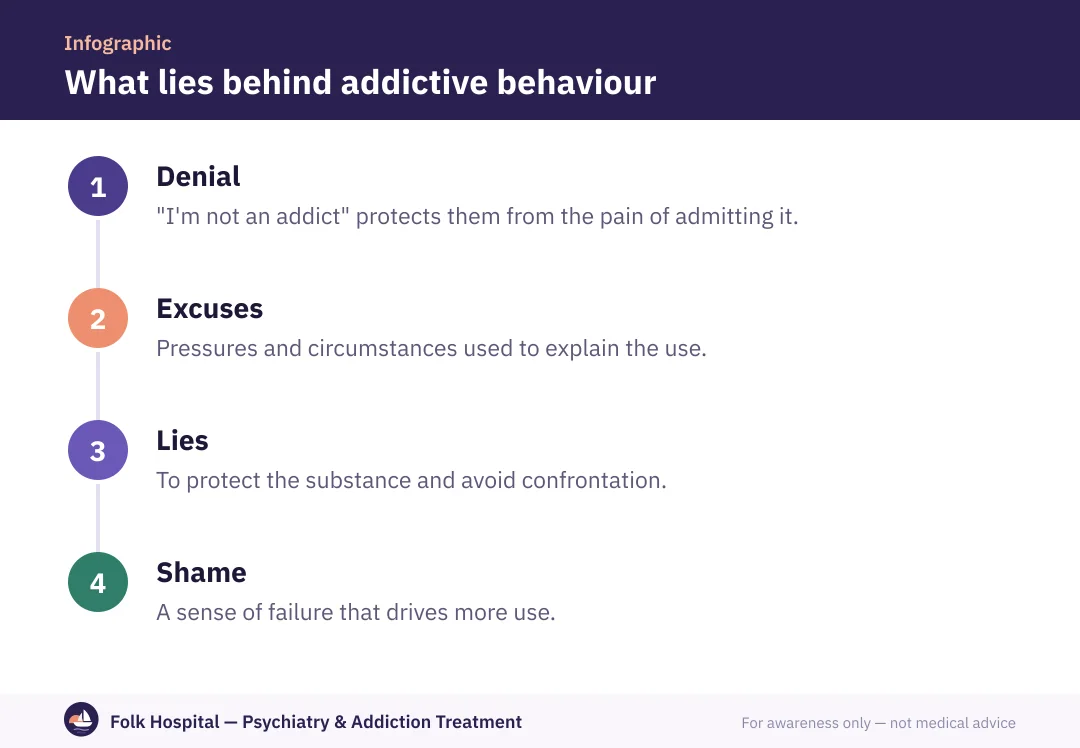
02Common thinking patterns
| Pattern | Example | What's behind it |
|---|---|---|
| Denial | «I'm not an addict; I can stop whenever I want» | Fear of facing the truth |
| Justification | «Work is hard and I need something to keep me going» | Protecting continued use |
| Minimising | «Everyone takes it» | Reducing guilt |
| Blaming others | «You're the ones pressuring me» | Escaping responsibility |
| Promises | «Last time, I swear» | Momentary sincerity overpowered by craving |
03What do they feel inside?
Often: shame about themselves, fear of withdrawal and exposure, helplessness in the face of cravings, and sometimes depression or anxiety that came before the addiction. Read about dual diagnosis.
04How can the family use this understanding?
- Don't argue with denial directlytalk about facts and effects.
- Separate the person from the illness«I love you, and I don't accept what's happening».
- Don't accept promises in place of treatmentlink trust to concrete steps.
- Set boundariesunderstanding doesn't mean funding use or covering for it.
- Look after yourselfdealing with this thinking is exhausting.
Read how to convince an addict to get treatment and where addiction ends.
؟Frequently asked questions
Does an addict love their family?
Usually yes, but addiction makes the substance a compulsive priority that overrides feelings and decisions. Recovery puts these priorities back in order.
Why does an addict keep lying?
To protect continued use and avoid confrontation and shame. Over time lying becomes automatic, and it improves with recovery.
Why do they promise to stop and then don't?
They're often sincere in the moment, but cravings and withdrawal are stronger than willpower alone. That's why they need treatment, not promises.
Is addiction a choice or an illness?
The first use is usually a choice, but continued use causes brain changes that weaken control, which is why addiction is treated as a chronic, treatable illness.
Sources and references
- Drugs, Brains, and Behavior: The Science of Addiction — National Institute on Drug Abuse (NIDA)
- Treatment Approaches for Drug Addiction — DrugFacts — National Institute on Drug Abuse (NIDA)
- Co-Occurring Disorders and Health Conditions — National Institute on Drug Abuse (NIDA)

A specialist in psychological rehabilitation, behaviour modification and relapse prevention, with over 15 years in addiction programmes.
For awareness only — not a substitute for medical advice. Editorial policy · View profile