01Why doesn't quitting heroin alone work?
Withdrawal makes the first days harsh, cravings linger for months, and the brain strongly links the drug with relief. People who stop alone usually go back at a moment of stress, with lower tolerance, which raises the risk of overdose.
Heroin, known on the street in Egypt as "powder", is one of the fastest drugs to create dependence. It reaches the brain within seconds, gives an intense feeling of warmth and calm, then fades quickly, so the person needs repeated doses. Over time they no longer use to feel high but to avoid the pain of withdrawal. That cycle isn't broken by promises or by locking someone in a room, but by a real treatment plan. Read what heroin is and how it affects the body.
02What are the stages of heroin treatment?
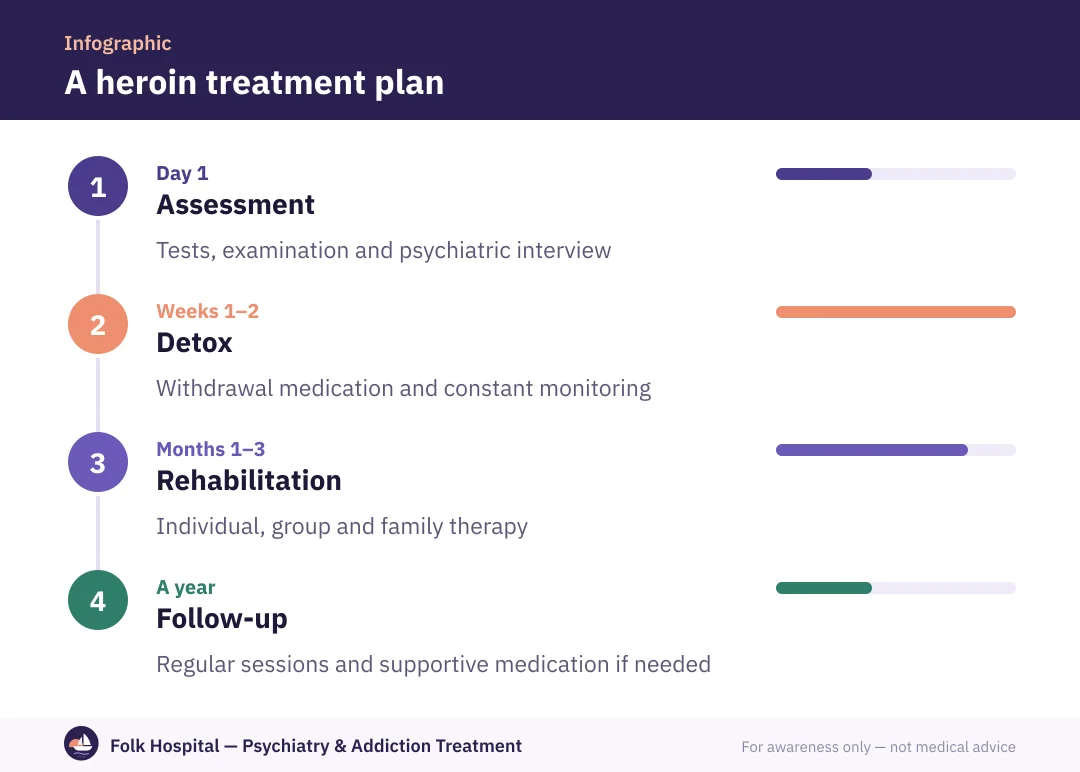
- Full assessmentliver, kidney and blood-borne virus tests, the amount and route of use and other drugs, plus a psychological assessment for depression and anxiety.
- Detoxmedicines to ease bone pain, diarrhoea, insomnia and anxiety, with fluid replacement. Details in heroin withdrawal.
- Rehabilitationcognitive behavioural therapy for the thoughts and situations that lead to using, motivational interviewing and group therapy.
- Family therapyrebuilding trust and training the family to support without enabling. See our family programme.
- Follow-upregular sessions for a year, and the doctor may add medication that lowers relapse risk.
03Assessment: what exactly are we looking for?
Someone using heroin needs a broader assessment than with many other drugs, because the way it's used leaves its own marks:
- Daily dose and route: snorting, smoking on foil or injecting, and how many times a day.
- Other substances: many mix heroin with tramadol, sedatives or alcohol, which changes the detox plan and raises the risk.
- Blood-borne viruses: hepatitis C and B and HIV, especially with shared needles or equipment.
- Complications of injecting: inflamed veins, abscesses, skin infections and sometimes infection of the heart valves.
- Mental state: depression, anxiety, past trauma and suicidal thoughts.
- Nutrition, teeth and weight: long neglect leaves nutritional deficiencies and dental problems needing follow-up.
04Heroin detox: what happens day by day?
| Period | What usually happens | What we do |
|---|---|---|
| First 24 hours | Anxiety, yawning, runny nose and eyes, sweating | Medicines for anxiety and symptoms, fluids and monitoring |
| Days 2–3 | Peak: bone pain, diarrhoea, vomiting, chills, severe insomnia | Adjust medicines by withdrawal score and prevent dehydration |
| Days 4–7 | Gradual easing of physical symptoms | Improve sleep and nutrition, start sessions |
| After week one | Insomnia, low mood and intermittent cravings | Psychological rehabilitation, and treating depression if present |
The doctor uses medicines to ease each symptom and, in selected cases, may use a medical opioid at reducing doses to soften withdrawal. The aim is for the patient to get through this stage with as little pain as possible and in full safety, not to "tough it out" to prove their willpower.
05What role does medication play?
Medicines fall into two groups: withdrawal medicines that ease symptoms during detox, and relapse-prevention medicines that reduce cravings or block the high if the person uses again. Choosing a medicine and how long to take it is a medical decision based on the patient's history, family support and wishes.
Medical substitution treatment
- Buprenorphine or methadone at a stable, supervised dose.
- Prevents withdrawal and eases cravings without a high.
- Reduces overdose deaths in studies.
- Needs regular attendance and long-term follow-up.
Blocking treatment after detox
- Naltrexone blocks the effect of opioids.
- Starts days after detox is complete.
- Isn't addictive.
- Success depends on adherence and family support.
The World Health Organization recommends combining medication with psychosocial support, because each strengthens the other. The availability of some of these medicines, and the rules for dispensing them, vary between countries, and the doctor decides what's available and suitable. Read more in opioid addiction treatment.
Warning
Some people try to treat themselves with tramadol or sedatives instead of heroin. This doesn't treat the addiction; it swaps one drug for another and can cause seizures or overdose when mixed.
06Psychological rehabilitation: the heart of treatment
After detox, the real work begins. Rehabilitation for heroin focuses on:
- Understanding the person's own cycle: when do cravings peak? What feelings was heroin silencing?
- Cognitive behavioural therapy: changing thoughts such as "I can't live without it" or "once won't matter".
- Motivational interviewing: strengthening the patient's own reasons for recovery, not other people's.
- Group therapy: many people using heroin live with intense isolation and shame, and the group breaks both.
- Treating trauma and depression: among the strongest drivers of relapse if left untreated. Read about dual diagnosis.
- Life skills: managing money, returning to work and building new relationships away from the using circle.
07The body's recovery after heroin
After stopping, the body gradually recovers: sleep and appetite return within weeks, weight and immunity improve, and bowel habits and, in women, periods become regular. Some complications need specific treatment:
- Hepatitis C is now curable with modern medicines in most cases, so we make sure it's tested for and the patient referred for treatment.
- Teeth need a dentist once the patient is stable.
- Damaged veins may not fully recover, but skin care prevents infections.
Read about the harms of heroin and how the body recovers after addiction.
08Overdose: the most important thing families should know
- Extreme drowsiness or no response.
- Very slow breathing or strange snoring.
- Blue lips and fingernails.
- Pinpoint pupils.
Call an ambulance on 123 immediately, place the person on their side and don't leave them alone.
Ambulance: 123The risk rises at three moments: after leaving detox, residential care or prison, because tolerance has dropped; when heroin is mixed with sedatives or alcohol; and when the source changes, because its purity is unknown and it may be cut with stronger substances such as fentanyl. So the discharge plan includes educating the patient and family about these moments.
09How long does heroin treatment take?
Detox takes 7 to 14 days, rehabilitation 4 to 12 weeks, and follow-up at least a year. Long-standing cases or those with a mental illness need longer, and the doctor decides after assessment. If the patient chooses long-term medication, it may continue for months or years with regular follow-up.
10Residential or outpatient?
In most heroin cases we advise starting with residential care, especially with injecting, high doses, mixing other drugs or failed previous attempts. Once stable, the patient moves to outpatient care and aftercare. Read about residential rehab.
11If you're family of someone using heroin
- Don't wait for "rock bottom"; early action protects their life.
- Learn the signs of overdose and how to respond.
- Don't give cash, and don't pay drug debts.
- Start family counselling even if they refuse treatment. Read how to deal with someone using heroin.
؟Frequently asked questions
What is the success rate of heroin treatment?
It depends on commitment, follow-up and family support. What we do know is that people who complete rehab and stay in follow-up, with suitable medication, do far better than those who stop at detox.
Is there a medicine that treats heroin addiction?
There are approved medicines that reduce cravings or block the effect of opioids, such as buprenorphine, methadone and naltrexone, used within a full programme on medical advice after assessment. Never use any of them without supervision.
Can I get treatment without anyone knowing?
Yes. Treatment is fully confidential and we never contact an employer or anyone else without the patient's consent.
Is snorting safer than injecting?
Injecting adds risks of infection, clots and abscesses, but dependence, withdrawal and overdose risk exist with every route. Treatment is needed either way.
How long does heroin withdrawal last?
Symptoms start 8 to 24 hours after the last dose, peak on days two and three, and the acute symptoms ease within about a week, while insomnia and cravings can last for weeks.
Does the body return to normal after heroin?
Weight, sleep, appetite and immunity improve within weeks to months of stopping. Some complications, such as hepatitis, need specific treatment, and vein damage may be permanent.
My son uses heroin and refuses treatment. What can I do?
Start with family counselling to learn persuasion and boundary-setting, and learn the signs of overdose and how to respond, because his life comes first until he accepts treatment.
Can heroin addiction be treated during pregnancy?
Yes, but with a specialist plan, because stopping suddenly can harm the baby; a stable substitution treatment with obstetric follow-up is often preferred.
Sources and references
- Guidelines for the psychosocially assisted pharmacological treatment of opioid dependence — World Health Organization
- Medications to Treat Opioid Use Disorder — Research Report — National Institute on Drug Abuse (NIDA)
- Heroin — research topic — National Institute on Drug Abuse (NIDA)
- Opioid overdose — fact sheet — World Health Organization
- Drug misuse in over 16s: opioid detoxification (CG52) — National Institute for Health and Care Excellence (NICE)
- Opiate and opioid withdrawal — U.S. National Library of Medicine — MedlinePlus

A psychiatrist specialising in addiction and mental illness in adults and adolescents, with a focus on dual diagnosis.
For awareness only — not a substitute for medical advice. Editorial policy · View profile