01Who is outpatient care for?
Outpatient care fits when
- Use is recent or occasional.
- There's no severe withdrawal.
- A supportive family is around.
- The person genuinely wants to stop.
It usually doesn't fit when
- The drug is heroin or heavy alcohol use.
- Several attempts to stop have failed.
- There are suicidal thoughts or psychotic symptoms.
- Drugs are easy to get nearby.
Outpatient care also suits three other groups: people who have finished a residential stay and need continued support in the first months, people with a behavioural addiction such as gambling or internet addiction without substance use, and people with a stable mental health condition alongside irregular use of a substance.
02Why do many people choose outpatient care?
- Staying in work or study without a long absence that draws attention.
- Staying with family, especially parents caring for children.
- Applying skills straight away in real life rather than waiting for discharge.
- Lower cost than a full residential stay.
But these same advantages bring a challenge: the patient returns every day to their surroundings and all their triggers. So before starting, we carefully assess whether outpatient care is safe and sufficient for them, not just convenient.
03How does the outpatient programme run?
- Initial assessmentexam, lab tests and a psychiatric interview to judge severity and whether outpatient care is safe.
- Intensive phasetwo to three sessions a week during the first month, with medication where needed.
- Stabilisation phaseweekly sessions, regular testing and family sessions.
- Follow-upspaced-out sessions as part of relapse prevention.
04What happens in a session?
A session isn't general "advice" but structured work that builds from week to week:
- Reviewing the week: how were sleep and mood? Were there cravings? What helped and what didn't?
- A specific topic: such as dealing with old friends, anger, or evening boredom.
- Practical training: role-playing a refusal, writing a weekend plan, or a calming exercise.
- A small task: something doable before the next session, such as noting moments of craving and their triggers.
Sessions draw on evidence-based approaches, chiefly cognitive behavioural therapy, motivational interviewing and contingency management, which rewards engagement and negative test results.
05Regular testing: protection, not policing
The programme includes regular or random urine tests. Their aim isn't to "catch" the patient but to:
- Give the patient objective proof of progress that gradually restores the family's trust.
- Spot any slip early, before it turns into a full relapse.
- Help the doctor adjust medicines safely.
Read about drug testing and medicines that can affect the result.
06Medicines in outpatient care
Some patients need medicines during outpatient care, such as medicines that reduce cravings, relapse-prevention treatments like naltrexone, or treatment for co-existing depression, anxiety or insomnia. They're prescribed and monitored, and their effect is reviewed at every visit. Read about medicines used in addiction treatment.
07Outpatient or residential?
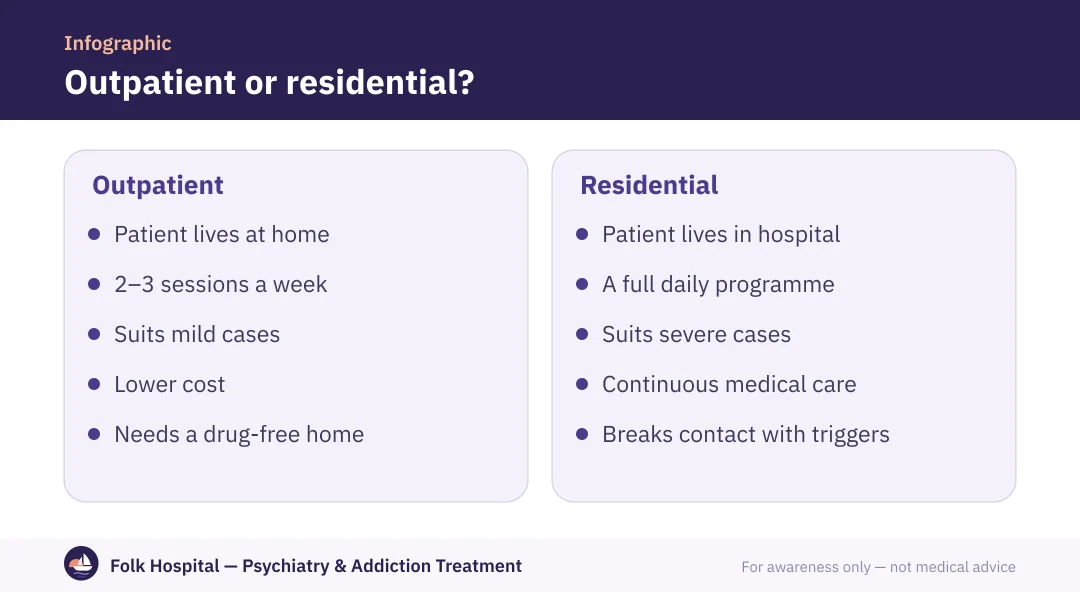
The rule of thumb is simple: the more severe the case and the less safe the environment, the stronger the case for residential rehab. Many of our patients start residential and then step down to outpatient care, which is the most common route.
08When do we advise moving to residential care?
Signs that call for a higher level of care
Repeated use despite sessions, frequently missed appointments, withdrawal that can't be managed at home, thoughts of self-harm, or a worsening situation at home or work. In these cases a temporary residential stay protects the progress made; it isn't a failure.
09The family's role in outpatient care
Home is where the real treatment happens in this programme, so:
- Remove the drug and any related equipment, and check the medicines kept at home.
- Agree clear rules on going out, money and the phone, in coordination with the therapist.
- Don't turn into police; suffocating surveillance pushes people to lie, while support with clear boundaries works better.
- Attend family sessions, which teach you how to respond to cravings or a slip.
Read about our family programme and understanding how someone with addiction thinks.
10How long does outpatient care last?
| Phase | Approximate length | Sessions |
|---|---|---|
| Intensive | First month | 2–3 a week |
| Stabilisation | Months 2–3 | Once a week |
| Follow-up | Month 4–6 and beyond | Every two weeks or monthly |
The actual length depends on progress. Dropping out early as soon as things feel better is one of the commonest causes of relapse, so we encourage completing the programme.
11Confidentiality
Medical information is fully confidential, and we don't contact an employer, school or anyone else without the patient's permission. We try to schedule appointments so they don't clash with work.
؟Frequently asked questions
Is outpatient care less effective than residential care?
Not necessarily. In the right case it works very well. The problem comes when it's chosen for a severe case because it's easier or cheaper, and relapse becomes likely.
Can treatment start as outpatient and move to residential?
Yes. If difficult withdrawal appears or use recurs during the programme, we recommend a temporary move to residential care.
Are sessions available online?
Some follow-up sessions can be remote, but the first assessment and lab tests need an in-person visit.
How long does outpatient treatment last?
Usually three to six months or more, starting with an intensive phase and then spacing sessions out gradually according to progress.
Will my employer know I'm in treatment?
No. Medical information is confidential, we try to fit appointments around working hours, and we don't contact anyone without the patient's permission.
Can withdrawal be done at home as part of outpatient care?
In selected cases with low doses of substances whose withdrawal isn't high-risk, with family present and close medical follow-up. Alcohol, sedatives, heroin and high doses need detox in hospital.
What if I slip during treatment?
We talk about it openly without blame, understand what led up to it and adjust the plan. Repeated slips may mean a higher level of care is needed for a while.
Does anyone from the family join the sessions?
Yes, family sessions are a core part of the programme, because home is where the patient lives throughout treatment.
Sources and references
- Treatment Approaches for Drug Addiction — DrugFacts — National Institute on Drug Abuse (NIDA)
- Drug misuse in over 16s: psychosocial interventions (CG51) — National Institute for Health and Care Excellence (NICE)
- Alcohol-use disorders: diagnosis, assessment and management (CG115) — National Institute for Health and Care Excellence (NICE)
- Drug addiction: getting help — NHS (UK)

A specialist in psychological rehabilitation, behaviour modification and relapse prevention, with over 15 years in addiction programmes.
For awareness only — not a substitute for medical advice. Editorial policy · View profile