01What are the short-term harms of heroin?
Straight after a dose: nausea and vomiting, itching, heavy limbs, foggy thinking and slower breathing. The real danger is that people never know how strong what they're using is, so a "usual" dose can turn out stronger than last time.
02What are the long-term harms?
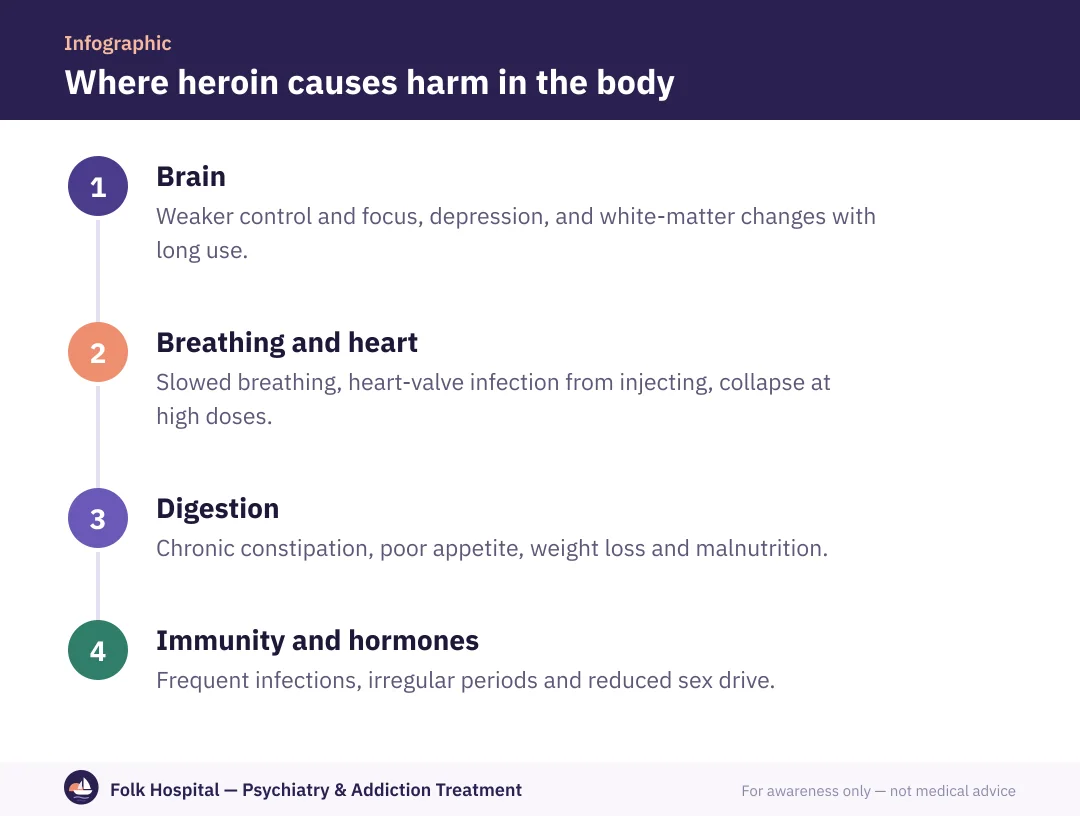
| System | Harm |
|---|---|
| Brain | Poor decision-making and impulse control, depression and anxiety |
| Lungs | Suppressed breathing and repeated chest infections |
| Heart and vessels | Endocarditis and collapsed veins from injecting |
| Liver and kidneys | Viral hepatitis and damage from cutting agents |
| Hormones | Irregular periods, low libido and erectile problems |
| Teeth and skin | Severe decay, abscesses and skin infections |
03What are the specific risks of injecting?
Sharing needles spreads hepatitis B and C and HIV. Repeated injecting collapses veins and causes abscesses that may need surgery, and bacteria can reach the heart valves. That's why we screen every patient for blood-borne viruses on admission.
04How does heroin damage life beyond the body?
Debts, lost jobs or studies, family conflict, legal trouble and relationships that revolve around the drug. Many families live through years of worry before they learn the truth, which is why treatment includes a family programme.
05What improves after stopping?
- First weekssleep and appetite gradually return and digestion settles.
- First monthsimmunity, energy and mood improve and hormones begin to rebalance.
- After a yearclear gains in focus, emotional control and the ability to enjoy ordinary things.
؟Frequently asked questions
Are heroin's harms permanent?
Many improve a lot after stopping, including immunity, digestion, sleep and sexual function, while some brain changes take months to recover. Chronic infections such as hepatitis need their own treatment.
Is snorting heroin less harmful than injecting?
Snorting avoids needle risks, but it causes the same addiction, overdose is still possible, and it damages the nose and sinuses.
Sources and references
- Heroin — research topic — National Institute on Drug Abuse (NIDA)
- Opioid overdose — fact sheet — World Health Organization
- Opioids — research topic — National Institute on Drug Abuse (NIDA)

A psychiatrist specialising in addiction and mental illness in adults and adolescents, with a focus on dual diagnosis.
For awareness only — not a substitute for medical advice. Editorial policy · View profile