01When is treatment from home possible?
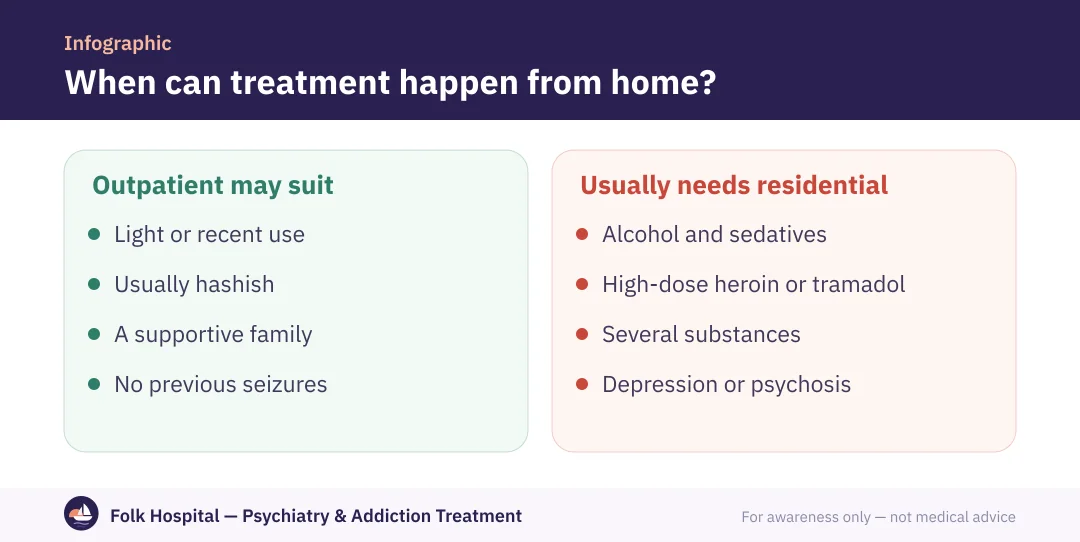
Treatment "from home" usually means outpatient care: the person lives at home and attends regular sessions, and the doctor may oversee a mild withdrawal with medicines and frequent visits. This is possible and safe in selected cases:
Home treatment may suit
- Recent or occasional use at low doses.
- A drug whose withdrawal isn't high-risk (such as cannabis, usually).
- No previous seizures or delirium.
- A present, supportive family and a drug-free home.
- No severe depression or suicidal thoughts.
It usually doesn't suit
- Heavy daily drinking.
- High-dose or long-term sedative use.
- Heroin, high-dose tramadol or mixing drugs.
- Previous seizures or serious physical illness.
- Suicidal thoughts or psychosis.
02Why can home detox sometimes be dangerous?
| Drug | The risk at home |
|---|---|
| Alcohol | Seizures and delirium tremens, which can be life-threatening |
| Sedatives | Seizures on sudden stopping |
| High-dose opioids | Severe dehydration, and overdose risk on returning after tolerance drops |
| Tramadol | Seizures at high doses |
| Stimulants | Severe depression and suicidal thoughts |
Read about withdrawal symptoms and our detox programme.
03Locking someone in a room: why it fails
It isn't treatment
Some families lock the person in a room until "withdrawal is over". This can cause withdrawal without medical care, dehydration, seizures, violence, attempts to escape or self-harm. It usually ends in a quick return to using with lower tolerance, raising the risk of overdose.
04What makes outpatient treatment safe?
- A medical assessment firstto decide whether the case allows treatment from home.
- A written planmedicines at set doses, frequent visits and clear danger signs.
- A safe homefree of drugs and equipment, with household medicines locked away.
- Someone presenta family member who knows the plan and the emergency signs.
- Regular sessionspsychological therapy and regular testing.
- A back-up planmoving to hospital if symptoms worsen or use recurs.
Read about outpatient care.
05The family's role in home treatment
- Watch for danger signs and call the doctor, or an ambulance on 123, if they appear.
- Give medicines as planned and keep them somewhere safe.
- Provide a calm setting, regular meals and enough fluids.
- Don't become guards; support with boundaries works better than suffocating surveillance.
؟Frequently asked questions
Can addiction be treated at home?
Some mild cases yes, through outpatient care with medical supervision and regular follow-up. Severe cases or those needing risky detox need a hospital.
Can cannabis withdrawal be done at home?
Usually yes, with a plan to regulate sleep, treat insomnia and anxiety, and outpatient follow-up, unless there are psychotic symptoms or other drugs.
My son refuses rehab. Should I lock him in until he stops?
We never advise it. Locking someone up can cause dangerous withdrawal without care, violence, trauma and a quicker return to using. Start with family counselling so we can set a safe plan.
Which medicines are used in home detox?
The doctor decides according to the drug and the case. Withdrawal medicines or sedatives must not be used without a prescription and follow-up, because some are dangerous when mixed.
Sources and references
- Drug misuse in over 16s: opioid detoxification (CG52) — National Institute for Health and Care Excellence (NICE)
- Alcohol-use disorders: diagnosis, assessment and management (CG115) — National Institute for Health and Care Excellence (NICE)
- Treatment Approaches for Drug Addiction — DrugFacts — National Institute on Drug Abuse (NIDA)
- Drug addiction: getting help — NHS (UK)

A specialist in psychological rehabilitation, behaviour modification and relapse prevention, with over 15 years in addiction programmes.
For awareness only — not a substitute for medical advice. Editorial policy · View profile