01Where the harm shows
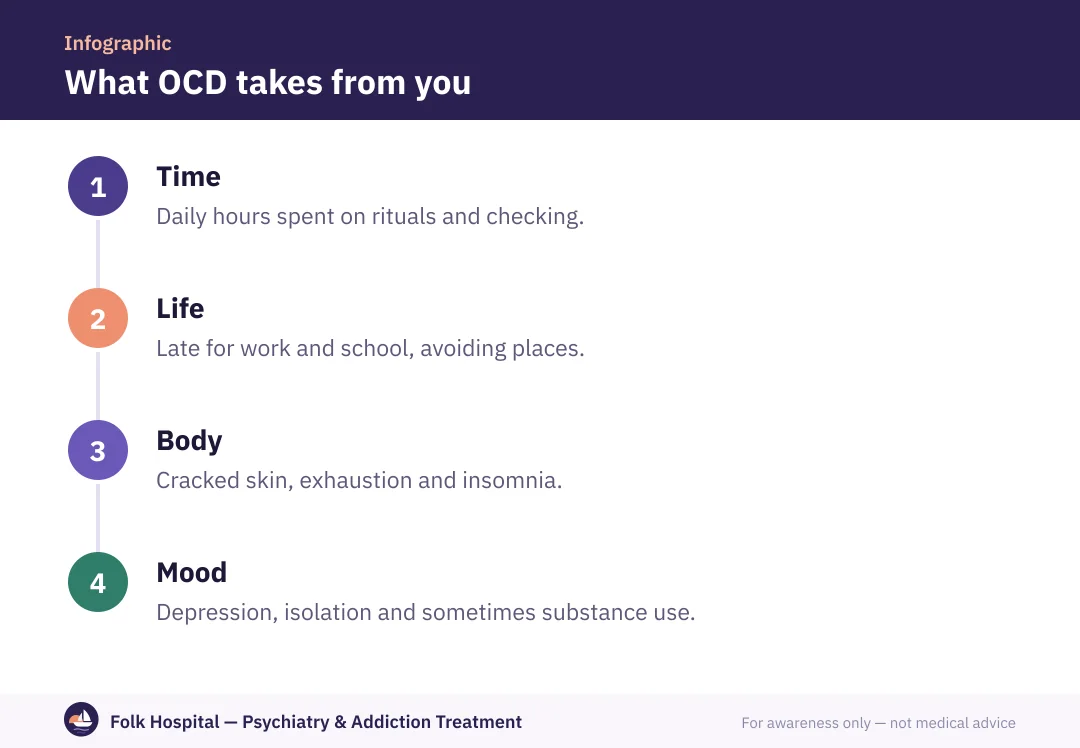
| Area | Harm |
|---|---|
| Time | Hours a day on rituals |
| Work and study | Lateness, absence, slowness |
| Family | Joining rituals, conflict |
| Life | Avoiding places and activities |
| Mood | Depression and exhaustion |
| Body | Cracked skin, exhaustion |
| Substances | Dependence on sedatives or alcohol |
02Family involvement in rituals
What families do with good intentions
- Answering reassurance questions again and again.
- Joining in washing or checking.
- Changing household routines to avoid anxiety.
What actually happens
- OCD strengthens.
- Reassurance requests increase.
- The family is exhausted.
03Treatment gives life back
- ERPgradually reducing rituals.
- Medication when needed.
- Involving the familygently reducing participation in rituals.
- Treating depressionif present.
Read OCD, OCD treatment, types of OCD and the OCD test.
؟Frequently asked questions
What are the harms of OCD?
Lost time, declining work and study, family tension, avoidance, depression, exhaustion and physical harm from rituals.
Does OCD cause depression?
Yes. Many people with OCD develop depression from exhaustion and restrictions.
How does OCD affect the family?
Relatives may be asked to join rituals or give reassurance, raising tension and strengthening OCD.
Does OCD harm the skin?
Excessive washing with water and disinfectants can cause dryness, cracking and infections.
Is OCD linked to addiction?
Some turn to alcohol or sedatives to calm anxiety, raising the risk of dependence.
Do the harms go away with treatment?
Most improve as rituals reduce and time and life are regained.
Sources and references
- Obsessive-Compulsive Disorder — National Institute of Mental Health (NIMH)
- Obsessive compulsive disorder (OCD) — overview — NHS (UK)
- Psychotherapies — National Institute of Mental Health (NIMH)

A psychiatrist specialising in addiction and mental illness in adults and adolescents, with a focus on dual diagnosis.
For awareness only — not a substitute for medical advice. Editorial policy · View profile