01Common obsessions
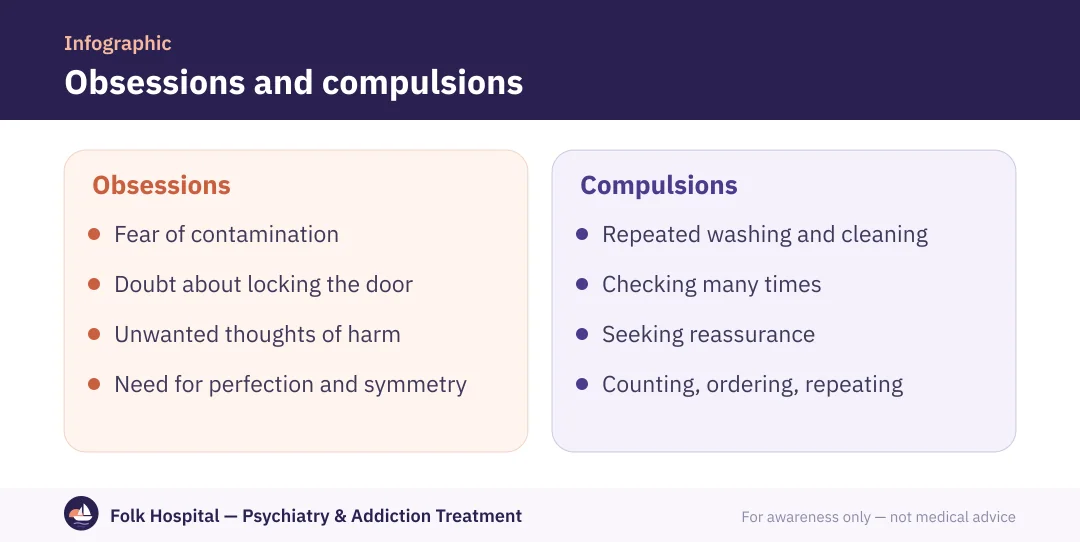
Repeated intrusive thoughts
- Fear of germs and contamination.
- Fear of harming oneself or others without wanting to.
- Doubt about locking doors or turning off gas.
- A need for symmetry and «just right» order.
- Distressing religious thoughts.
- Unwanted sexual thoughts.
02Common compulsions
| Act | Imagined aim |
|---|---|
| Washing and cleaning | Removing contamination |
| Checking | Preventing disaster |
| Counting and repeating | Cancelling the thought |
| Arranging | Reaching a «right» feeling |
| Reassurance-seeking | Making sure everything is fine |
| Mental acts | Reviewing or neutralising the thought |
03The OCD cycle
- An intrusive thought«my hands might be contaminated».
- Intense anxietyand a sense of danger.
- A compulsionrepeated washing.
- Temporary reliefteaching the brain the act «saved» it.
- The thought returnsstronger, and the cycle repeats.
Read OCD, OCD treatment, types of OCD and the OCD test.
؟Frequently asked questions
What are the symptoms of OCD?
Repeated distressing intrusive thoughts, and compulsions such as washing, checking, counting, arranging and reassurance-seeking to relieve anxiety.
What's the difference between obsessions and compulsions?
An obsession is a distressing thought or image; a compulsion is a behaviour or mental act repeated to relieve the resulting anxiety.
Can compulsions be internal?
Yes, such as counting, repeating words or prayers, and mentally reviewing events.
How much time do symptoms take?
In the disorder, usually more than an hour a day, or they cause clear distress and disrupt life.
Do people with OCD know their thoughts are irrational?
Usually yes, to varying degrees; this insight may be weaker in some cases.
Is repeatedly checking doors OCD?
It may be, if it's repetitive, time-consuming, anxiety-driven and hard to stop.
Sources and references
- Obsessive-Compulsive Disorder — National Institute of Mental Health (NIMH)
- Obsessive compulsive disorder (OCD) — overview — NHS (UK)
- Psychotherapies — National Institute of Mental Health (NIMH)

A psychiatrist specialising in addiction and mental illness in adults and adolescents, with a focus on dual diagnosis.
For awareness only — not a substitute for medical advice. Editorial policy · View profile