01Contributing factors
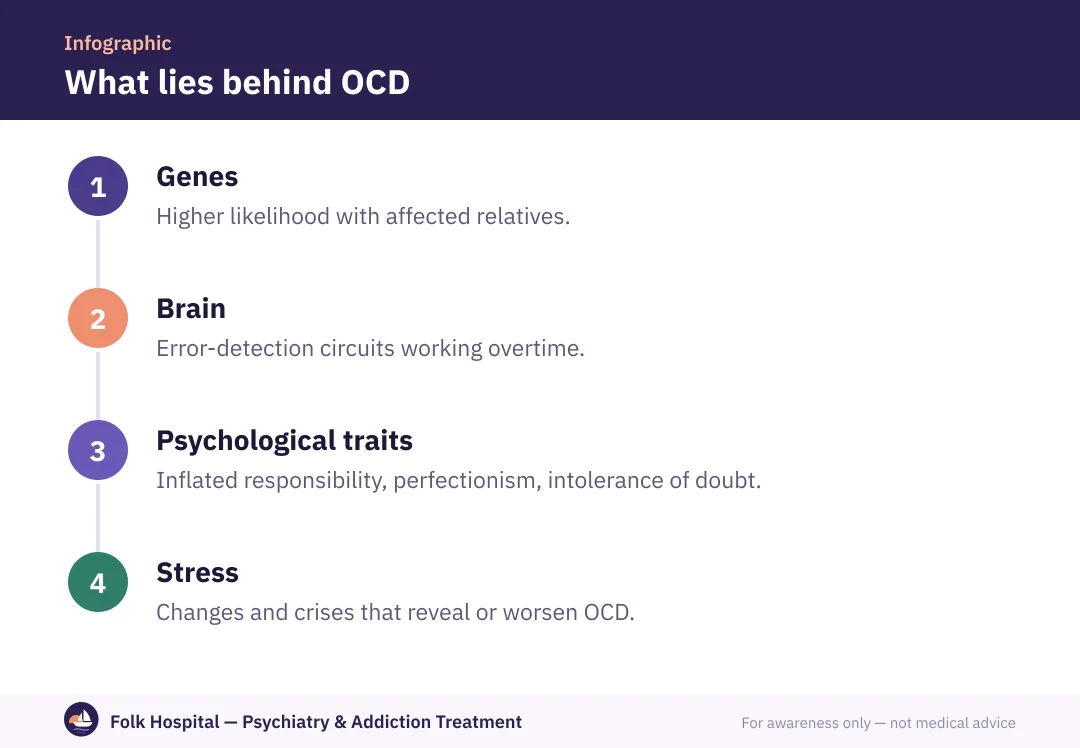
| Factor | Role |
|---|---|
| Genes | Raise vulnerability |
| Brain circuits | Overactive alarm and checking circuits |
| Serotonin | Its role explains why some antidepressants help |
| Thinking style | Inflated responsibility, over-importance of thoughts, intolerance of doubt |
| Stress | Childbirth, bereavement, moving, illness |
| Rare infections in children | Sometimes sudden onset after certain infections |
02Thoughts that feed OCD
Obsessional beliefs
- «If I think it, it could happen».
- «I'm responsible for preventing any harm».
- «I have to be 100% sure».
- «This thought means I'm a bad person».
What treatment teaches
- Thoughts don't make events happen.
- No one can prevent all harm.
- Uncertainty is part of life.
- A distressing thought hurts because it goes against your values.
Read OCD, OCD treatment, types of OCD and the OCD test.
؟Frequently asked questions
What causes OCD?
An interaction of genes, overactive brain circuits, a role for serotonin, certain thinking styles, and stress that triggers symptoms.
Is OCD hereditary?
Genes play a role: an affected relative raises risk but doesn't make it inevitable.
Does stress cause OCD?
It can trigger or worsen it in vulnerable people, such as childbirth, bereavement or a big change.
What role does thinking play?
Believing that thinking something makes it more likely, or that one must prevent all harm, feeds OCD.
Can OCD start after childbirth?
Yes. Postpartum OCD can appear, usually centred on the baby's safety.
Is OCD weak faith?
No. It has biological and psychological causes, and religious obsessions hurt precisely because the person values their faith.
Sources and references
- Obsessive-Compulsive Disorder — National Institute of Mental Health (NIMH)
- Obsessive compulsive disorder (OCD) — overview — NHS (UK)
- Psychotherapies — National Institute of Mental Health (NIMH)

A psychiatrist specialising in addiction and mental illness in adults and adolescents, with a focus on dual diagnosis.
For awareness only — not a substitute for medical advice. Editorial policy · View profile