01How OCD shows in marriage
| Form | What happens |
|---|---|
| Cleanliness rituals | Strict rules for partner and children |
| Checking | Delays leaving and going to bed |
| Reassurance-seeking | Repeated questions that wear the partner out |
| Relationship OCD | Doubting love and constant comparison |
| Religious or sexual obsessions | Effects on intimacy |
02The partner's role
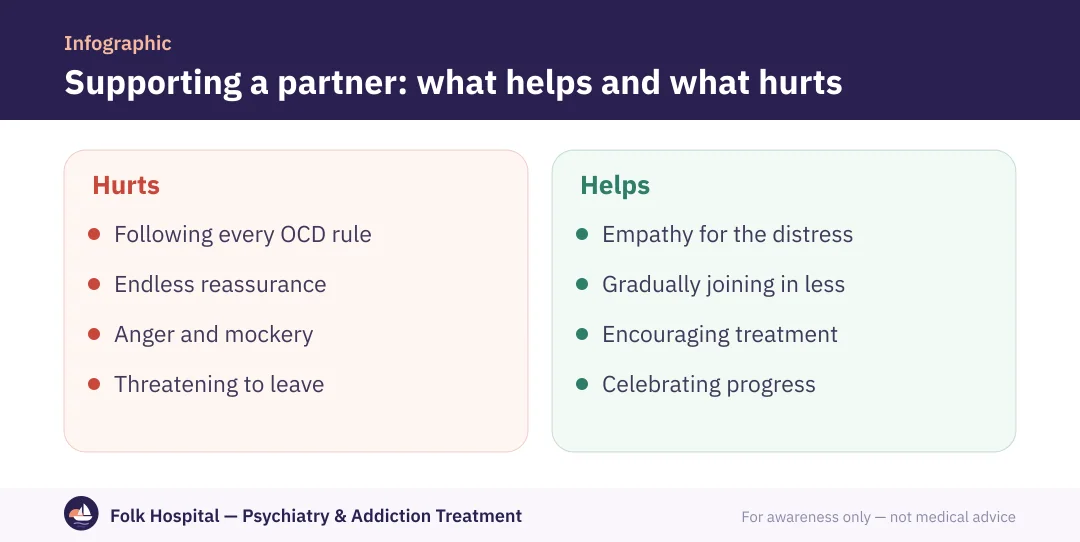
What strengthens OCD
- Joining in rituals.
- Repeated reassurance.
- Anger and mockery.
What helps
- Understanding OCD as an illness.
- A calm, brief reply: «I understand it's the OCD».
- Encouraging and joining treatment.
03Practical steps
- Educationa session with the therapist for both partners.
- Agreementon gradually reducing participation in rituals.
- Communicationcalm time to talk about OCD's impact.
- Supportmarital counselling when needed.
Read OCD, its types and its treatment. Also read mental illness and marriage.
؟Frequently asked questions
Does OCD affect marriage?
It can, through rituals, rules, reassurance-seeking and doubt, but it's treatable and manageable.
What is relationship OCD?
Repeated doubts about loving a partner or their suitability, with comparing, analysing and reassurance-seeking, without a real problem in the relationship.
How do I deal with a partner who has OCD?
Understand OCD, don't join rituals, respond calmly to reassurance requests without repetition, and encourage treatment.
Should I marry while I have OCD?
Yes, with treatment and honesty with your partner; a successful marriage is possible.
Does OCD affect intimacy?
Contamination OCD or sexual and religious obsessions can, and they improve with treatment.
Is marital counselling useful?
Yes, especially alongside OCD treatment, to learn to handle it together.
Sources and references
- Obsessive-Compulsive Disorder — National Institute of Mental Health (NIMH)
- Obsessive compulsive disorder (OCD) — overview — NHS (UK)
- Psychotherapies — National Institute of Mental Health (NIMH)

A psychiatrist specialising in addiction and mental illness in adults and adolescents, with a focus on dual diagnosis.
For awareness only — not a substitute for medical advice. Editorial policy · View profile