01Why do myths spread?
Myths spread because they're comforting: they make the first try seem harmless, continued use seem like a choice, and asking for help seem shameful. Many carry half a truth, so people believe them. Below are the myths we hear most from patients and families, and what the evidence says.
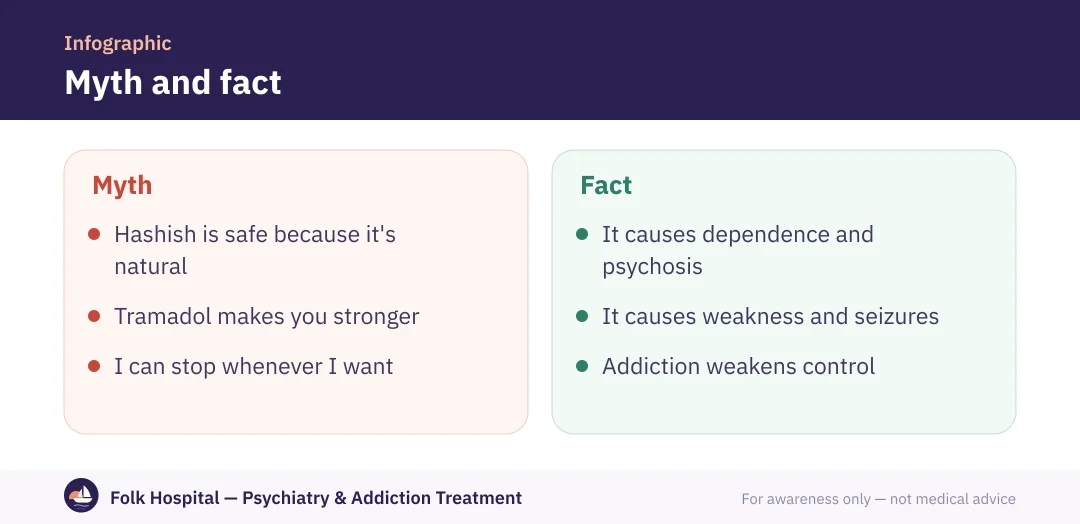
02Myth and fact
| What people say | What the evidence says |
|---|---|
| Hashish is natural and not addictive | It can cause dependence and withdrawal, and raises psychosis risk in teenagers. Read hashish |
| Tramadol boosts strength and focus | A temporary effect followed by dependence, sexual dysfunction and seizure risk. Read tramadol |
| I can stop whenever I want | Addiction makes stopping harder than expected, and stopping some substances suddenly is dangerous |
| Addiction is weak will or weak faith | A disorder that changes brain function and responds to treatment like chronic illnesses |
| Pharmacy medicines are safe | Safe at the prescribed dose and duration; dangerous with increases or mixing. Read prescription drugs |
| Shabu and captagon help with studying | Temporary wakefulness followed by a crash, anxiety and sometimes psychosis. Read shabu |
| Alcohol helps you sleep | It speeds sleep onset but ruins sleep quality and causes dependence. Read alcohol |
| Once won't hurt | The first dose can be fatal with strox or adulterated «powder» |
| Treatment is a scandal | Treatment is confidential; delay is what exposes the problem to everyone |
| Relapse means failure | Relapse is a possible part of recovery and means adjusting the plan, not abandoning it |
03Drug «benefits»: a debt repaid later
Many substances first give something that seems useful: calm, energy, confidence, sleep or delayed ejaculation. But the brain adapts quickly, the effect fades, the person needs more, and then the opposite appears when the drug is absent:
What the drug gives at first
- Calm with sedatives and hashish.
- Energy and wakefulness with stimulants.
- Pain relief and ease with opioids.
- Boldness with alcohol.
What it takes with continued use
- Worse anxiety and insomnia without it.
- Crash, depression and psychosis.
- Worse pain and sexual dysfunction.
- Isolation, losses and family problems.
04Medical uses: the real difference
Some substances have proven medical uses: opioid painkillers for severe pain, sedatives for panic attacks and epilepsy, stimulants for ADHD, and some cannabis compounds for specific conditions. The difference between medicine and drug here isn't the substance alone but the diagnosis, dose, duration and supervision. Read pregabalin for anxiety as an example.
05Why correcting these myths matters
Because myths delay treatment by years. A patient who comes early needs shorter treatment, has better chances of recovery and loses less. Read what is addiction and physical vs psychological addiction.
؟Frequently asked questions
Do drugs have any benefits?
Some substances have specific medical uses on prescription and under supervision, such as opioid painkillers and sedatives. The «benefits» felt on the street are temporary and followed by dependence and greater harm.
Is hashish safe because it's natural?
No. Hashish can cause dependence and poorer memory and concentration, and raises the risk of psychosis, especially in teenagers. Being natural doesn't make a substance safe.
Does tramadol strengthen the body and delay ejaculation?
It may give a temporary sense of energy and delay ejaculation at first, but with continued use it causes dependence, sexual dysfunction and sometimes seizures, and its effect fades so larger doses are needed.
Is addiction weak willpower?
No. Addiction changes the brain's reward and decision-making circuits, so stopping is hard even with a sincere wish. That's why it needs treatment like other chronic conditions.
Can I stop on my own whenever I want?
Some people can, but many find it harder than they thought, and with some substances, such as sedatives and alcohol, stopping suddenly is dangerous.
Will treatment expose me?
Treatment in specialist centres is confidential, and information isn't shared with anyone without the patient's consent except where the law requires it.
Sources and references
- Drugs, Brains, and Behavior: The Science of Addiction — National Institute on Drug Abuse (NIDA)
- Cannabis (Marijuana) — research topic — National Institute on Drug Abuse (NIDA)
- Treatment Approaches for Drug Addiction — DrugFacts — National Institute on Drug Abuse (NIDA)
- Mental health: strengthening our response — World Health Organization

A psychiatrist specialising in addiction and mental illness in adults and adolescents, with a focus on dual diagnosis.
For awareness only — not a substitute for medical advice. Editorial policy · View profile