
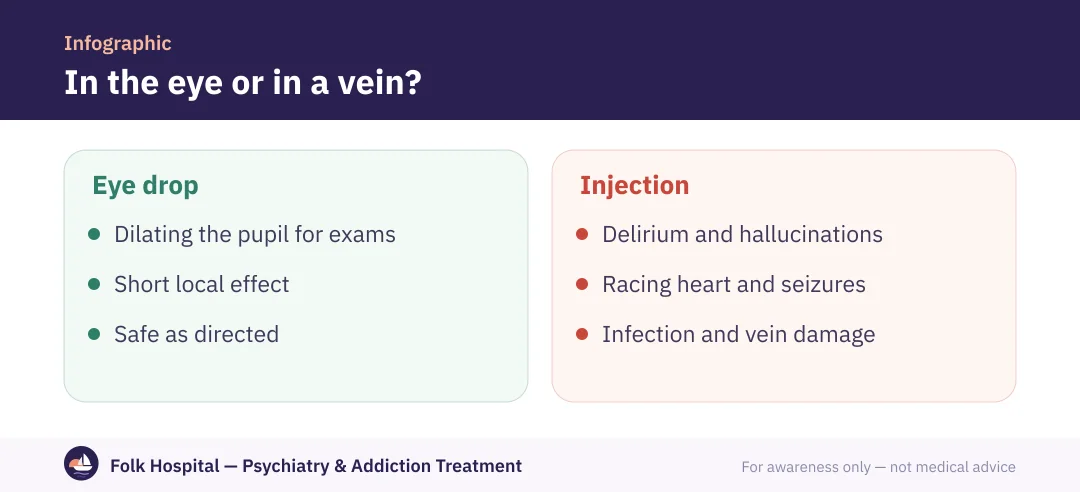
Tropicamide is safe when used in the eye for examination, but injecting it into a vein turns it into a dangerous substance causing delirium and serious harm.
01Key facts
| Item | Details |
|---|---|
| Class | Anticholinergic (eye drop) |
| Common forms and names | Medical eye drops |
| How it's used | Misused by intravenous injection |
| Does it show on a standard test? | No, it needs a specific test |
| Risk of dependence | Psychological, often with opioid addiction |
02How does it affect the brain and body?
It blocks acetylcholine in the brain and body, causing delirium, hallucinations, dryness, warmth and a fast heartbeat.
03The main risks
- Delirium and dangerous behaviour.
- Overheating and fast heartbeat.
- Vein damage and abscesses.
- Hepatitis and HIV infection.
Call an ambulance on 123 immediately for
- Severe delirium or high temperature.
- Seizures.
What to do right nowAmbulance: 123
04What to read next
؟Frequently asked questions
Why do some people inject eye drops?
To seek cheap hallucinations or boost opioids, which exposes them to severe risks to the heart and brain.
Why is tropicamide mixed with opioids?
To boost the effect, which doubles the danger.
Are the eye drops dangerous in normal use?
No; the danger lies in injecting them.
Sources and references
- Prescription Medicines — research topic — National Institute on Drug Abuse (NIDA)
- Drugs, Brains, and Behavior: The Science of Addiction — National Institute on Drug Abuse (NIDA)

Written byDr. Mahmoud ElsawyConsultant in psychiatry and addiction treatment
A psychiatrist specialising in addiction and mental illness in adults and adolescents, with a focus on dual diagnosis.
For awareness only — not a substitute for medical advice. Editorial policy · View profile