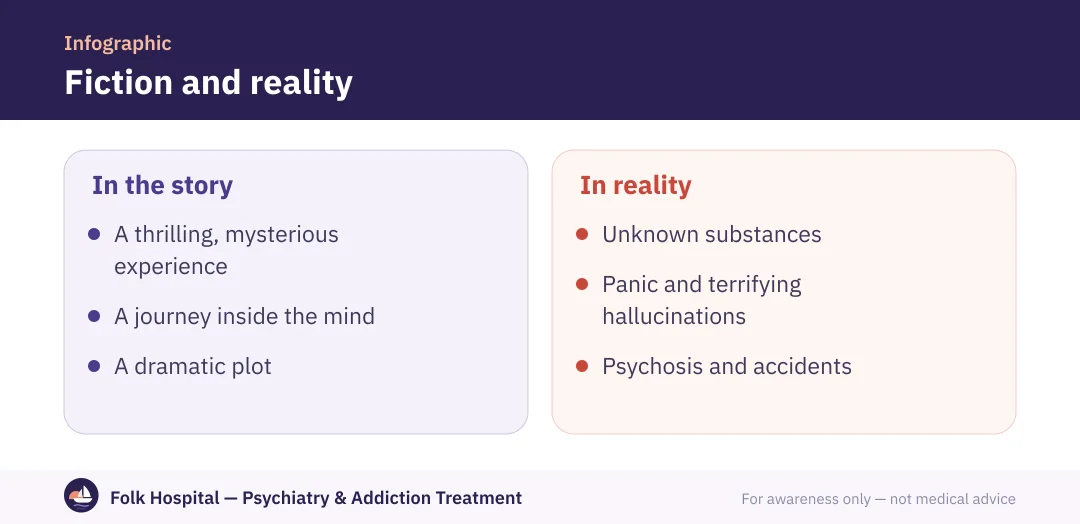
«Blue Elephant» has become a street brand for substances sold with the promise of an experience like the story. But what's sold under this name is unknown and may be synthetic hallucinogens or a dangerous mixture.
01Key facts
| Item | Details |
|---|---|
| Class | Hallucinogens (unknown content) |
| Common forms and names | Pills, papers or powders under various names |
| How it's used | By mouth or smoked |
| Does it show on a standard test? | No, it needs a specific test |
| Risk of dependence | Low physically; high psychological risk |
02How does it affect the brain and body?
Hallucinogens alter perception and the sense of reality, and can cause detachment, strong visual hallucinations, and a bad trip with panic and fear.
03The main risks
- Panic and dangerous behaviour.
- Psychosis in predisposed people.
- Fast heartbeat and overheating.
- Unknown contents that may be fatal.
- Seizures or high temperature.
- Attempts at self-harm.
04What to read next
؟Frequently asked questions
Is the Blue Elephant a real drug?
The name comes from a work of fiction, but it's used on the street to sell real hallucinogens, usually of unknown composition.
Is Blue Elephant a real substance?
The name comes from fiction, and what's sold under it is various substances of unknown content.
Is there treatment?
Yes. It includes psychiatric assessment and treatment of symptoms and any other substances.
Sources and references
- Hallucinogens — research topic — National Institute on Drug Abuse (NIDA)

A psychiatrist specialising in addiction and mental illness in adults and adolescents, with a focus on dual diagnosis.
For awareness only — not a substitute for medical advice. Editorial policy · View profile