01The three clusters
| Cluster | Types |
|---|---|
| Odd | Paranoid, schizoid |
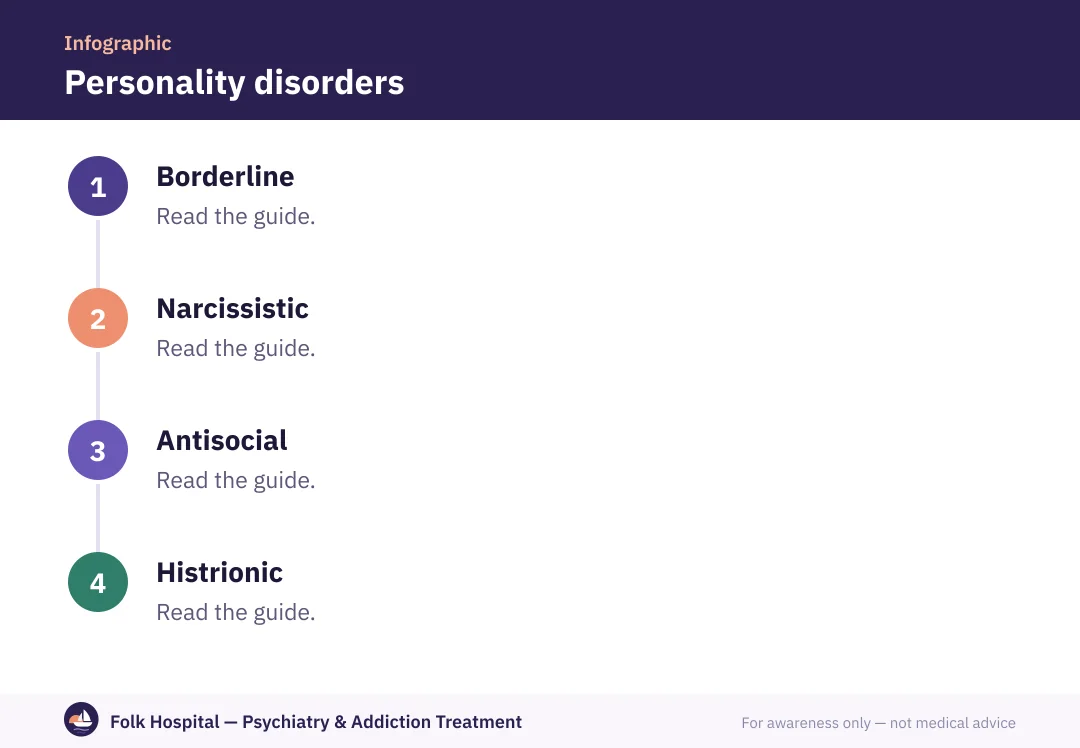
| Dramatic | Borderline, narcissistic, antisocial, histrionic |
| Anxious | Avoidant, dependent, obsessive-compulsive |
02Trait or disorder?
Personality trait
- Flexible across situations.
- Doesn't cause much suffering.
Personality disorder
- Rigid in every situation.
- Causes suffering and dysfunction in relationships and work.
Read also: DBT, manipulative personality, borderline test.
؟Frequently asked questions
What is a personality disorder?
A fixed pattern of thinking, feeling and relating that causes suffering or clear problems.
What are the clusters?
Odd, dramatic-emotional and anxious-fearful.
Are personality disorders treatable?
Yes. Many improve with long-term psychotherapy such as DBT.
Are they linked to addiction?
Yes, especially borderline and antisocial, needing dual-diagnosis treatment.
Does every difficult person have a personality disorder?
No. Diagnosis needs a broad fixed pattern causing dysfunction, made by a specialist.
When is it diagnosed?
Usually after 18, with patterns beginning in adolescence.
Sources and references
- Personality Disorders — U.S. National Library of Medicine — MedlinePlus
- Personality disorders — MedlinePlus — U.S. National Library of Medicine — MedlinePlus
- Borderline Personality Disorder — National Institute of Mental Health (NIMH)

Written byDr. Mahmoud ElsawyConsultant in psychiatry and addiction treatment
A psychiatrist specialising in addiction and mental illness in adults and adolescents, with a focus on dual diagnosis.
For awareness only — not a substitute for medical advice. Editorial policy · View profile