01Harms during an episode
Acute risks
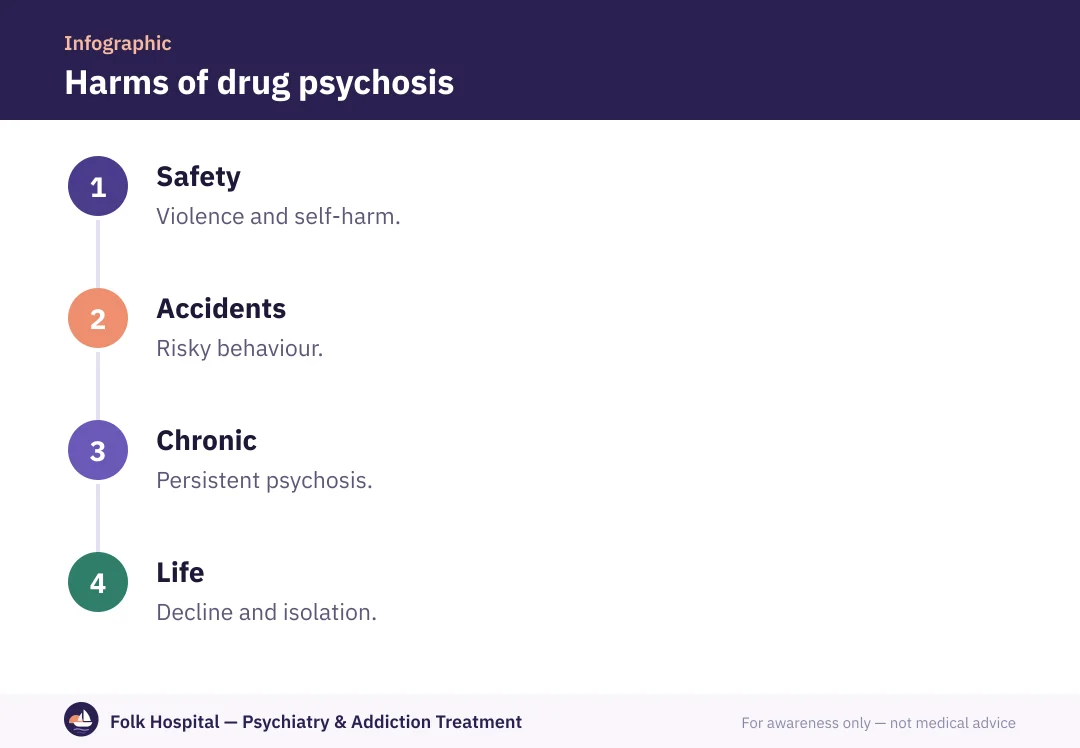
- Violence towards others driven by suspicion or fear.
- Self-harm or a suicide attempt.
- Accidents while fleeing «pursuers».
- Dehydration and exhaustion from sleeplessness and not eating.
- Legal trouble from actions during psychosis.
02Long-term harms
| Harm | What happens |
|---|---|
| Recurrence | Psychosis returns with use, sometimes faster and harsher |
| Persistence | Some cases keep symptoms for months or longer |
| Unmasking a disorder | Schizophrenia or bipolar disorder emerges in vulnerable people |
| Cognitive decline | Poorer concentration and memory with long stimulant use |
| Social life | Job loss, family tension and stigma |
| Depression and suicide | Higher risk after the episode resolves |
03Why does it recur?
With each episode the brain becomes more sensitive to the substance, so a smaller dose and shorter time bring psychosis back, a pattern seen especially with stimulants. That's why the goal is stopping the substance completely, not just cutting down.
- Threats to harm themselves or others.
- Severe agitation or violence.
- High fever, seizures or marked confusion.
- Visual hallucinations with tremor and sweating after stopping alcohol.
Mental health hotline: 08008880700.
Ambulance: 12304How to reduce the harms
- Fast interventionevery day of untreated psychosis adds risk.
- Treating the psychosisantipsychotics and safety.
- Treating the addictiondetox and rehabilitation.
- Follow-upto detect any underlying disorder or post-episode depression.
- Family supportthe family programme and a clear emergency plan.
Read drug-induced psychosis, shabu harms and hashish harms.
؟Frequently asked questions
Does drug-induced psychosis cause lasting damage?
Many recover fully, but some keep symptoms or a higher vulnerability to psychosis, especially after long or repeated use.
Does drug-induced psychosis recur?
Yes. Returning to the same substance often brings it back, sometimes faster and at a lower dose than the first time.
Can someone with drug psychosis harm their family?
Violence can occur during intense suspicion or hallucinations, especially with stimulants, which is why safety and urgent assessment matter.
Does hashish psychosis cause schizophrenia?
Hashish doesn't cause schizophrenia in everyone, but it can bring it on earlier or unmask it in vulnerable people, and a share of hashish psychosis cases later become schizophrenia.
What are the social harms?
Losing work or study, legal problems, family tension, and stigma that can delay treatment.
How can these harms be prevented?
Through urgent assessment, treating the psychosis, then addiction treatment and follow-up to prevent a return to the substance.
Sources and references
- Psychosis — NHS (UK)
- Methamphetamine — research topic — National Institute on Drug Abuse (NIDA)
- Cannabis (Marijuana) — research topic — National Institute on Drug Abuse (NIDA)
- Synthetic Cannabinoids (K2/Spice) DrugFacts — National Institute on Drug Abuse (NIDA)
- Comorbidity: Substance Use and Other Mental Disorders — National Institute on Drug Abuse (NIDA)

A psychiatrist specialising in addiction and mental illness in adults and adolescents, with a focus on dual diagnosis.
For awareness only — not a substitute for medical advice. Editorial policy · View profile