Many people who become dependent on sedatives start with a prescription for anxiety or insomnia; use then continues for months without review, the dose loses its effect, and they raise it themselves. Others buy them on the street to soften a stimulant comedown or boost tramadol. Either way, people reach dependence without feeling they are «addicts».
01How do depressants and sedatives affect the brain?
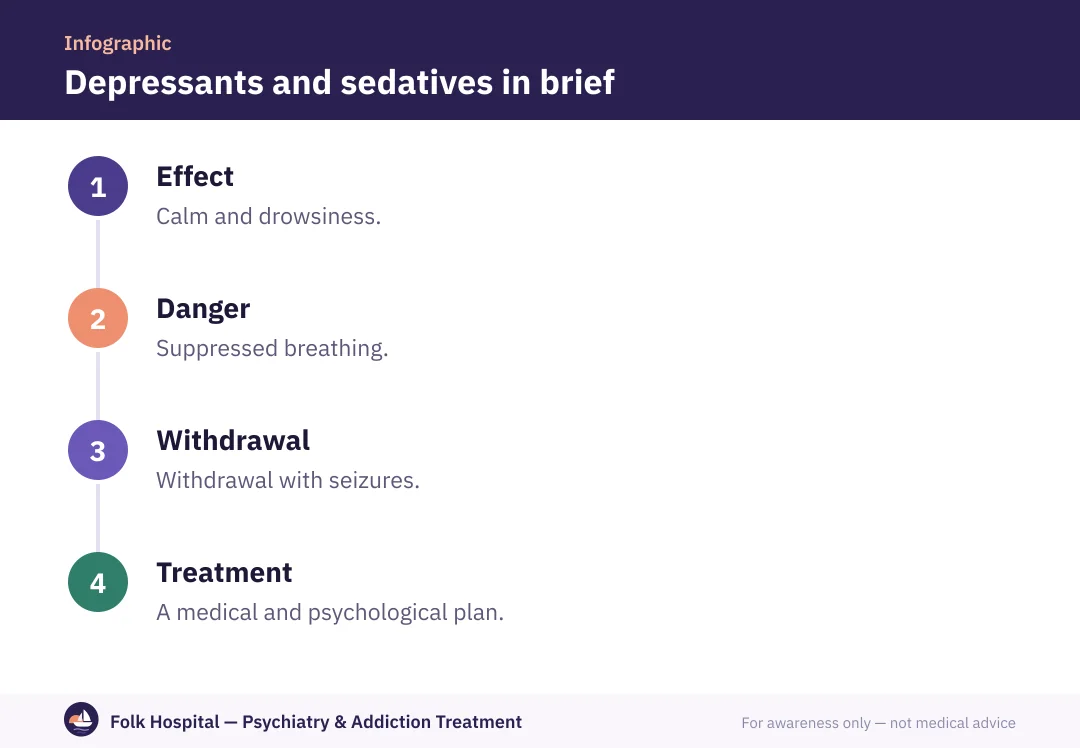
GABA is the brain's «brake» messenger. Benzodiazepines, sleeping pills and barbiturates make its receptors more responsive, quietening the brain's electrical activity: anxiety falls, sleep comes and muscles relax. With repetition the brain adapts by becoming less sensitive to GABA, so if the substance stops suddenly the brain is left «without brakes»: severe anxiety, insomnia, tremor and sometimes seizures. Pregabalin and gabapentin work differently, on calcium channels, but their calming effect and misuse potential put them in the same group in practice.
02The best-known substances in this group
| Substance | Common form | What sets it apart |
|---|---|---|
| Benzodiazepines | Tablets | The largest family of sedatives |
| Xanax | Tablets | Fast and short-acting, so dependence comes quickly |
| Rivotril | Tablets | Long-acting, prescribed for epilepsy and panic |
| Valium | Tablets | Long-acting, sometimes used in alcohol withdrawal |
| Lorazepam | Tablets | Intermediate-acting |
| Bromazepam | Tablets | Widely used for anxiety in Egypt |
| Rohypnol | Tablets | Very strong and causes memory loss |
| Zolpidem | Sleeping tablets | Can cause complex behaviour during sleep |
| Night Calm | Tablets | A sleeping pill that gets misused |
| Barbiturates | Tablets or injections | A very narrow safety margin |
| GHB | Liquid | The dangerous dose is very close to the active dose |
| Pregabalin | Capsules | Misused at high doses |
| Gabapentin | Capsules | Weaker, but often mixed with other drugs |
03Signs you may notice in someone using them
Common signs
- Drowsiness and slurred speech, as if drunk but with no smell of alcohol.
- Unsteadiness and repeated falls.
- Forgetting recent events.
- Mood swings between calm and irritability.
- Seeking prescriptions from several doctors or pharmacies.
- Severe anxiety and insomnia when a dose is late.
04Health and mental-health risks
- Slowed breathing and death, far more likely with opioids or alcohol.
- Road accidents, falls and fractures, especially in older people.
- Poorer memory and concentration with long use.
- Physical dependence even at therapeutic doses if use is prolonged.
- Withdrawal that can cause seizures and delirium.
- Being exploited while unconscious or unable to remember.
- Deep drowsiness with no response.
- Slow breathing or unusual snoring.
- Blue lips.
- Seizures after stopping suddenly.
Put the person on their side, don't leave them alone, and tell the paramedics everything they took, especially tramadol or alcohol.
Ambulance: 12305What is withdrawal like?
How severe withdrawal is depends on the substance, dose and duration. Short-acting drugs such as Xanax cause faster, harsher symptoms; long-acting ones such as Rivotril start later but last longer.
- Onset (hours to days)rebound anxiety, insomnia, tremor and sweating.
- Peak (weeks 1–2)irritability and sensitivity to light and sound; seizures or delirium can occur after abrupt stopping.
- Extended phase (weeks to months)intermittent anxiety and poor sleep that gradually improve.
06How does treatment differ?
The golden rule: don't stop a sedative suddenly after long use. The doctor sets a gradual taper, sometimes switching to a long-acting sedative and reducing it over weeks. The reasons for use are treated at the same time: anxiety with cognitive behavioural therapy, insomnia by changing sleep habits, and depression with appropriate treatment. Cases mixed with opioids or alcohol usually need inpatient detox. Read benzodiazepine withdrawal.
07Read also
؟Frequently asked questions
Can sedatives prescribed by a doctor cause addiction?
They can cause dependence if taken daily for long periods, which is why doctors usually prescribe them short-term and review them. Sticking to the dose and duration greatly reduces the risk.
Why shouldn't I stop a sedative suddenly?
Because the brain has adapted to it, and stopping abruptly after long use can cause severe anxiety and insomnia, and sometimes seizures. A gradual taper under a doctor is safer.
Is pregabalin a sedative?
It isn't a benzodiazepine and works differently, but it causes calm and drowsiness, is misused at high doses, and can cause dependence and withdrawal.
How dangerous is mixing sedatives with tramadol?
Both slow breathing, so the risk of overdose multiplies even at doses that seem normal for each alone.
How long does sedative withdrawal last?
It varies widely: days to weeks for acute symptoms, and some mild symptoms can last months, especially after stopping quickly.
Are there alternatives to sedatives for anxiety and insomnia?
Yes, including cognitive behavioural therapy, some antidepressants that don't cause dependence, and better sleep routines. The doctor decides what suits each case.
Sources and references
- Prescription Medicines — research topic — National Institute on Drug Abuse (NIDA)
- Drugs, Brains, and Behavior: The Science of Addiction — National Institute on Drug Abuse (NIDA)
- Commonly Used Drugs Charts — National Institute on Drug Abuse (NIDA)
- Pregabalin — medicines A to Z — NHS (UK)
- Gabapentin — medicines A to Z — NHS (UK)

A psychiatrist specialising in addiction and mental illness in adults and adolescents, with a focus on dual diagnosis.
For awareness only — not a substitute for medical advice. Editorial policy · View profile