01Does hashish even need treatment?
Many people believe hashish is a "soft drug" that doesn't cause addiction. In fact, a share of users develop what doctors call cannabis use disorder, and the risk rises with starting in adolescence, daily use and smoking high-potency products. The problem shows when someone can't sleep, relax or get through the day without "the joint", or tries to stop and fails.
Signs hashish has become a problem
- Smoking daily or several times a day.
- Being unable to sleep or eat well without it.
- Failed attempts to cut down or stop.
- A decline in study, work or relationships.
- Irritability and insomnia when it's delayed.
- Carrying on despite anxiety, paranoia or problems with the family.
Read about signs of hashish use and how people who use hashish behave.
02What are the steps in hashish treatment?
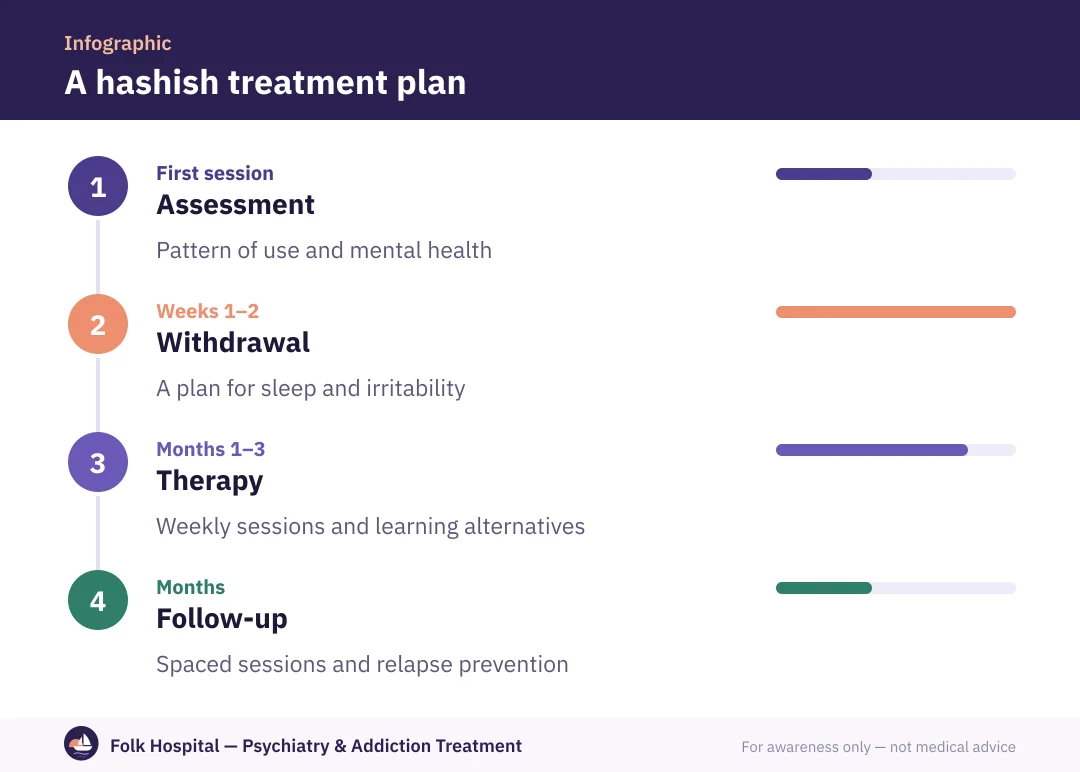
- Assessmenthow much, when and why they smoke, and whether there's anxiety, depression, psychosis or other drug use.
- Withdrawal plansleep routines, physical activity and medication if needed for insomnia or anxiety. See hashish withdrawal.
- Motivational interviewingstrengthening the person's own reasons to stop instead of imposing them.
- Cognitive behavioural therapyidentifying what triggers smoking and learning other ways to handle boredom, anxiety and friends.
- Follow-upspaced-out sessions and a relapse-prevention plan.
03The first two weeks: how to get through them
Withdrawal usually starts within one to three days, is strongest in the first week and improves gradually over two to four weeks:
| Symptom | What helps |
|---|---|
| Insomnia and vivid dreams | Fixed sleep times, less caffeine and fewer screens at night, daytime exercise, and short-term prescribed medicine if needed |
| Irritability and anxiety | Breathing exercises, physical activity, therapy sessions, and avoiding confrontations in the first days |
| Poor appetite | Small, frequent meals and enough fluids |
| Cravings | A ready plan of alternatives, keeping away from smoking places and friends, and calling a supportive person |
| Boredom and empty evenings | A schedule of evening activities planned in advance |
Memory, concentration and energy improve gradually over weeks of abstinence. Read the recovery timeline after stopping hashish.
04Psychological therapy: what happens in sessions?
Research shows that combining motivational interviewing with cognitive behavioural therapy, and sometimes contingency management, is the most effective treatment for cannabis use disorder. In practice, sessions work on:
- Why do you smoke?: to sleep? To escape anxiety? Boredom? To fit in with friends? Each reason needs a different alternative.
- A map of triggers: times, places, people and feelings linked to smoking.
- Refusal skills: how to say no to smoking friends without losing them or seeming odd.
- Managing anxiety and sleep without the drug.
- Building a full day: study, work, sport or a hobby to fill the time smoking used to fill.
05Are there medicines for hashish addiction?
There's still no approved medicine for cannabis use disorder itself, and several are being studied without clear results yet. But the doctor may prescribe short-term medicines for severe insomnia, anxiety or co-existing depression, avoiding addictive sedatives. Read about medicines used in hashish treatment.
06When is hashish a sign of a deeper mental health problem?
Signs that call for a psychiatrist
Irrational suspicion of others, hearing voices, disorganised speech, marked withdrawal, deep sadness and thoughts of death, or repeated panic attacks. Hashish can reveal or worsen a vulnerability to psychosis, anxiety or depression, and early assessment changes the course.
Read about hashish and paranoia and drug-induced psychosis.
07When is outpatient care enough, and when is a stay needed?
Outpatient care is usually enough if
- Hashish is the only drug.
- There are no psychotic symptoms.
- There's family support and motivation to stop.
- They can attend sessions regularly.
A residential stay is better if
- Attempts to stop keep failing.
- Hallucinations or strong paranoia appear.
- Other drugs are used alongside it.
- The drug is a synthetic such as strox or voodoo.
08Hashish and synthetic drugs
What's sold as "hashish" or "bango" may be mixed or sprayed with synthetic substances that are far stronger and less predictable, such as strox and voodoo. These can cause agitation, acute psychosis or heart problems even with light use, and need a closer assessment. Read strox addiction treatment.
09Hashish in teenagers
The brain keeps maturing until the mid-twenties, and early, regular use is linked to a higher risk of dependence, concentration problems, anxiety and psychosis. Treatment with a teenager focuses on family, school and alternative activities, and avoids relying on fear and punishment alone, which rarely works. Read teenagers and drugs.
10How long does treatment take?
Usually two to three months of regular sessions, followed by spaced-out follow-up. It varies with how long the person has used and whether there's anxiety, depression or other drug use.
11Advice for families
- Talk about specific observations (sleep, study, money) rather than general accusations.
- Don't play it down as "just hashish", and don't blow it up with shouting.
- Agree clear house rules, and encourage any step towards an assessment.
- Read how to deal with someone using hashish.
؟Frequently asked questions
Do I need a rehab centre for hashish?
Not always. Most cases succeed with outpatient care. We recommend a residential stay if attempts to stop keep failing, psychotic symptoms appear, or other drugs are involved.
How long does hashish treatment take?
Usually two to three months of regular sessions, followed by spaced-out follow-up. It varies with how long the person has used and whether there's anxiety or depression.
Is hashish really addictive?
Yes. A share of users develop cannabis use disorder, and the risk is higher with starting young and daily use. It shows as loss of control and withdrawal symptoms on stopping.
Why can't I sleep after stopping hashish?
Because the body got used to its calming effect. Insomnia and vivid dreams are among the commonest withdrawal symptoms and usually improve within two to four weeks with sleep routines and treatment.
Does hashish cause mental illness?
Heavy use, especially in adolescence and with high-potency products, is linked to a higher risk of psychosis and anxiety, and may reveal an underlying vulnerability. Responses vary from person to person.
My son is a student and smokes hashish. Should he leave school for treatment?
Usually not. Outpatient care lets him keep studying, and we arrange sessions around his timetable. A short residential stay is only needed for severe cases or psychotic symptoms.
How does treating hashish differ from treating strox?
Strox is a synthetic drug that's stronger and less predictable, and can cause agitation or acute psychosis, so it needs a closer assessment and sometimes a residential stay even when use seems light.
Can I smoke occasionally after treatment?
Goals vary, but for anyone who developed a use disorder or psychiatric symptoms, full abstinence is the safest aim, because going back to occasional use often ends in the old pattern.
Sources and references
- Cannabis (Marijuana) — research topic — National Institute on Drug Abuse (NIDA)
- Treatment Approaches for Drug Addiction — DrugFacts — National Institute on Drug Abuse (NIDA)
- Drug misuse in over 16s: psychosocial interventions (CG51) — National Institute for Health and Care Excellence (NICE)
- Co-Occurring Disorders and Health Conditions — National Institute on Drug Abuse (NIDA)
- World Drug Report 2024 — United Nations Office on Drugs and Crime (UNODC)

A psychiatrist specialising in addiction and mental illness in adults and adolescents, with a focus on dual diagnosis.
For awareness only — not a substitute for medical advice. Editorial policy · View profile