01Why strox isn't like hashish
Strox is usually sold as herbs sprayed with synthetic chemicals that mimic the effect of cannabis, but bind to brain receptors far more strongly, and the mix changes from batch to batch. So the user doesn't know what they're really smoking or how strong it is. That explains the sudden cases that reach emergency departments with seizures, agitation or psychosis after a single joint.
Similar substances are sold under other street names, including voodoo, and are treated in much the same way.
02When do you need emergency care immediately?
- Seizures or loss of consciousness.
- A very fast heart rate or chest pain.
- Severe agitation, violence or frightening hallucinations.
- Persistent vomiting or passing very little urine.
- High temperature or confusion.
Call an ambulance on 123, keep the person somewhere calm and safe, and don't leave them alone.
Ambulance: 12303What are the stages of strox treatment?
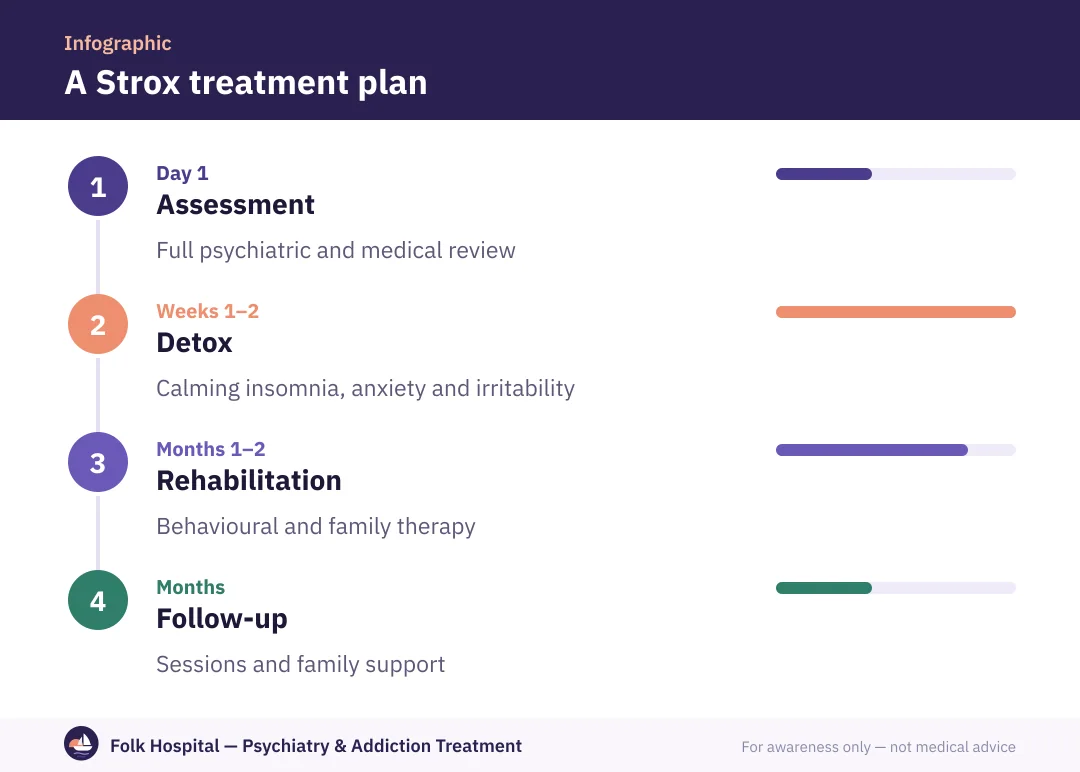
- Assessmenthow heavily they use, other drugs, any seizures or hallucinations, and the situation at school and home.
- Detoxmedicines for insomnia, anxiety and nausea if needed, with mental-state monitoring. See strox withdrawal.
- Treating psychosis if presentspecialist psychiatric assessment and follow-up until symptoms resolve.
- RehabilitationCBT, motivational interviewing to strengthen the young person's wish to change, and skills for saying no to friends.
- Family therapy and follow-uptraining parents to supervise and support, and a plan for returning to study or work.
04Withdrawal: what to expect
| Period | Common symptoms | What we do |
|---|---|---|
| Days 1–3 | Irritability, anxiety, insomnia, nausea, poor appetite, sweating | Symptom medicines, fluids and a calm setting |
| Weeks one and two | Strong cravings, mood swings, vivid dreams, poor concentration | Early sessions, sleep regulation and physical activity |
| After that | Broken sleep, boredom, cravings in social situations | Rehabilitation, refusal skills and a daily plan |
During this period the doctor watches for any psychotic symptoms or thoughts of self-harm, because some users go through low mood or severe anxiety after stopping.
05Psychosis and anxiety linked to strox
One of the things families fear most is a son showing irrational suspicion, strange talk or hearing voices. These symptoms may be drug-induced psychosis that improves with stopping and treatment, or may reveal a vulnerability to mental illness that needs longer follow-up. So we treat acute symptoms first, then reassess after weeks of abstinence. Read about drug-induced psychosis and our dual diagnosis programme.
06Rehabilitation: what do we work on with young people?
- Motivational interviewing: many young people don't see a problem; the aim is for them to discover for themselves what they're losing.
- Cognitive behavioural therapy: high-risk situations, boredom, peer pressure, and coping with anxiety without the drug.
- Refusal skills: how to say no without losing their place in the group, or how to move away from a harmful group.
- Building alternatives: sport, hobbies, and near, realistic study or work goals.
- Contingency management: small agreed rewards for engagement and negative tests.
07Why does family therapy matter here?
Because most strox users are teenagers and young adults living with their families. An understanding home with clear boundaries and sensible supervision greatly reduces the chance of relapse, while a home that relies on shouting or ignoring the problem pushes young people to lie and go back.
What usually harms
- Shouting, threats and insults.
- Daily searches without conversation.
- Large pocket money without oversight.
- Ignoring the problem until it grows.
What usually helps
- Calm conversation about specific observations.
- A few clear rules with consequences that are kept.
- Measured pocket money and awareness of how it's spent.
- Seeking an early assessment and attending family sessions.
Read how to deal with someone using strox and teenagers and drugs.
08Residential or outpatient?
Outpatient care may be enough
- Occasional or recent use.
- No psychosis, seizures or violence.
- A supportive, engaged family.
- Commitment to sessions.
Residential care is better with
- Daily use or failed previous attempts.
- Psychosis, agitation or seizures.
- Mixing other drugs.
- Thoughts of self-harm.
09Returning to study or work
We agree a gradual return plan with the young person and family: a realistic study timetable, or a return to work with set hours, avoiding the old group as far as possible. Concentration and memory improve gradually over weeks to months of abstinence, so slow progress at first is no reason to lose heart.
؟Frequently asked questions
How long does strox treatment take?
Detox takes one to two weeks, rehabilitation usually one to two months, then follow-up for several months. It takes longer with psychosis or other drug use.
Is strox more dangerous than hashish?
Usually, yes. It's a group of synthetic substances that bind to brain receptors more strongly than natural cannabis, and the mix changes from batch to batch, so it can cause sudden seizures, psychosis or heart problems.
Do hallucinations go away after stopping?
They improve in many people within days to weeks with treatment, but some need longer psychiatric follow-up, especially if symptoms persist after stopping.
Can strox addiction be treated at home?
With light use and no psychotic symptoms or seizures, outpatient care with a supportive family may be enough. Daily use or acute symptoms need a residential stay.
Does strox show up on a drug test?
It usually doesn't show on a standard cannabis test because it's chemically different, and needs special tests that aren't available everywhere. Read how long strox stays in the body.
My son smokes strox and won't talk about it. What should I do?
Choose a calm moment, talk about specific observations without shouting, and book family counselling to learn how to persuade him to have an assessment. If there's agitation or hallucinations, seek emergency care.
Does strox affect studying after stopping?
Concentration and memory are affected during use and improve gradually over weeks to months of abstinence, and we plan a gradual return to study.
Sources and references
- Cannabis (Marijuana) — research topic — National Institute on Drug Abuse (NIDA)
- Treatment Approaches for Drug Addiction — DrugFacts — National Institute on Drug Abuse (NIDA)
- Drug misuse in over 16s: psychosocial interventions (CG51) — National Institute for Health and Care Excellence (NICE)
- Co-Occurring Disorders and Health Conditions — National Institute on Drug Abuse (NIDA)
- World Drug Report 2024 — United Nations Office on Drugs and Crime (UNODC)

A psychiatrist specialising in addiction and mental illness in adults and adolescents, with a focus on dual diagnosis.
For awareness only — not a substitute for medical advice. Editorial policy · View profile