01How does a hashish user's behaviour change?
Hashish affects brain areas responsible for memory, motivation and reward. With regular use, gradual changes appear that the person may not notice, but the family sees clearly.
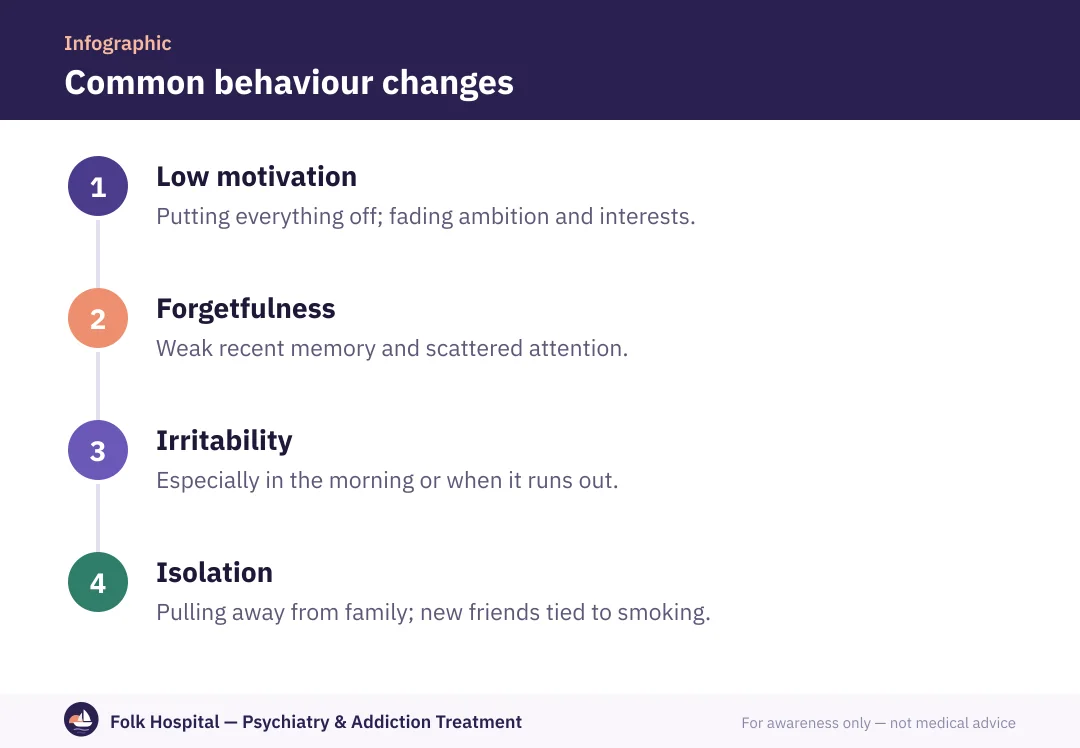
Common changes
- Sleeping late and waking late.
- Putting off study or work, and declining performance.
- Losing interest in sport and old hobbies.
- Forgetting appointments and things.
- Irritability and arguing over small matters.
- Lying about whereabouts and pocket money.
- Constant justification: «It's not addiction.»
02Changes across areas of life
| Area | What you may notice |
|---|---|
| Study and work | Falling grades, absences, loss of ambition |
| Relationships | New friends nobody knows, drifting from family |
| Mood | Irritability between doses, unusual calm afterwards |
| Body | Red eyes, sudden hunger, coughing, neglected appearance |
| Money | Repeated requests for money, missing belongings |
| Thinking | Forgetfulness, slow reactions, sometimes suspicion and anxiety |
03How to tell personality from the effect of hashish
Compare how he was a year or two ago with how he is now. A clear change in study or work, motivation, sleep and relationships, without another obvious cause such as grief or a health problem, points to hashish. Remember that adolescence itself brings normal changes in mood and relationships, so don't judge from one sign. Read teen psychological changes.
04Signs that need a prompt psychiatric assessment
- Intense suspicion that people are watching or plotting against him.
- Hearing voices or seeing things that aren't there.
- Repeated panic attacks.
- Talk of death or self-harm.
These signs may indicate psychosis or depression needing specialist treatment. Read hashish paranoia.
Ambulance: 12305How to handle it
What drives denial
- Angry confrontation in front of others.
- Searches and accusations without evidence.
- Threats to throw him out or cut money immediately.
- Long moral lectures.
What opens conversation
- A calm time when he isn't high.
- Specific observations without generalising.
- Showing worry, not anger.
- Offering help and a clear plan.
Read how to convince an addict to get treatment, hashish addiction treatment and hashish symptoms.
؟Frequently asked questions
How can I tell from his behaviour that my son uses hashish?
Watch for change from how he was: falling grades, new friends, late sleeping, isolation, red eyes, the smell, sudden hunger and lying about money. Several signs together deserve a conversation.
Does hashish cause laziness?
Regular use can be linked to lost motivation and interest in goals, especially in teenagers, and usually improves after a period of stopping.
Why do hashish users become irritable?
Irritability may be withdrawal between doses or when restricted, or come from poor sleep or accompanying anxiety.
Does hashish cause suspicion and paranoia?
It can cause suspicion and anxiety, especially with high doses and strong strains; if suspicion persists after the effect wears off, a psychiatric assessment may be needed.
How do I talk to my son about hashish?
Choose a calm time when he isn't high, mention specific observations rather than general accusations, listen more than you speak, express worry rather than anger, and offer help.
When does a hashish user need specialist treatment?
If he can't stop despite wanting to, if use affects his study or work, if psychological symptoms such as suspicion or panic appear, or if he's using other substances too.
Sources and references
- Cannabis (Marijuana) — research topic — National Institute on Drug Abuse (NIDA)
- Parents & Educators — National Institute on Drug Abuse (NIDA)
- Psychosis — NHS (UK)

A psychiatrist specialising in addiction and mental illness in adults and adolescents, with a focus on dual diagnosis.
For awareness only — not a substitute for medical advice. Editorial policy · View profile