01Why is there no medicine for hashish addiction?
Many medicines have been tested in research, and some showed promising results in reducing withdrawal or cravings for some patients, but none has yet reached wide approval as standard treatment. Part of the reason is that hashish acts on a complex brain system regulating mood, sleep, appetite and memory, so there's no single «switch» to turn off. Treatment therefore relies on therapy sessions, with medicines for symptoms.
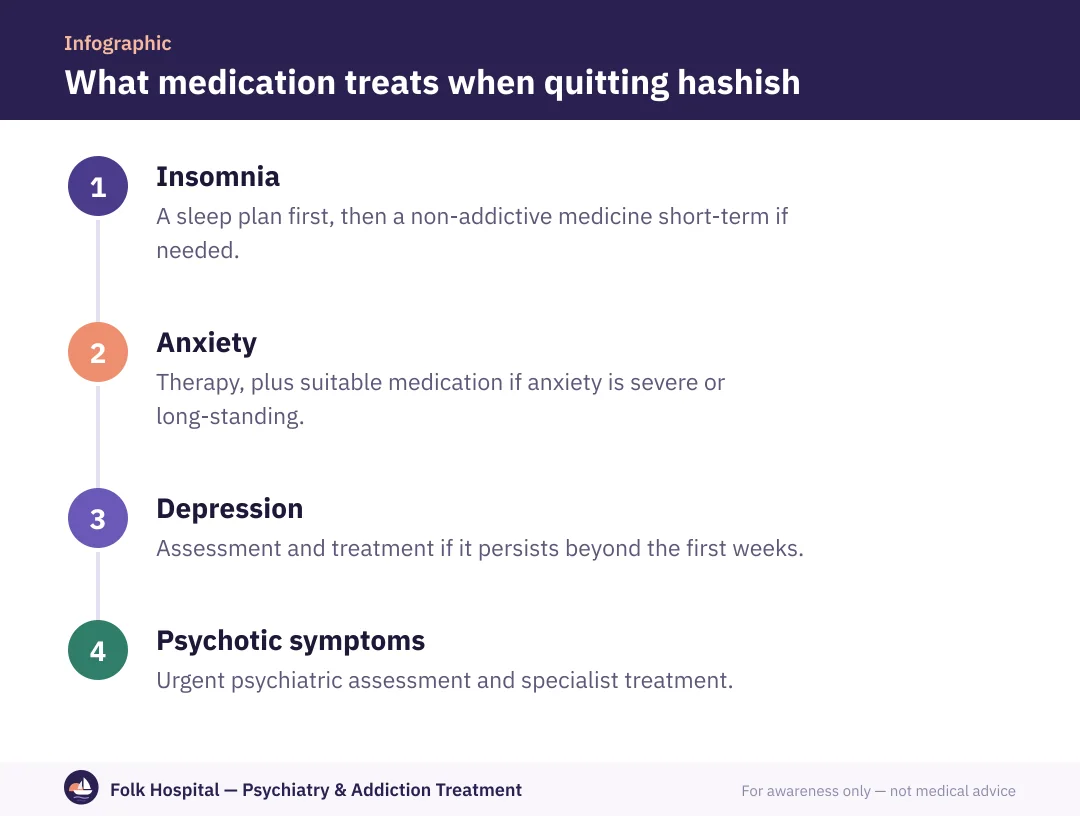
02Medicines the doctor may use
| Problem | What the doctor may do | Note |
|---|---|---|
| Insomnia | Regulate sleep first; a non-addictive medicine short-term if needed | Avoid dependence-forming sleeping pills |
| Anxiety and irritability | Therapy, sometimes a suitable medicine for a set period | No long-term sedatives without follow-up |
| Depression | An antidepressant after assessment | Takes weeks to work |
| Psychosis | An antipsychotic under a psychiatrist | Needs longer follow-up |
| Pre-existing disorder | Treating the original condition, such as ADHD or bipolar disorder | Greatly reduces relapse |
03Common mistakes
Wrong
- Pharmacy sleeping pills without a prescription.
- Swapping hashish for sedatives or pregabalin.
- Searching for a «magic pill» instead of therapy.
- Herbs and drinks that «cleanse the body».
Right
- Consulting a doctor before any medicine.
- Starting with regular sleep and activity.
- Using medicine for a set period with a stopping plan.
- Sticking with therapy sessions and follow-up.
04Psychological treatment: the real foundation
- Motivational interviewinghelps the person find their own reasons to stop and strengthens the decision.
- Cognitive behavioural therapyteaches how to handle the situations and feelings that lead to hashish.
- Contingency managementrewarding abstinence confirmed by testing, especially effective with young people.
- Family therapyparticularly with teenagers, because the family is part of the solution.
- Relapse preventiona clear plan for risky situations, friends and places.
Read hashish addiction treatment, hashish withdrawal, how long hashish stays in the body and dual diagnosis.
؟Frequently asked questions
Is there a medicine for hashish addiction?
Not yet: no medicine is widely approved for cannabis addiction itself. Treatment relies on therapy sessions, with medicines for accompanying symptoms when needed.
Which medicines does the doctor use during hashish withdrawal?
Short-term medicines to improve sleep and ease anxiety and irritability, chosen so they don't cause dependence, and sometimes antidepressants if depression is present.
Should I take a sleeping pill to sleep after quitting hashish?
Don't take one without a prescription. Many sleeping pills and sedatives cause dependence. Ask the doctor for a safe option and start by regulating sleep times and activity.
Does pregabalin help with quitting hashish?
Using it unsupervised to ease withdrawal can lead to dependence on it, so self-medicating isn't advised. The doctor decides case by case.
Is there a medicine that removes hashish from the body quickly?
No. No medicines, herbs or drinks clear hashish from the body quickly; the body eliminates it gradually once use stops.
When does a hashish user need psychiatric medication?
If depression, severe anxiety, psychosis or persistent insomnia appears, or if there's a pre-existing condition such as ADHD or bipolar disorder.
Sources and references
- Cannabis (Marijuana) — research topic — National Institute on Drug Abuse (NIDA)
- Treatment Approaches for Drug Addiction — DrugFacts — National Institute on Drug Abuse (NIDA)
- Comorbidity: Substance Use and Other Mental Disorders — National Institute on Drug Abuse (NIDA)

A psychiatrist specialising in addiction and mental illness in adults and adolescents, with a focus on dual diagnosis.
For awareness only — not a substitute for medical advice. Editorial policy · View profile