01What's the idea behind the 12-step programme?
The idea began in the 1930s with groups of people recovering from alcohol, then spread to drugs and other addictions. It rests on the belief that recovery doesn't happen in isolation, and that someone who has lived the same experience can offer a kind of support no one else can.
02What are the steps about?
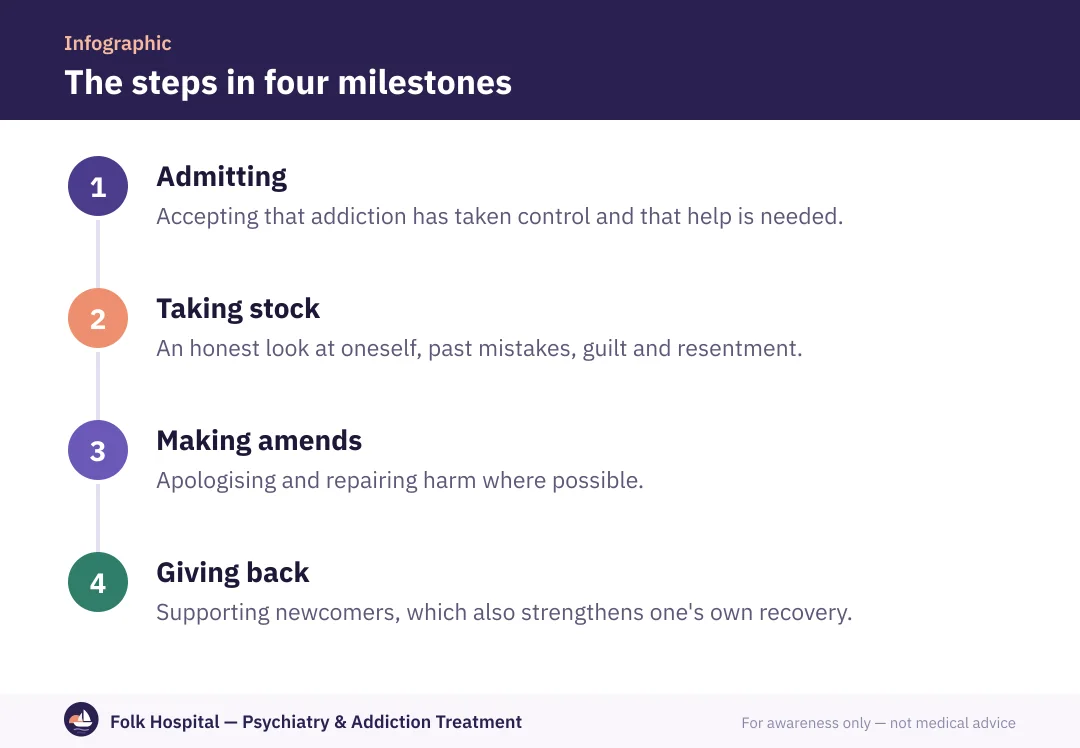
We won't list the wording of the steps, but their journey can be summarised in four main stages:
- Admission and acceptancerecognising that addiction has gone out of control and that asking for help isn't weakness.
- Self-reflectionan honest look at the past, mistakes and the patterns that led to using, shared with someone trusted.
- Making amendsapologising to those who were hurt and repairing what can be repaired without harming anyone.
- Continuing and giving backdaily self-review, maintaining recovery and helping newcomers.
These stages overlap with what psychological therapy works on: strengthening motivation, taking responsibility, letting go of paralysing guilt and building healthy relationships.
03What happens at a meeting?
- The meeting opens with a welcome and a short reading, and people introduce themselves by first name.
- Anyone who wishes talks about their experience or a set topic, and others listen without interrupting or giving direct advice.
- No one has to speak, and a newcomer can simply listen.
- What's said in the meeting stays there.
- The newcomer meets longer-standing members, and later chooses one as a sponsor.
04What does the research say?
Scientific reviews indicate that regular participation in 12-step groups, or treatment that encourages it, is linked to better abstinence rates, especially for alcohol use disorders. Much of the benefit seems to come from social support, a drug-free environment and continuity for years after formal treatment ends. That's why medical guidelines mention it as a supportive option to offer patients.
05How we combine the steps with treatment at Folk
- During the residential stayweekly meetings where patients learn about the steps and begin the first.
- Before dischargeconnecting the patient with a support group near them and helping them choose a sponsor.
- After dischargecombining group attendance with aftercare sessions with a therapist.
06The programme doesn't replace medical treatment
When groups alone aren't enough
If someone uses alcohol, sedatives or opioids regularly, stopping needs medical detox first. If they have depression, anxiety or psychosis, they need a psychiatrist. Groups are an important partner in recovery, but not a substitute for treatment.
It's also important that patients don't feel that taking a prescribed medicine for addiction or a mental health condition conflicts with recovery; prescribed, monitored medication is part of the plan, not a departure from it.
07Who is this programme for?
It suits anyone who needs long-term support and a new community away from using friends. Some people don't feel comfortable with it, and for them we offer alternatives such as therapist-led support groups, because the goal is staying in recovery, not sticking to one method.
It may suit you better if
- You feel lonely and need a supportive community.
- Your old friends were tied to using.
- You're comfortable talking with people who've lived the same experience.
- You need support available for years after treatment.
You may prefer an alternative if
- You're uncomfortable with the idea of a "higher power".
- You prefer structured sessions led by a therapist.
- You have severe social anxiety at first.
- You need more focus on specific practical skills.
08Tips for your first meeting
- Arrive a few minutes early; it's fine to say you're new.
- Listen at several meetings before judging the whole idea; every group has its own character.
- Take the numbers of one or two people you can call.
- Discuss how you felt at your next session with your therapist.
؟Frequently asked questions
Is the 12-step programme religious?
It speaks of a 'higher power' that each person understands in their own way, and people from many backgrounds take part. The core focus is honesty, responsibility and a supportive community.
What is a sponsor?
Someone further along in recovery who accompanies a newer member through the steps and is available when needed. Having one reduces loneliness in the first months.
Is attending groups enough without medical treatment?
It isn't advised at first, especially with alcohol, sedatives or opioids, or with a mental health condition. Groups complement treatment and don't replace medical detox and psychological therapy.
Do I have to speak at my first meeting?
No. You can just listen at first, and sharing is optional whenever you feel comfortable.
Does what I say in the group stay confidential?
One of the rules of these groups is that what's said there stays there, and members are known by first names only.
How long should I keep attending?
There's no fixed period. Many attend regularly in the first year and then less often, and some continue for years because they find support and meaning in it.
Is the programme only for drugs?
It began with alcohol and extended to drugs, and similar groups exist for behavioural addictions such as gambling.
Sources and references
- Treatment Approaches for Drug Addiction — DrugFacts — National Institute on Drug Abuse (NIDA)
- Drug misuse in over 16s: psychosocial interventions (CG51) — National Institute for Health and Care Excellence (NICE)
- Alcohol-use disorders: diagnosis, assessment and management (CG115) — National Institute for Health and Care Excellence (NICE)
A specialist in psychological rehabilitation, behaviour modification and relapse prevention, with over 15 years in addiction programmes.
For awareness only — not a substitute for medical advice. Editorial policy · View profile