01The withdrawal timeline
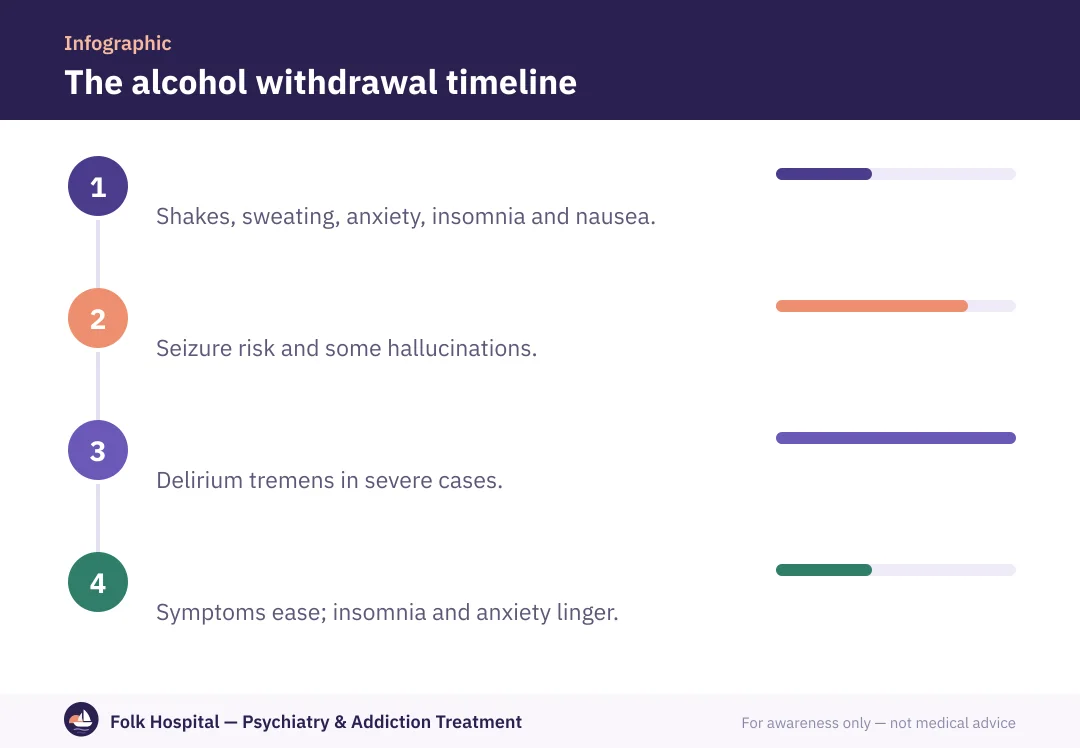
| Time since last drink | What may happen |
|---|---|
| 6–24 hours | Tremor, sweating, anxiety, insomnia, nausea and palpitations |
| 12–48 hours | Hallucinations in some cases, and seizures |
| 48–96 hours | Delirium tremens in severe cases |
| Days to weeks | Insomnia, anxiety, mood swings and cravings |
02Who is most at risk of severe withdrawal?
Risk factors
- Heavy daily drinking over a long period.
- Seizures or delirium in a previous withdrawal.
- Mixing alcohol with sedatives or pregabalin.
- Liver or heart disease, or malnutrition.
- Older age.
03How is safe detox done?
- A medical assessmentamount of drinking, previous episodes and other illnesses.
- Medicines that prevent seizureschosen by the doctor and reduced gradually.
- Vitamin B1 and fluidsto protect the brain and correct deficiencies.
- Monitoring vital signspulse, blood pressure, temperature and consciousness.
- Starting psychological therapyto prevent a return once detox ends.
Read about alcohol addiction treatment and detox.
- Seizures.
- Severe confusion or hallucinations.
- High temperature or a very fast heartbeat.
04After the first days
Many people are left with insomnia, anxiety and cravings for weeks. Psychological therapy, support groups and prescribed medicines that reduce cravings help prevent relapse. Read about the harms of alcohol and how long alcohol stays in the body.
؟Frequently asked questions
How long does alcohol withdrawal last?
Acute symptoms usually last from a few days to a week, then insomnia, anxiety and mood swings may continue for weeks.
Can I stop drinking at home?
With light drinking it may be possible with a doctor's follow-up. With heavy daily drinking or previous seizures or delirium, safety lies in medical admission.
What is delirium tremens?
A severe state usually appearing between days two and four: severe confusion, hallucinations, tremor, sweating, and a fast pulse and fever. It's an emergency needing hospital care immediately.
Why is vitamin B1 given during withdrawal?
Because deficiency is common with long-term drinking and can damage the brain and memory, so the doctor gives it as part of the detox plan.
Should I have a drink to ease the symptoms?
That postpones withdrawal without treating it. Medical detox with safe medicines that prevent seizures is better.
Sources and references
- Alcohol withdrawal — U.S. National Library of Medicine — MedlinePlus
- Alcohol-use disorders: diagnosis, assessment and management (CG115) — National Institute for Health and Care Excellence (NICE)
- Alcohol — fact sheet — World Health Organization
- Alcohol — research topic — National Institute on Drug Abuse (NIDA)

A psychiatrist specialising in addiction and mental illness in adults and adolescents, with a focus on dual diagnosis.
For awareness only — not a substitute for medical advice. Editorial policy · View profile