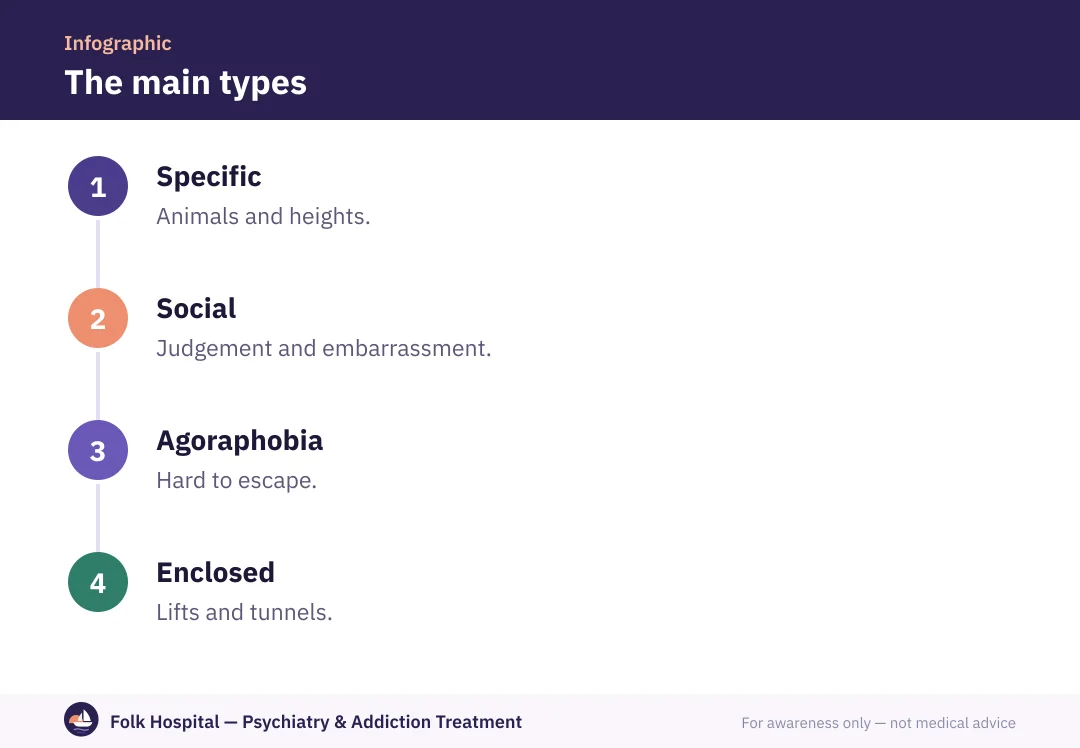
01Specific phobias
| Category | Examples |
|---|---|
| Animals | Dogs, cats, insects, snakes, spiders |
| Natural environment | Heights, water, darkness, storms |
| Blood, injections and injury | Seeing blood, injections, operations |
| Situations | Enclosed spaces, lifts, flying, tunnels, bridges |
| Other | Vomiting, choking, loud noises |
02Social phobia
Intense, persistent fear of situations where one might be evaluated or embarrassed.
Common feared situations
- Speaking in a group or meeting.
- Eating or writing in front of others.
- Job interviews or meeting new people.
- Using public toilets.
- Being the centre of attention.
It differs from avoidant personality and introversion in the intensity and impact of the fear.
03Agoraphobia
Fear of situations that are hard to escape: public transport, open spaces, enclosed places such as shops and cinemas, queues and crowds, and going out alone. It's often linked to panic attacks.
04A quick comparison
Specific phobia
- Focused on one thing.
- Usually begins in childhood.
- Sometimes treated in a few exposure sessions.
Social phobia and agoraphobia
- Spread across many situations.
- Begin in adolescence or early adulthood.
- Need longer treatment, sometimes medication.
Read phobias, phobia symptoms, phobia treatment and the social anxiety test.
؟Frequently asked questions
What are the commonest specific phobias?
Fear of animals and insects, heights, enclosed spaces, flying, blood and injections, darkness and water.
What's the difference between shyness and social phobia?
Shyness is a common trait that doesn't stop life; social phobia is intense fear of embarrassment that drives avoidance of important situations and affects work and relationships.
What is agoraphobia?
Fear of situations where escape or help is hard, such as transport, crowds and going out alone, often linked to panic attacks.
Is fear of flying a phobia?
Yes, if it's intense, exaggerated and leads to avoiding travel despite needing to.
Is social phobia treatable?
Yes, with cognitive behavioural therapy and gradual exposure, sometimes with antidepressants.
Can I have more than one phobia?
Yes, it happens, and they're usually treated using the same principles.
Sources and references
- Phobias — overview — NHS (UK)
- Anxiety Disorders — National Institute of Mental Health (NIMH)
- Anxiety disorders — fact sheet — World Health Organization
- Psychotherapies — National Institute of Mental Health (NIMH)

A psychiatrist specialising in addiction and mental illness in adults and adolescents, with a focus on dual diagnosis.
For awareness only — not a substitute for medical advice. Editorial policy · View profile