01Why does the fear persist?
A phobia is an intense, disproportionate fear of a specific thing or situation. When a person avoids what frightens them they feel momentary relief, so the brain learns that avoidance is the answer, and the fear grows over time. Treatment is built on breaking that cycle. Read about the symptoms of phobias and their types.
02Gradual exposure step by step
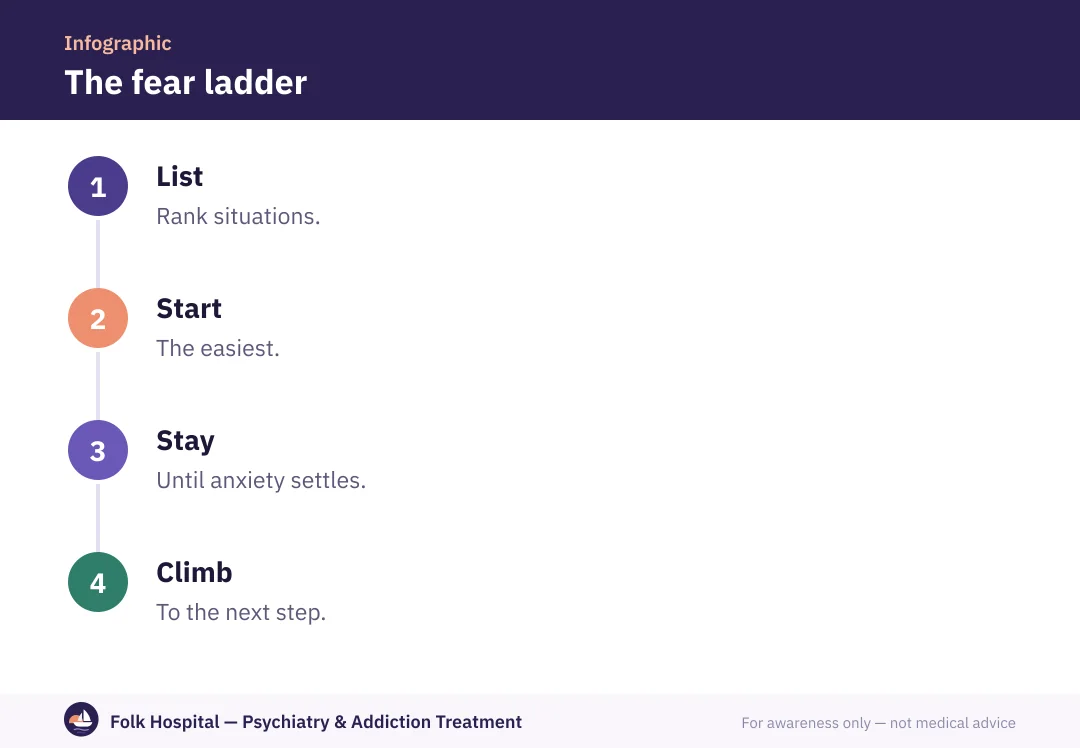
- Building a fear ladderranking situations from least to most anxiety-provoking.
- Starting with the easiest stepand staying in the situation until the anxiety settles by itself.
- Repetitionuntil the step becomes easy, then moving to the next.
- No escaping or excessive reassurancebecause they stop the brain learning the situation is safe.
- Practice between sessionsimprovement comes from repetition in real life.
| Example: fear of heights | Step |
|---|---|
| Looking at pictures of high places | 1 |
| Standing on a first-floor balcony | 2 |
| Standing on a higher balcony | 3 |
| Looking out of a tall building's window | 4 |
03Cognitive therapy and breathing
- Cognitive therapy reviews catastrophic predictions such as «I'll lose control» and tests them through experience.
- Slow breathing eases physical symptoms, but it's used to stay in the situation, not to escape it.
Read about cognitive behavioural therapy.
04The role of medicines
Sedatives aren't a treatment
Sedatives hide anxiety temporarily but block learning during exposure and cause dependence. In social anxiety the doctor may prescribe antidepressants that help in the long run. Read about sedative addiction.
05When should you get help?
When fear disrupts work, study, travel or relationships, or comes with panic attacks or turning to substances. Read about claustrophobia and the causes of phobias.
؟Frequently asked questions
How many sessions does phobia treatment need?
A specific phobia may improve in a few sessions; social anxiety takes longer.
Is facing the fear safe?
Yes, when it's done gradually and with a plan agreed with the therapist; nobody is forced to face what they can't bear all at once.
Does a phobia come back after treatment?
Some symptoms may return with stress or long avoidance, but repeating the exercises keeps the improvement.
Are there medicines for phobias?
Specific phobias are treated mainly with psychological therapy. In social anxiety some antidepressants may help, on a doctor's prescription.
Can claustrophobia be treated?
Yes, with gradual exposure, such as staying in a small room, then a lift for one floor, then more, along with breathing exercises.
Sources and references
- Anxiety Disorders — National Institute of Mental Health (NIMH)
- Psychotherapies — National Institute of Mental Health (NIMH)
- Anxiety disorders — fact sheet — World Health Organization
- Mental Health Medications — National Institute of Mental Health (NIMH)

A psychiatrist specialising in addiction and mental illness in adults and adolescents, with a focus on dual diagnosis.
For awareness only — not a substitute for medical advice. Editorial policy · View profile