01Physical symptoms
What the body feels
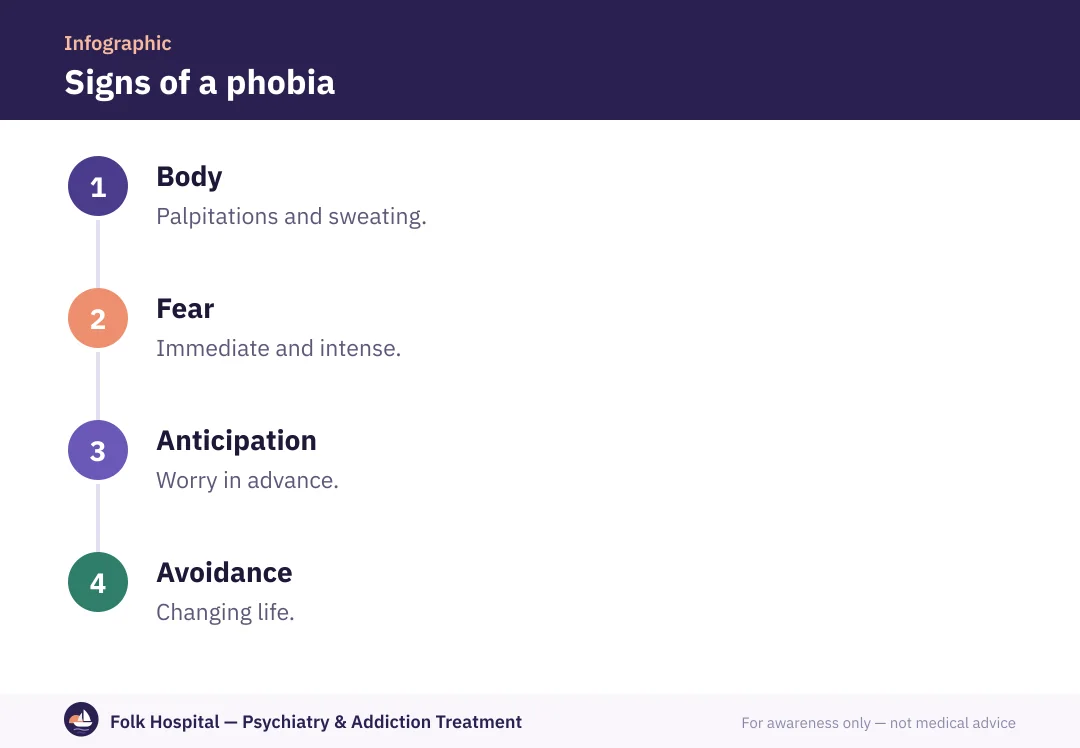
- Palpitations and a racing pulse.
- Sweating and trembling.
- Breathlessness or a choking feeling.
- Dizziness or light-headedness.
- Nausea or an upset stomach.
- A dry mouth.
- Chest pain or tightness.
02Psychological and behavioural symptoms
| Kind | Examples |
|---|---|
| Panic | Sudden intense fear on facing the trigger |
| Catastrophic thoughts | «I'll suffocate», «I'll lose control» or «I'll be humiliated» |
| Urge to escape | Leaving immediately whatever the cost |
| Anticipatory anxiety | Tension days before the situation |
| Avoidance | Changing routes, refusing to travel, excusing oneself from events |
| Safety behaviours | Sitting near the door, carrying medicine, bringing a companion |
03Blood-injection phobia: a special case
Why do some people faint?
In most phobias pulse and blood pressure rise. In blood-injection phobia they rise and then drop suddenly, so fainting can occur. These patients learn an applied tension technique to keep their blood pressure up.
04When do symptoms become a phobia?
Normal fear
- Proportionate to real danger.
- Fades when the situation ends.
- Doesn't stop you living your life.
Phobia
- Exaggerated relative to the danger.
- Lasts months and starts just from thinking about it.
- Leads to avoidance that restricts life.
Read phobias, types of phobias and panic attack symptoms.
؟Frequently asked questions
What are the physical symptoms of a phobia?
Palpitations, sweating, trembling, breathlessness, dizziness, nausea and a dry mouth, sometimes reaching a panic attack.
Can a phobia cause fainting?
Rarely, except blood-injection phobia, which can cause a drop in blood pressure and pulse leading to fainting.
What is anticipatory anxiety?
Anxiety that starts hours or days before a feared situation, such as before a flight or a meeting.
How do phobia symptoms show in children?
Through crying, freezing, tantrums or clinging to parents when facing the feared thing.
Do people with phobias know their fear is excessive?
Adults usually do, but can't control it, which is what characterises a phobia.
When are symptoms considered a phobia?
When they're exaggerated relative to the danger, last a long time, lead to avoidance and affect life.
Sources and references
- Phobias — overview — NHS (UK)
- Anxiety Disorders — National Institute of Mental Health (NIMH)
- Anxiety disorders — fact sheet — World Health Organization
- Psychotherapies — National Institute of Mental Health (NIMH)

A psychiatrist specialising in addiction and mental illness in adults and adolescents, with a focus on dual diagnosis.
For awareness only — not a substitute for medical advice. Editorial policy · View profile