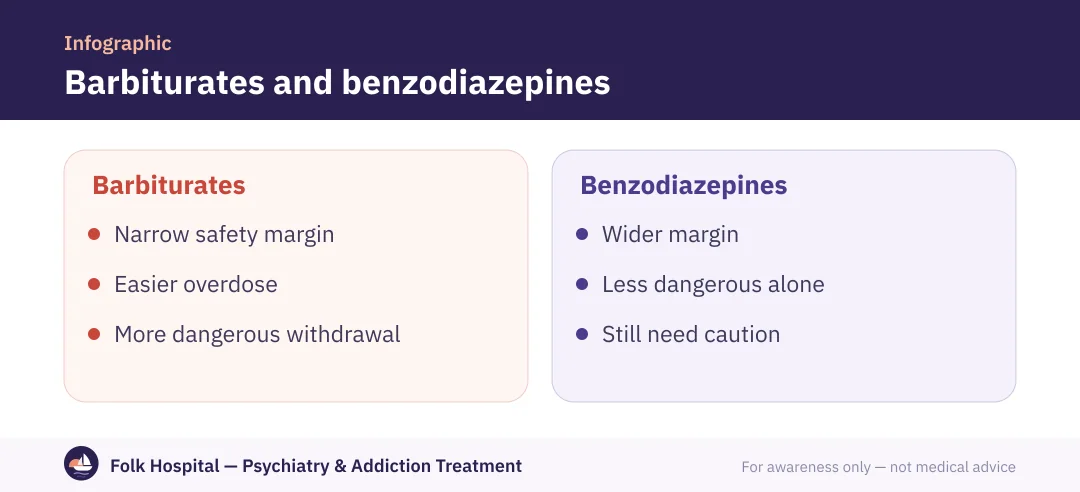
Barbiturates such as phenobarbital were once widely used for anxiety and insomnia, then declined because they're far more dangerous than modern alternatives.
01Key facts
| Item | Details |
|---|---|
| Class | Sedatives (depressants) |
| Common forms and names | Tablets and injections |
| How it's used | By mouth or injection |
| Does it show on a standard test? | Usually needs a specific test |
| Risk of dependence | High |
02How does it affect the brain and body?
They strongly depress brain activity, causing calm and drowsiness, and at higher doses they slow breathing until it may stop.
03The main risks
- Fatal overdose.
- Slowed breathing when mixed.
- Dependence and dangerous withdrawal.
- Falls and accidents.
Call an ambulance on 123 immediately for
- Unresponsiveness or slow breathing.
- Seizures after stopping.
What to do right nowAmbulance: 123
04What to read next
؟Frequently asked questions
Are barbiturates still used?
Yes, in limited cases such as some types of epilepsy and in anaesthesia, under close medical supervision.
Is phenobarbital still used?
It's used for specific epilepsy cases under medical supervision.
Can they be stopped at home?
No; stopping needs hospital supervision.
Sources and references
- Prescription Medicines — research topic — National Institute on Drug Abuse (NIDA)

Written byDr. Mahmoud ElsawyConsultant in psychiatry and addiction treatment
A psychiatrist specialising in addiction and mental illness in adults and adolescents, with a focus on dual diagnosis.
For awareness only — not a substitute for medical advice. Editorial policy · View profile