01What is the GAD-7?
A seven-question scale covering the core symptoms of generalised anxiety, used in clinics to screen for anxiety, estimate severity and track treatment. Each answer scores 0 to 3, for a total of 0 to 21.
02How do you read your score?
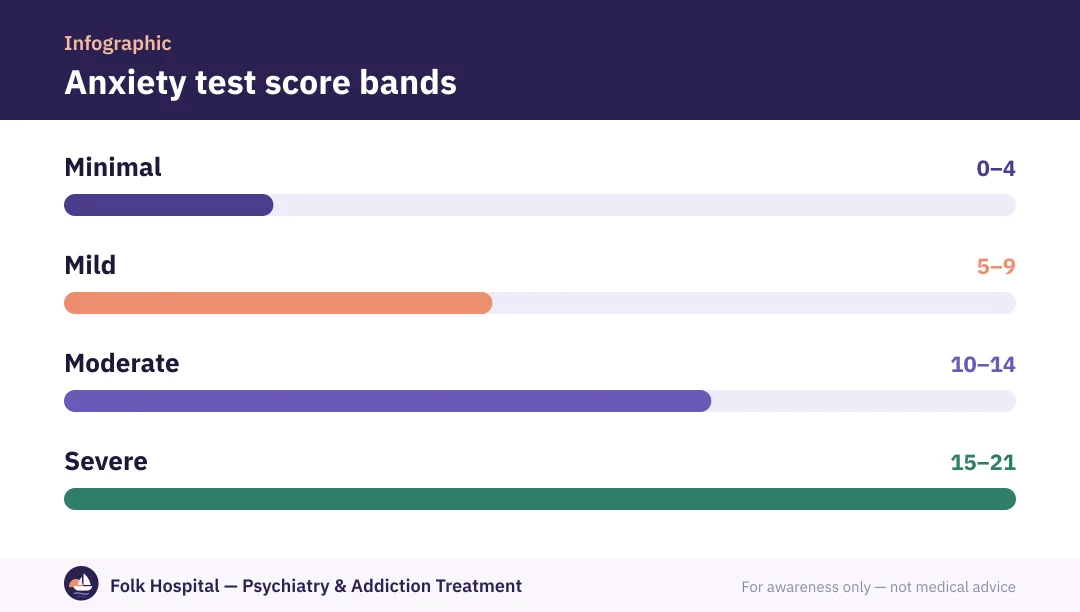
| Score | Level |
|---|---|
| 0–4 | Minimal |
| 5–9 | Mild |
| 10–14 | Moderate |
| 15–21 | Severe |
A score of 10 or more deserves a specialist assessment. Read about generalised anxiety.
03What the test doesn't measure
| Condition | Better tool |
|---|---|
| Sudden panic attacks | Assessment for panic disorder |
| Fear of social situations | Social anxiety test |
| Obsessive thoughts | OCD test |
| Anxiety after trauma | PTSD test |
- Cut stimulantscaffeine and nicotine amplify symptoms.
- Try slow breathingout longer than in, for a few minutes.
- Don't rely on sedatives alonewithout medical supervision.
- Book an assessmentif you score 10 or more.
؟Frequently asked questions
Does the anxiety test diagnose an anxiety disorder?
No, it's a validated screening tool that gives an indication. Diagnosis needs an assessment with a specialist who rules out other causes such as thyroid problems and stimulants.
My score is moderate. Do I need medication?
Not necessarily. CBT is very effective for anxiety, and the doctor decides whether medication would help you.
What is the GAD-7?
A seven-question screening tool used worldwide to estimate generalised anxiety severity.
Does it detect panic attacks?
It's designed for generalised anxiety and may miss panic or phobias.
Does caffeine affect the result?
Too much increases physical anxiety symptoms.
Are sedatives the answer?
They may be prescribed short-term; long-term use can cause dependence.
Sources and references
- Anxiety Disorders — National Institute of Mental Health (NIMH)
- Generalised anxiety disorder (GAD) — NHS (UK)
- Anxiety disorders — fact sheet — World Health Organization

A psychiatrist specialising in addiction and mental illness in adults and adolescents, with a focus on dual diagnosis.
For awareness only — not a substitute for medical advice. Editorial policy · View profile