01Psychological symptoms
What goes on in the mind
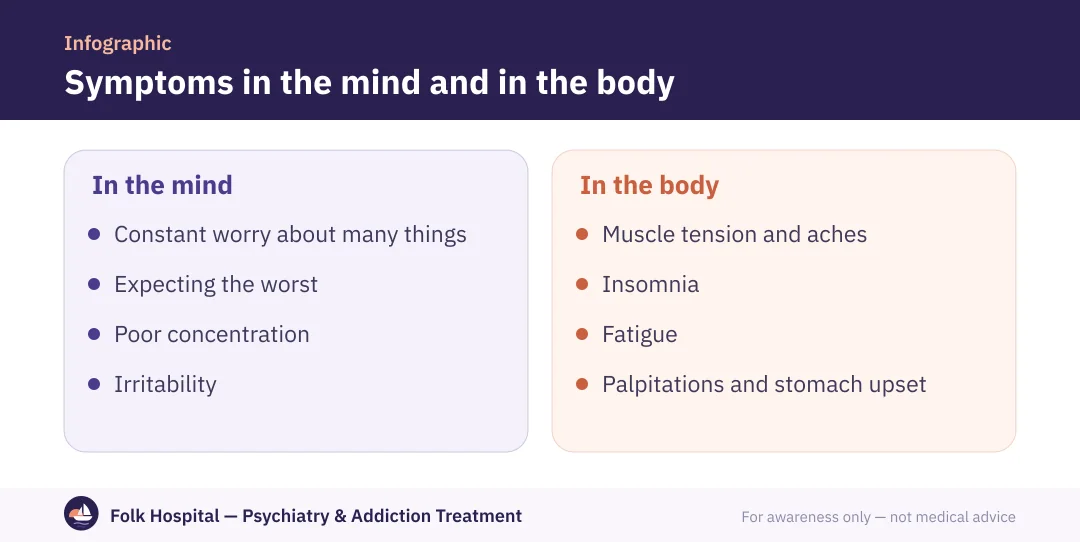
- Constant worry moving between topics.
- Difficulty stopping the thoughts.
- Always expecting the worst.
- Poor concentration or «mind going blank».
- Irritability and being easily provoked.
- A constant sense of tension or anticipation.
02Physical symptoms
| Symptom | Why it happens |
|---|---|
| Muscle tension | Constant readiness for danger |
| Fatigue | Energy drained by constant worry |
| Headaches | Tension in the neck and head |
| Stomach upset | The effect of stress on digestion |
| Palpitations and sweating | Activity of the autonomic nervous system |
| Insomnia | A mind that won't settle at night |
03Anxious behaviours
They seem helpful
- Reassurance-seeking.
- Over-planning.
- Avoiding uncertain situations.
- Procrastination.
But they
- Relieve only briefly.
- Prevent learning to tolerate uncertainty.
- Maintain the anxiety.
- Add to the burden.
Read generalised anxiety, anxiety at night, overthinking and the anxiety test.
؟Frequently asked questions
What are the symptoms of GAD?
Constant, hard-to-control worry, restlessness, fatigue, poor concentration, irritability, muscle tension and insomnia.
Does anxiety cause fatigue?
Yes. Constant worry drains physical and mental energy, causing fatigue despite rest.
What is reassurance-seeking?
Repeatedly asking others or searching online to confirm everything is fine; it relieves briefly and then worry returns.
How does anxiety show in children?
Through stomach aches, headaches, repeated «what if?» questions, sleep difficulty, clinginess and perfectionism.
Can anxiety symptoms resemble other illnesses?
Yes, such as an overactive thyroid, heart problems or the effects of caffeine and stimulants, so a medical assessment is done.
When are symptoms a disorder?
When they're excessive and present most days for six months and affect work, relationships and sleep.
Sources and references
- Anxiety Disorders — National Institute of Mental Health (NIMH)
- Anxiety disorders — fact sheet — World Health Organization
- Psychotherapies — National Institute of Mental Health (NIMH)

A psychiatrist specialising in addiction and mental illness in adults and adolescents, with a focus on dual diagnosis.
For awareness only — not a substitute for medical advice. Editorial policy · View profile