01Why isn't medication enough on its own?
Because addiction isn't only chemistry; it's habits, thoughts, relationships and triggers. Medicine calms the body and reduces cravings, while psychological treatment teaches the skills to live without the drug. Research shows that combining them gives better results than either alone.
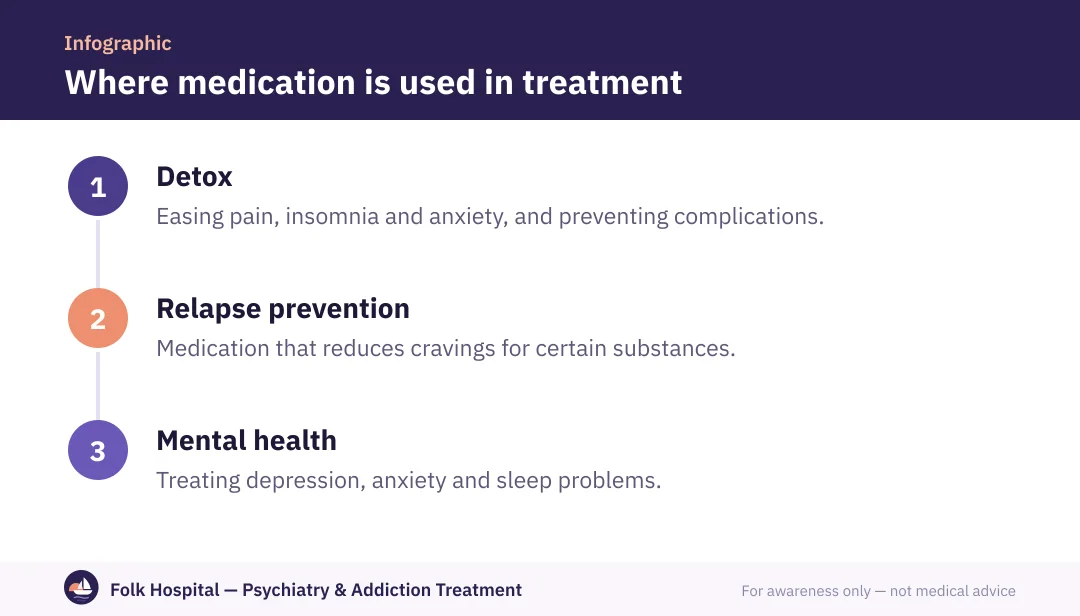
02Three jobs medicines do in addiction treatment
- Easing withdrawaltemporary medicines that relieve pain, diarrhoea, insomnia and anxiety, and prevent complications such as seizures in alcohol and sedative withdrawal.
- Preventing relapse and reducing cravingsapproved medicines for some drugs, used for longer periods after detox.
- Treating what accompanies addictionantidepressants, mood stabilisers, non-addictive anxiety and sleep medicines, and ADHD treatment.
03Medicines by type of drug
| Drug | Approved relapse-prevention medicines | Notes |
|---|---|---|
| Opioids (heroin, tramadol, painkillers) | Methadone, buprenorphine and naltrexone | Reduce relapse and overdose deaths; the choice is a medical decision |
| Alcohol | Naltrexone, acamprosate and disulfiram | The doctor chooses according to liver, kidneys and goal |
| Smoking | Nicotine replacement and medicines that reduce cravings, prescribed by a doctor | Double the chances of quitting with support |
| Stimulants (crystal meth, cocaine) | No approved medicine yet | Behavioural treatment with medicines for symptoms |
| Cannabis and synthetic drugs | No approved medicine yet | Behavioural treatment with medicines for insomnia and anxiety when needed |
| Sedatives | No specific medicine; treatment is gradual tapering | The patient may be switched temporarily to a long-acting sedative |
Read about naltrexone, methadone and buprenorphine.
04Opioid medicines: why are they so important?
The World Health Organization and the US National Institute on Drug Abuse recommend medicines for opioid use disorder as a core part of treatment, because they clearly reduce relapse and overdose deaths. They come in two types:
Medical substitution
- Methadone or buprenorphine at a stable dose.
- Prevent withdrawal and cravings without a high.
- Need regular attendance and long follow-up.
Blocking treatment
- Naltrexone blocks the effect of opioids.
- Starts after detox is complete.
- Isn't addictive and needs commitment.
The availability of some of these, and the rules for dispensing them, vary between countries. Read opioid addiction treatment.
05Withdrawal medicines: temporary and supervised
They're used only during detox, at doses reduced gradually, such as medicines that calm the nervous system in alcohol withdrawal, symptom medicines in opioid withdrawal, and vitamin B1 to protect the brain. They aren't left open-ended after detox, so they don't become a new dependence.
06Treating co-existing conditions
Many people with addiction also have depression, anxiety, bipolar disorder or ADHD. Treating these with suitable medicines clearly reduces relapse. The doctor chooses medicines that aren't addictive and avoids sedatives open to misuse wherever possible. Read about dual diagnosis.
07Important warnings
Don't treat yourself
- Don't buy "addiction cure pills" online or on non-medical advice.
- Don't swap one drug for another (such as tramadol instead of heroin, or sedatives instead of alcohol).
- Some relapse-prevention medicines can cause sudden withdrawal if taken while the drug is still in the body.
- Don't stop a prescribed psychiatric medicine or start a new one without checking with your doctor.
08How is a medicine chosen?
The doctor considers the type of drug, the severity of dependence, previous attempts, liver and kidney function, co-existing illnesses, pregnancy, other medicines and the patient's own wishes. They explain the benefits, side effects and alternatives, and review the plan at follow-up.
؟Frequently asked questions
Is there a medicine that cures addiction for good?
No medicine cures addiction on its own. Some reduce cravings and prevent relapse for certain drugs, and they work best with psychological treatment and follow-up.
Is medication-assisted treatment just a substitute addiction?
Some medicines, such as methadone and buprenorphine, are opioids, but they're given at stable, supervised doses that prevent withdrawal and cravings without a high and reduce overdose deaths. That's entirely different from drug use.
Why is there no medicine for cannabis or crystal meth addiction?
Because research hasn't yet produced a medicine proven effective enough and approved for these drugs; treatment relies on behavioural approaches with medicines for accompanying symptoms.
Can I buy addiction medicine from a pharmacy without a doctor?
That's never advised. Some of these medicines can cause sudden withdrawal or dangerous interactions, or need tests before starting.
How long is relapse-prevention medicine taken?
It varies by medicine and case, from months to sometimes years, decided by the doctor with regular review.
Sources and references
- Medications to Treat Opioid Use Disorder — Research Report — National Institute on Drug Abuse (NIDA)
- Guidelines for the psychosocially assisted pharmacological treatment of opioid dependence — World Health Organization
- Alcohol-use disorders: diagnosis, assessment and management (CG115) — National Institute for Health and Care Excellence (NICE)
- Treatment Approaches for Drug Addiction — DrugFacts — National Institute on Drug Abuse (NIDA)
- Drug misuse in over 16s: opioid detoxification (CG52) — National Institute for Health and Care Excellence (NICE)

A psychiatrist specialising in addiction and mental illness in adults and adolescents, with a focus on dual diagnosis.
For awareness only — not a substitute for medical advice. Editorial policy · View profile