01Types of test
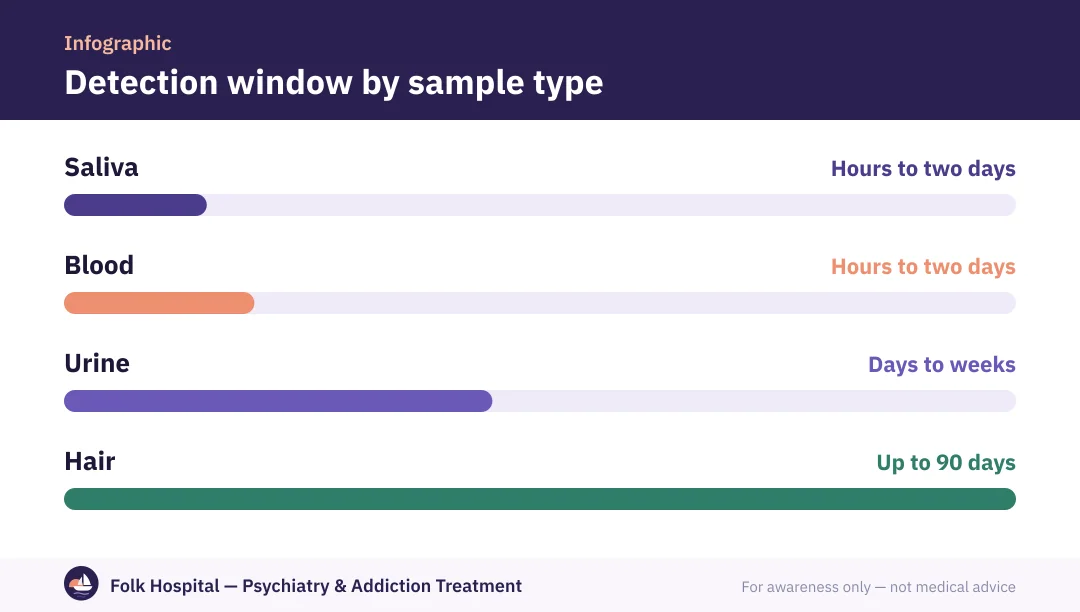
| Type | Approximate detection window | Use |
|---|---|---|
| Urine | Usually days, longer with repeated cannabis use | The most common |
| Blood | Hours to a day or two | Recent use and emergencies |
| Saliva | Hours to about two days | Quick checks |
| Hair | Up to about 90 days | Repeated use over a long period |
02How long common substances show in urine
| Substance | Approximate time |
|---|---|
| Cannabis | Days to weeks depending on frequency |
| Tramadol | About 1–4 days |
| Shabu | About 2–4 days |
| Heroin | About 1–3 days |
| Strox | Not detected by standard strips |
Times are approximate and depend on dose, frequency, weight and liver and kidney function.
03Stages of proper testing
- Rapid screeninga strip or cassette gives an initial indication.
- Declaring medicinesto interpret any positive result.
- Lab confirmationGC-MS or LC-MS to identify the substance precisely.
- Medical interpretationwith history and symptoms, not the number alone.
04When should a family ask for a test?
When strong signs keep appearing, and ideally as part of an assessment rather than a tool for confrontation alone. Read about the signs of drug use and how to convince your child to get treatment.
05Read also
؟Frequently asked questions
Is a rapid test accurate?
It's good for screening, but can give false positives or negatives, so important results are confirmed with a lab test such as GC-MS or LC-MS.
How long does cannabis show in urine?
It depends on frequency: a few days for occasional use, and up to weeks with long-term daily use, because it's stored in fat.
Does a hair test detect old use?
Yes. It detects repeated use over up to about 90 days in a standard hair sample, but not very recent use.
Can a test be cheated?
Labs detect diluted or tampered samples, and cheating attempts can be dangerous to health. Read about drug cleanse myths.
Is testing confidential?
In medical centres, test results are part of the confidential medical file and are released only with the patient's consent or as the law requires.
Sources and references
- Drug Testing — U.S. National Library of Medicine — MedlinePlus
- Cannabis (Marijuana) — research topic — National Institute on Drug Abuse (NIDA)
- Opioids — research topic — National Institute on Drug Abuse (NIDA)
- Methamphetamine — research topic — National Institute on Drug Abuse (NIDA)

A psychiatrist specialising in addiction and mental illness in adults and adolescents, with a focus on dual diagnosis.
For awareness only — not a substitute for medical advice. Editorial policy · View profile