01Types
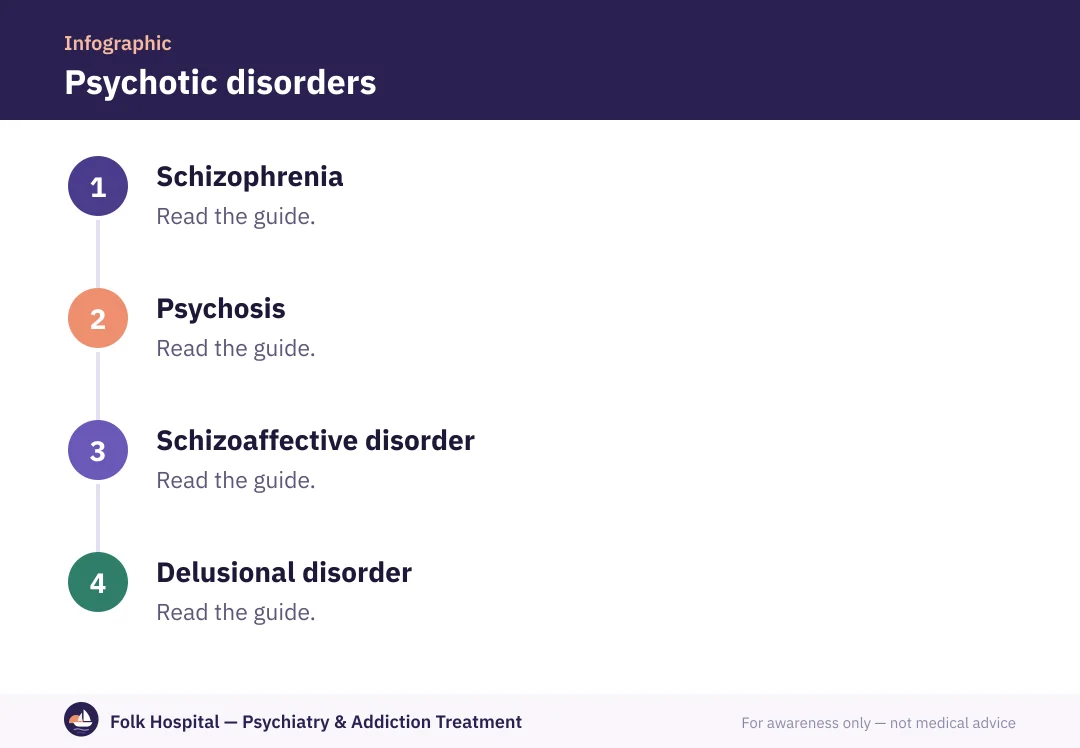
| Type | Feature |
|---|---|
| Schizophrenia | Psychotic symptoms and decline over a long period |
| Schizoaffective | Psychosis with mood episodes |
| Delusional disorder | Delusions without other prominent symptoms |
| Drug-induced psychosis | Linked to use or withdrawal |
| Paranoia | Excessive suspicion and mistrust |
02Early signs
May precede an episode
- Withdrawal and falling behind at school or work.
- Unusual suspicion.
- Sleep disturbance.
- Strange speech or ideas.
- Neglecting personal hygiene.
- Suicidal thoughts or intent to harm yourself or others.
- Losing touch with reality or severe agitation.
In Egypt call the ambulance on 123 or the mental-health hotline 08008880700.
Ambulance: 123Read also: psychosis, hallucinations, antipsychotics.
؟Frequently asked questions
What are psychotic disorders?
Disorders where a person partly loses touch with reality, with hallucinations, delusions or disordered thinking.
Is psychosis the same as schizophrenia?
No. Psychosis is a symptom that can appear in schizophrenia, bipolar disorder, severe depression, substance use and more.
Do drugs cause psychosis?
Yes, especially stimulants like meth and high-potency cannabis.
Can psychosis be cured?
Many recover or stabilise with treatment, especially with early intervention.
What if the patient refuses treatment?
Talk calmly without arguing about delusions and seek medical assessment; in dangerous situations admission may be needed.
Are people with psychosis dangerous?
Most aren't violent and are more likely to be victims, but risk rises with substance use and no treatment.
Sources and references
- Schizophrenia — National Institute of Mental Health (NIMH)
- Psychosis — MedlinePlus — U.S. National Library of Medicine — MedlinePlus
- Psychosis — NHS (UK)

A psychiatrist specialising in addiction and mental illness in adults and adolescents, with a focus on dual diagnosis.
For awareness only — not a substitute for medical advice. Editorial policy · View profile