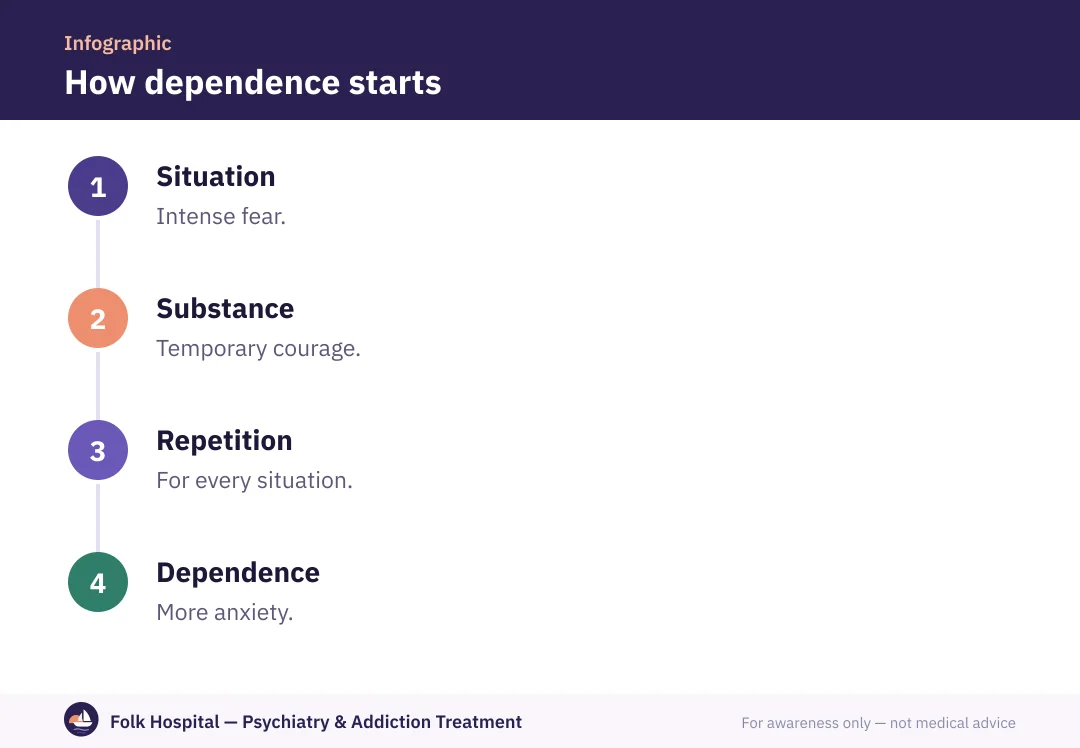
01The anxiety-substance cycle
- An upcoming social situationrising anxiety.
- The substancealcohol or a sedative beforehand.
- Temporary success«I got through it».
- Wrong learning«I can't without it».
- Dependencelarger amounts and more situations needing it.
02The commonest substances
| Substance | What happens |
|---|---|
| Alcohol | Temporary courage, then worse anxiety and dependence |
| Sedatives | Quick calm, then dependence and rebound anxiety |
| Hashish | Temporary calm, then anxiety and suspicion |
| Pregabalin | Self-medicated calm that can cause dependence |
03Integrated treatment
The patient needs
- Safe detox if there's dependence.
- CBT for social anxiety.
- Gradual exposure without the substance.
And may need
- A non-addictive antidepressant.
- Support groups.
- A plan for high-risk situations such as parties.
Read dual diagnosis, social anxiety and anxiety and addiction.
؟Frequently asked questions
Why do people with social anxiety turn to alcohol?
It eases tension and gives temporary courage in situations, so use repeats until it becomes necessary.
Are sedatives a treatment for social anxiety?
They're not used long-term, as they can cause dependence and block learning to cope; the main treatment is psychological, with antidepressants when needed.
What's the risk of hashish with social anxiety?
It may calm briefly but can increase anxiety and suspicion with continued use, and causes dependence.
How do I know I'm dependent on the substance?
If you can no longer attend social situations without it, the amount has increased, or you feel severe anxiety without it.
Can both be treated together?
Yes, with cognitive-behavioural treatment of social anxiety plus safe detox and addiction rehabilitation.
What happens to the anxiety when I stop the substance?
It may increase temporarily, so the patient needs support and anxiety treatment during recovery.
Sources and references
- Social anxiety (social phobia) — NHS (UK)
- Anxiety Disorders — National Institute of Mental Health (NIMH)
- Anxiety disorders — fact sheet — World Health Organization
- Comorbidity: Substance Use and Other Mental Disorders — National Institute on Drug Abuse (NIDA)

A psychiatrist specialising in addiction and mental illness in adults and adolescents, with a focus on dual diagnosis.
For awareness only — not a substitute for medical advice. Editorial policy · View profile