01What is social anxiety?
Social anxiety is an intense, persistent fear of situations where you're being judged by others: speaking in a meeting, eating in public, a job interview, or even making a phone call. It comes with blushing, trembling, sweating and repeated thoughts of "they'll notice" and "I'll look stupid", followed by avoidance that gradually narrows life. Read about the symptoms of social anxiety.
02Cognitive behavioural therapy
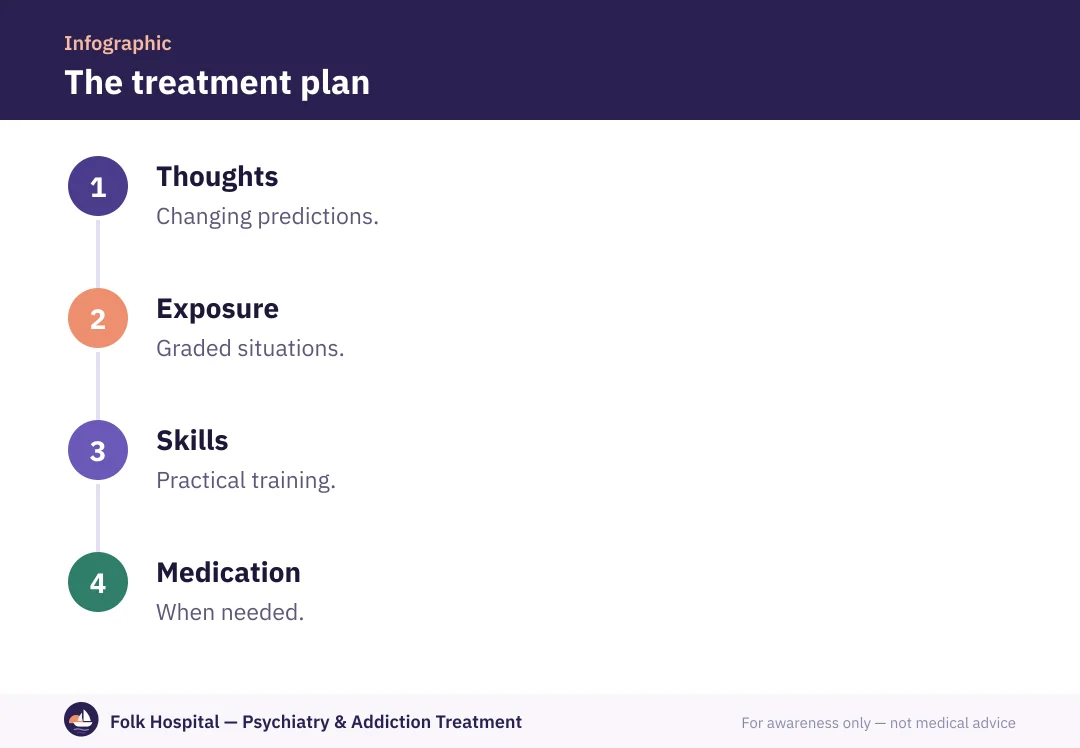
- Understanding the cyclefrightening thought → anxiety → safety behaviours and avoidance → the fear persists.
- Testing thoughtsdo people really notice? What's the worst that could happen, and how would I cope?
- Dropping safety behaviourssuch as avoiding eye contact, holding your phone, or memorising what to say word for word.
- Gradual exposurea ladder of situations from easiest to hardest, with real practice.
- Shifting attention outwardfocusing on the conversation and people instead of monitoring yourself.
- Social skillswhen needed, such as starting a conversation or giving your opinion.
| Example exposure ladder | Difficulty |
|---|---|
| Asking a shopkeeper a price | Low |
| Phoning to book an appointment | Medium |
| Giving an opinion in a small meeting | Medium to high |
| Presenting to a group | High |
03Medication
- Antidepressants such as SSRIs: help in moderate and severe cases and take weeks to work.
- Propranolol: eases trembling and a racing heart in specific performance situations, but doesn't treat the anxiety itself.
- Sedatives: avoided as regular treatment because of the risk of dependence.
04Social anxiety and addiction
A dangerous "dose of courage"
Many people with social anxiety use alcohol, cannabis or sedatives to get through social situations. It brings temporary relief, but stops them learning to cope and can turn into addiction. Read about social anxiety and addiction.
05Everyday tips
- Start with very small steps, and repeat them.
- Don't wait for the anxiety to vanish before acting; act while it's there.
- Notice that most people are more preoccupied with themselves than you think.
- Reward yourself for every attempt, not for a perfect performance.
؟Frequently asked questions
How long does social anxiety treatment take?
Many people notice improvement within 12 to 16 sessions of CBT.
Is it just shyness?
No. Shyness is a normal trait; social anxiety is an intense, persistent fear of embarrassment or negative judgement that makes people avoid important situations in study, work and relationships.
Does propranolol treat social anxiety?
It eases physical symptoms such as trembling and a racing heart in specific performance situations like presenting to an audience, but doesn't treat the anxiety itself, and is used on prescription.
Can it be treated online?
Some sessions can be remote, but an important part of treatment is exposure in real situations, done gradually by agreement with the therapist.
Sources and references
- Anxiety Disorders — National Institute of Mental Health (NIMH)
- Anxiety disorders — fact sheet — World Health Organization
- Psychotherapies — National Institute of Mental Health (NIMH)
- Mental Health Medications — National Institute of Mental Health (NIMH)

A psychiatrist specialising in addiction and mental illness in adults and adolescents, with a focus on dual diagnosis.
For awareness only — not a substitute for medical advice. Editorial policy · View profile