01The old subtypes
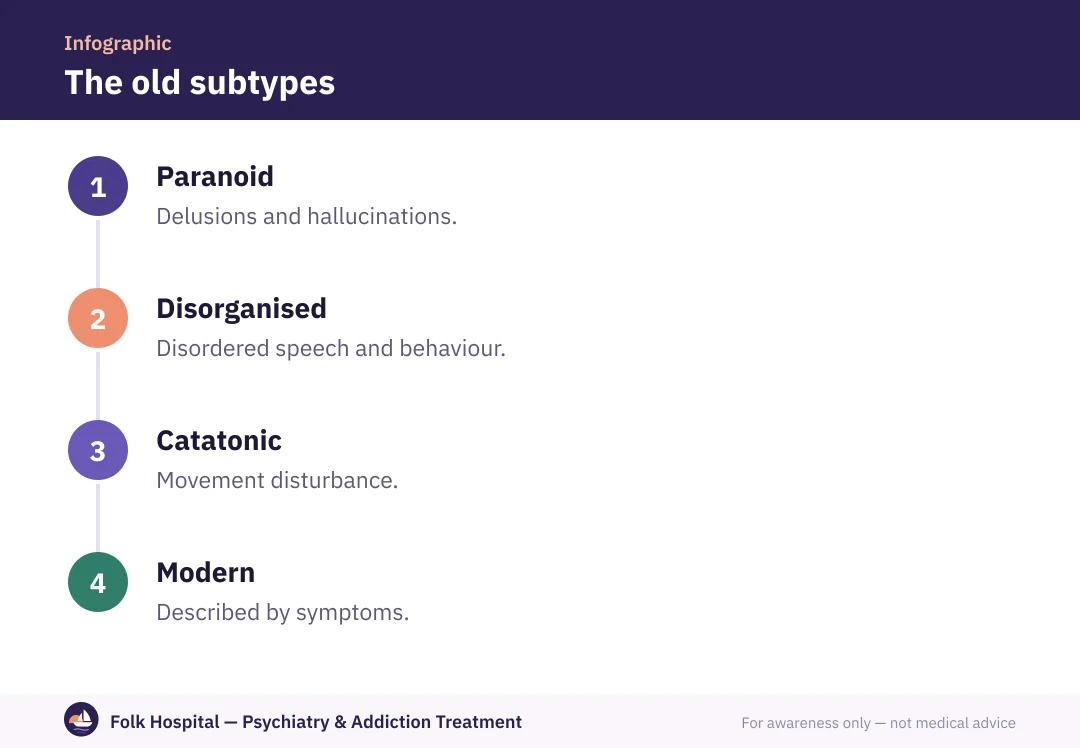
| Old subtype | Dominant picture |
|---|---|
| Paranoid | Persecutory delusions and auditory hallucinations with relatively organised thinking |
| Disorganised | Disorganised speech and behaviour, inappropriate emotions |
| Catatonic | Movement disturbance: freezing, strange movements or mutism |
| Undifferentiated | Symptoms not fitting one type |
| Residual | Mild negative symptoms after active symptoms fade |
02How doctors describe schizophrenia today
- Identifying symptom groupspositive, negative, cognitive and movement disturbance.
- Rating each group's severitymild, moderate or severe.
- Defining the coursefirst episode, multiple episodes or continuous.
- Flagging what needs actionsuch as catatonia, which needs urgent treatment.
03Conditions related to schizophrenia
| Condition | What distinguishes it |
|---|---|
| Schizoaffective disorder | Psychosis with clear depressive or manic episodes |
| Schizophreniform disorder | Schizophrenia symptoms for under 6 months |
| Brief psychotic disorder | Psychosis lasting under a month |
| Delusional disorder | A fixed delusion without other clear schizophrenia symptoms |
| Schizoid personality | Detachment and emotional coldness without psychosis |
Catatonia is urgent
Prolonged freezing, refusing food and drink, or not speaking may be catatonia, which needs urgent hospital treatment, whether with schizophrenia or another condition.
Read schizophrenia, schizophrenia symptoms and psychosis vs schizophrenia.
؟Frequently asked questions
What are the types of schizophrenia?
Historically: paranoid, catatonic, disorganised, undifferentiated and residual. These are no longer used, and schizophrenia is described by symptom severity.
What is paranoid schizophrenia?
An old description of a picture dominated by delusions and hallucinations, especially persecution, with relatively preserved thinking and speech.
What is catatonic schizophrenia?
A picture dominated by movement disturbances such as freezing or strange movements. Catatonia is now seen as a state that can accompany various disorders and needs urgent treatment.
Why were the subtypes dropped?
Because they overlap, change in the same patient over time, and don't help much in choosing treatment or predicting outcome.
What's the difference between schizophrenia and schizoaffective disorder?
Schizoaffective disorder combines schizophrenia symptoms with clear mood episodes of depression or mania.
What is schizophreniform disorder?
A condition resembling schizophrenia that lasts more than a month but less than six months.
Sources and references
- Schizophrenia — overview — NHS (UK)
- Schizophrenia — National Institute of Mental Health (NIMH)
- Schizophrenia — fact sheet — World Health Organization

A psychiatrist specialising in addiction and mental illness in adults and adolescents, with a focus on dual diagnosis.
For awareness only — not a substitute for medical advice. Editorial policy · View profile