
01Core principles
What harms
- Constant criticism: «you're lazy».
- Arguing about delusions.
- Shouting and threats.
- Over-protection that blocks any independence.
- Hiding things from the doctor or stopping medication without advice.
What helps
- Praising small steps.
- Acknowledging feelings without confirming the delusion.
- A calm voice and short sentences.
- Encouraging gradual independence.
- Regular contact with the treatment team.
02A daily routine that supports stability
- Fixed timesfor sleep, waking, medication and meals.
- A simple activity each daya walk, a household task or a hobby.
- Calm social contacta short visit or call.
- Staying away from drugs and alcoholincluding hashish.
- Regular medical follow-upmedication and physical checks.
03Early signs of relapse
| Sign | What to do |
|---|---|
| Several nights of poor sleep | Contact the doctor early |
| Withdrawal and irritability | Calmly ask what's bothering them |
| Stopping medication | Discuss the reason with the doctor |
| Returning suspicion or voices | Seek prompt assessment |
| Talk of death or harm | Seek urgent help |
- Threats to harm themselves or others.
- Acting on commands from voices.
- Refusing food and drink, or prolonged freezing.
Mental health hotline: 08008880700.
Ambulance: 12304Caring for the carer
Caring for someone with schizophrenia is a long journey. Join the family programme, share responsibility with others, and don't hesitate to seek psychological support for yourself. Read supporting a mentally ill relative, schizophrenia and supporting someone with psychosis.
؟Frequently asked questions
How do I support someone with schizophrenia at home?
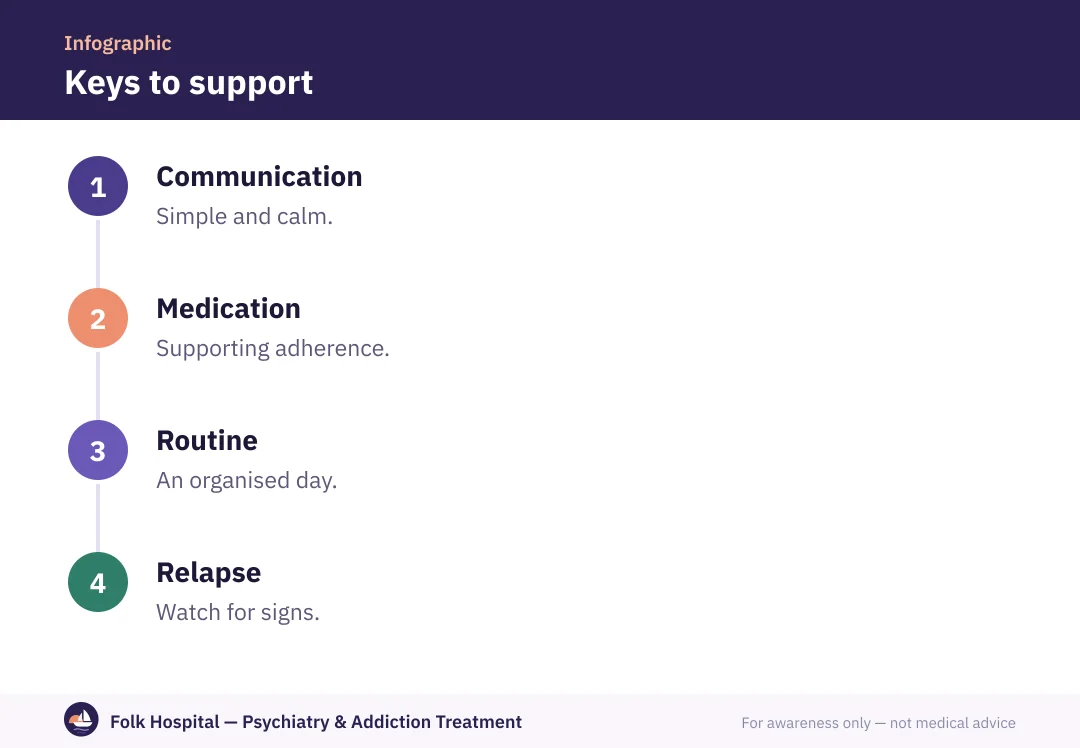
With calm, clarity and a steady routine, encouraging medication and simple activities, avoiding criticism and arguments, and watching for relapse signs.
What if they refuse medication?
Understand why, such as side effects or not believing they're ill, and discuss it with the doctor, who may change the medicine or use long-acting injections.
How do I talk to them about the voices?
Without mockery or argument; acknowledge they're distressing, ask how you can help, and tell the doctor about changes.
What are the signs of relapse?
Poor sleep, withdrawal, suspicion, irritability, stopping medication, and odd ideas or talk of voices returning.
Should I leave them alone?
A stable patient needs some independence, but during relapse or when there's risk they shouldn't be left alone.
How do I protect myself from burnout?
Share responsibility, get family support, make time to rest, and seek psychological help for yourself when needed.
Sources and references
- Schizophrenia — overview — NHS (UK)
- Schizophrenia — National Institute of Mental Health (NIMH)
- Schizophrenia — fact sheet — World Health Organization
- Psychotherapies — National Institute of Mental Health (NIMH)

A psychiatrist specialising in addiction and mental illness in adults and adolescents, with a focus on dual diagnosis.
For awareness only — not a substitute for medical advice. Editorial policy · View profile