01A direct comparison
| Aspect | Schizophrenia | Dissociative identity disorder |
|---|---|---|
| Nature | A psychotic disorder | A dissociative disorder |
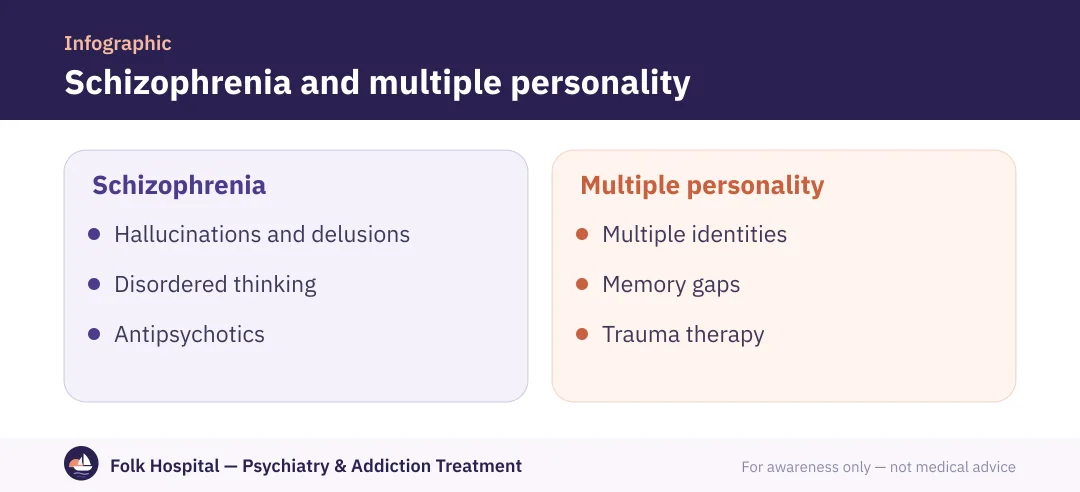
| Core symptoms | Hallucinations, delusions, negative symptoms | Two or more identities, memory gaps |
| Voices | Often heard as if from outside | May be heard inside as parts of the self |
| Contact with reality | May weaken during psychosis | Usually kept, with detachment and memory loss |
| Causes | Genes, brain development factors, substances | Severe, repeated childhood trauma |
| Treatment | Antipsychotics and rehabilitation | Long-term specialist psychotherapy |
| Prevalence | Roughly 1 in 300 worldwide | Rare |
02Common myths
Myth
- People with schizophrenia have two personalities.
- People with schizophrenia are always dangerous.
- Schizophrenia means total madness.
Fact
- They have one identity.
- Most patients aren't violent.
- Many live stable lives with treatment.
03Other dissociative conditions
- Depersonalisation and derealisation: feeling detached from oneself or the world.
- Dissociative amnesia: forgetting important personal events after trauma.
Read dissociative identity disorder, schizophrenia and psychosis vs schizophrenia.
؟Frequently asked questions
Is schizophrenia a split personality?
No. Schizophrenia is a psychotic disorder; «split personality» is a popular name for dissociative identity disorder, a different condition.
Where does the confusion come from?
From the word's meaning of «split», and from films and media depicting patients with two personalities.
What is dissociative identity disorder?
A rare condition with more than one identity or self-state and memory gaps, usually linked to severe, repeated childhood trauma.
Does someone with schizophrenia have two personalities?
No. They may hear voices or hold unrealistic beliefs, but their identity is single.
How is each treated?
Schizophrenia with antipsychotics and rehabilitation; dissociative identity disorder with long-term specialist trauma-focused psychotherapy.
Why does the distinction matter?
Because treatment is completely different, and confusion increases stigma and fear of patients.
Sources and references
- Schizophrenia — overview — NHS (UK)
- Schizophrenia — National Institute of Mental Health (NIMH)
- Schizophrenia — fact sheet — World Health Organization
- Dissociative disorders — NHS (UK)

A psychiatrist specialising in addiction and mental illness in adults and adolescents, with a focus on dual diagnosis.
For awareness only — not a substitute for medical advice. Editorial policy · View profile