01A direct comparison
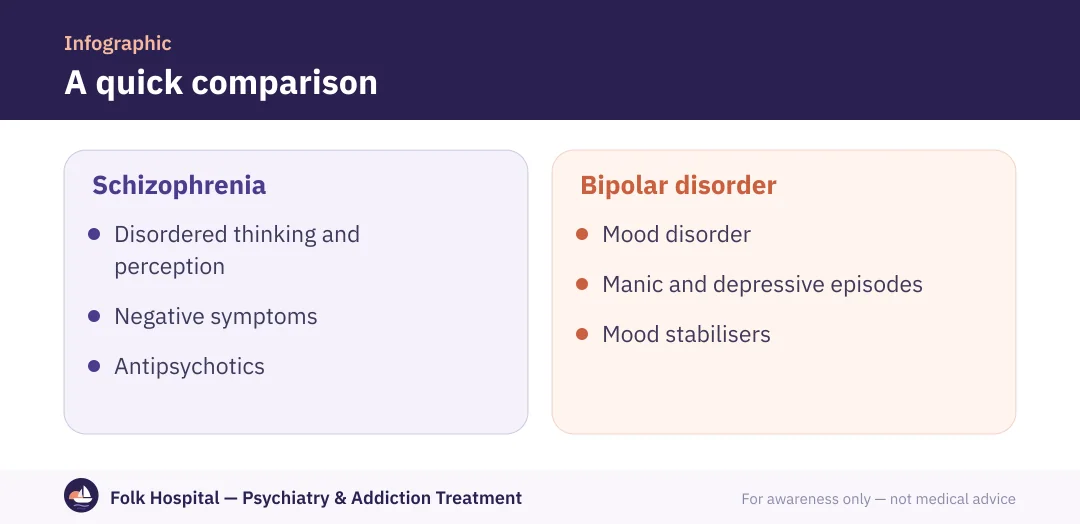
| Aspect | Schizophrenia | Bipolar disorder |
|---|---|---|
| Core disturbance | Thinking and perception | Mood |
| Main symptoms | Hallucinations, delusions, negative symptoms | Manic and depressive episodes |
| Psychosis | A core part of the illness | Only in severe episodes |
| Between episodes | Negative and cognitive symptoms may remain | Usually close to normal |
| Main treatment | Antipsychotics | Mood stabilisers, sometimes antipsychotics |
| Onset | Late teens and twenties | Usually teens and twenties |
02Signs pointing to each
Point to schizophrenia
- Persistent negative symptoms.
- Psychosis without a clear mood episode.
- Gradual decline in functioning.
- Commenting auditory hallucinations.
Point to bipolar disorder
- Periods of high energy, little sleep and fast speech.
- Clear depressive episodes.
- Mood-congruent psychosis (grandiosity or guilt).
- Return to normal between episodes.
03Schizoaffective disorder
It combines schizophrenia symptoms with major mood episodes, plus periods of psychosis without mood symptoms. It usually needs a mix of antipsychotics and mood stabilisers or antidepressants. Read schizoaffective disorder.
- Suicidal thoughts, especially in depressive episodes.
- Severe mania with risky decisions or days without sleep.
- Psychosis with risk to self or others.
Hotline 08008880700; ambulance 123.
Ambulance: 123Read schizophrenia, bipolar disorder and psychosis vs schizophrenia.
؟Frequently asked questions
What's the difference between schizophrenia and bipolar disorder?
Schizophrenia mainly affects thinking and perception with persistent negative symptoms; bipolar disorder affects mood with manic and depressive episodes, usually improving between them.
Does psychosis occur in bipolar disorder?
Yes, during severe manic or depressive episodes, resolving when the episode ends.
Which is more severe?
Each has its own severity. Schizophrenia often affects functioning continuously; bipolar disorder can be severe during episodes with a high suicide risk.
Is the treatment the same?
It overlaps partly, as some antipsychotics are used in both, but mood stabilisers are the mainstay of bipolar treatment.
What is schizoaffective disorder?
A condition combining schizophrenia symptoms with clear mood episodes, sitting between the two.
Can the diagnosis be confused?
Yes, especially at a first episode, so diagnosis needs follow-up over time.
Sources and references
- Schizophrenia — overview — NHS (UK)
- Schizophrenia — National Institute of Mental Health (NIMH)
- Schizophrenia — fact sheet — World Health Organization
- Bipolar Disorder — National Institute of Mental Health (NIMH)

A psychiatrist specialising in addiction and mental illness in adults and adolescents, with a focus on dual diagnosis.
For awareness only — not a substitute for medical advice. Editorial policy · View profile