01An over-sensitive alarm system
Picture a smoke alarm that goes off with cooking fumes. That's how the body behaves in panic disorder: ordinary signals such as palpitations after climbing stairs or mild dizziness are read as danger, adrenaline is released and symptoms intensify. The causes below are what make this alarm sensitive.
02Contributing factors
| Factor | How it contributes |
|---|---|
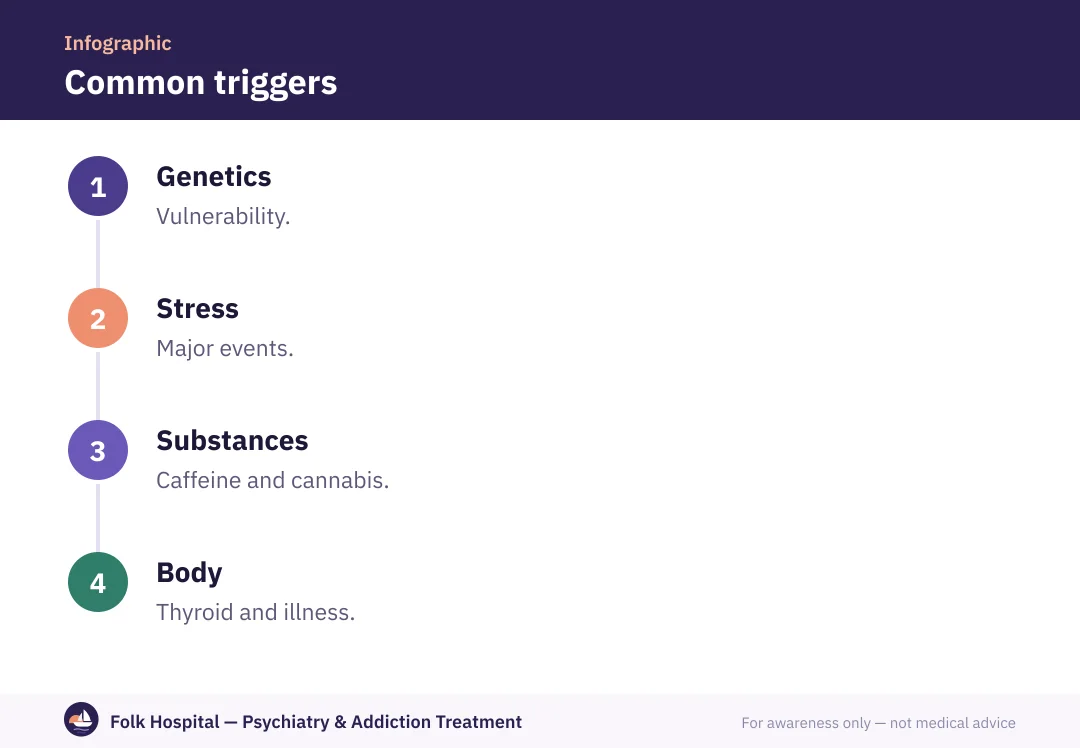
| Genes | A relative with the condition increases alarm sensitivity |
| Brain chemistry | Imbalance in fear circuits and messengers such as serotonin and noradrenaline |
| Major stress | Loss, separation, childbirth or heavy work pressure |
| Thinking style | Interpreting bodily sensations as catastrophe |
| Substances | Caffeine, stimulants, hashish, and withdrawal from sedatives or alcohol |
| Childhood experiences | Separation anxiety or a fearful environment |
Read serotonin and adrenaline.
03The loop that keeps the disorder going
- A bodily sensationpalpitations, dizziness or slight breathlessness.
- A frightening interpretation«this is a heart attack» or «I'm losing my mind».
- Fear and adrenalinepalpitations and dizziness increase.
- The peak of the attackthe original fear seems confirmed.
- Fear of recurrence and avoidancekeeps the brain on constant alert, making the next attack easier.
04Substances that can trigger attacks
- Caffeine in large amounts and energy drinks. Read caffeine.
- Stimulants such as shabu and captagon.
- Hashish and synthetic cannabinoids such as strox.
- Withdrawal from sedatives or alcohol.
Read panic and addiction.
05Physical causes the doctor rules out
Initial checks
Before diagnosing panic disorder, the doctor may request an ECG, thyroid tests, blood sugar and electrolytes, and ask in detail about substances and medicines.
06What this means for treatment
Understanding the causes shows that treatment targets the loop itself: correcting how sensations are interpreted, gradual exposure instead of avoidance, reducing triggers such as caffeine and substances, and addressing underlying stress. Read panic disorder treatment and causes of mental illness.
؟Frequently asked questions
Are panic attacks hereditary?
Genes play a part: a relative with the condition raises the likelihood, but environment, stress and thinking patterns matter a great deal too.
Do panic attacks come for no reason?
They can seem to, but there's usually an internal trigger, such as a mild bodily sensation read as danger, or accumulated stress.
Does coffee cause panic attacks?
Large amounts of caffeine can trigger attacks in predisposed people because it increases palpitations and tension.
Does hashish cause panic?
Yes, it can cause panic attacks, especially at high doses, with strong strains, or in predisposed people.
Are panic attacks linked to trauma?
They can start after a traumatic event or loss, and are sometimes part of post-traumatic stress disorder.
Do panic attacks have physical causes?
Conditions such as an overactive thyroid or heart rhythm problems can cause similar symptoms, so the doctor rules them out first.
Sources and references
- Panic disorder — NHS (UK)
- Anxiety Disorders — National Institute of Mental Health (NIMH)
- Anxiety disorders — fact sheet — World Health Organization
- Psychotherapies — National Institute of Mental Health (NIMH)

A psychiatrist specialising in addiction and mental illness in adults and adolescents, with a focus on dual diagnosis.
For awareness only — not a substitute for medical advice. Editorial policy · View profile