01How panic shrinks life
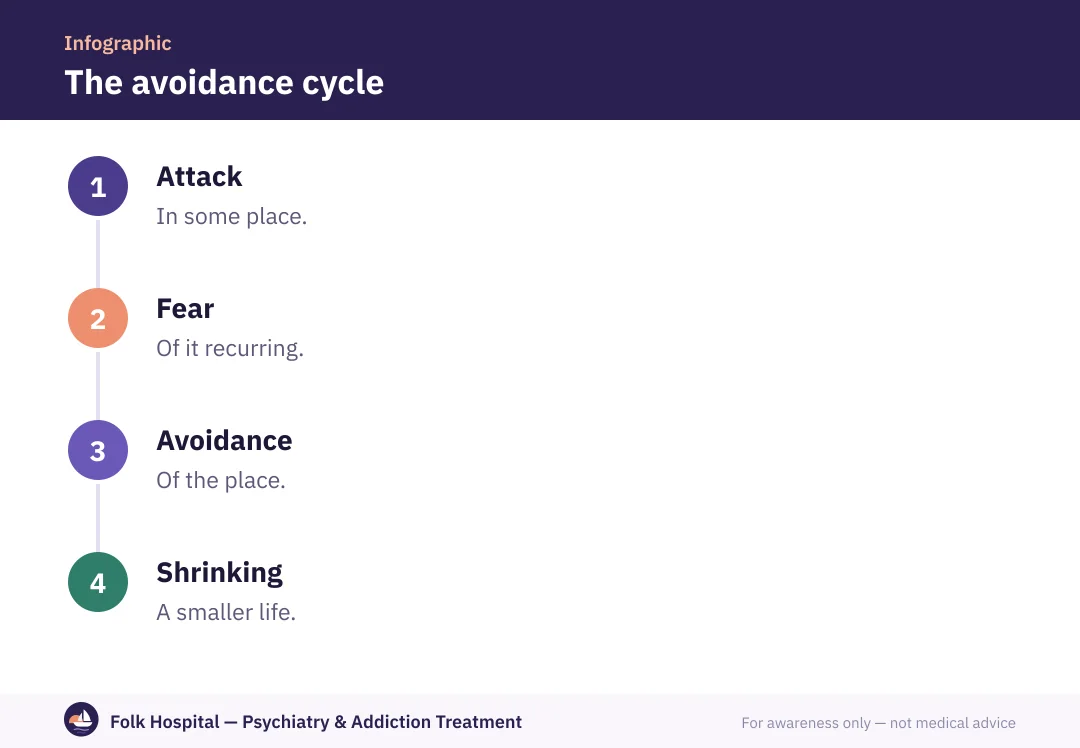
It starts with small avoidance: «I won't take the metro today». Avoidance then spreads to crowds, then travel, then going out alone. Every avoided place becomes a «danger zone» in the brain, and the circle tightens further. This is the real harm of untreated panic.
02The main harms
| Area | What may happen |
|---|---|
| Moving around | Agoraphobia; avoiding transport, crowds and travel |
| Work and study | Absences, avoiding meetings or exams, falling performance |
| Health | Repeated emergency visits and tests, insomnia, avoiding exercise |
| Mood | Depression, frustration and loss of confidence |
| Relationships | Needing a companion constantly, family tension |
| Substances | Dependence on sedatives, alcohol or other substances |
03Agoraphobia
The person fears situations where escape or help would be hard if an attack came: transport, shops, queues, and open or enclosed spaces. In severe cases they may not leave home. Read phobias.
04The sedative and alcohol trap
What looks like a solution
- Xanax or another sedative stops the attack quickly.
- Alcohol eases tension before hard situations.
- Carrying medicine in your pocket feels reassuring.
What happens over time
- Tolerance, dose increases and dependence.
- Worse rebound anxiety between doses.
- The brain never learns that attacks aren't dangerous.
- Withdrawal that can trigger worse attacks.
Read panic and addiction.
- Suicidal thoughts or deep hopelessness appear with panic and depression.
- The person hasn't left home for weeks.
- Sedative or alcohol use has clearly increased.
Call the mental health hotline on 08008880700, or an ambulance on 123 if there's danger.
Ambulance: 12305Treatment reverses most harms
- Correcting understandingknowing attacks aren't dangerous reduces fear of them.
- Gradual exposurereturning to avoided places step by step.
- Treating depressionif present.
- Reducing sedativeswith a medical plan if there's dependence.
Read panic disorder treatment and panic attack symptoms.
؟Frequently asked questions
Do panic attacks damage the heart?
An attack doesn't damage a healthy heart, but people with heart disease need medical follow-up, and any different chest pain deserves a check.
What is agoraphobia?
Fear of places or situations where escape or help might be difficult, such as transport, crowds and shops; it accompanies many cases of panic.
Does panic cause depression?
It can, because the restrictions and constant fear affect mood, and a share of patients develop depression.
Why do people with panic turn to sedatives?
Because they calm quickly, but repeated use without a plan causes tolerance and dependence and can increase anxiety on stopping.
Does panic affect work?
Yes. It can cause absences, avoidance of meetings or travel, and reduced performance, which improve with treatment.
Can life return to normal after years of panic?
Yes. Many patients regain their lives even after years, though early treatment is easier.
Sources and references
- Panic disorder — NHS (UK)
- Anxiety Disorders — National Institute of Mental Health (NIMH)
- Anxiety disorders — fact sheet — World Health Organization
- Psychotherapies — National Institute of Mental Health (NIMH)

A psychiatrist specialising in addiction and mental illness in adults and adolescents, with a focus on dual diagnosis.
For awareness only — not a substitute for medical advice. Editorial policy · View profile