01Why do we go round in the same thoughts?
Overthinking is repeatedly thinking about the past («why did I say that?») or the future («what if the worst happens?») without reaching a solution. It gives a false sense that we're «dealing with» the problem, while it increases anxiety and drains energy. Read about the signs of overthinking and its causes.
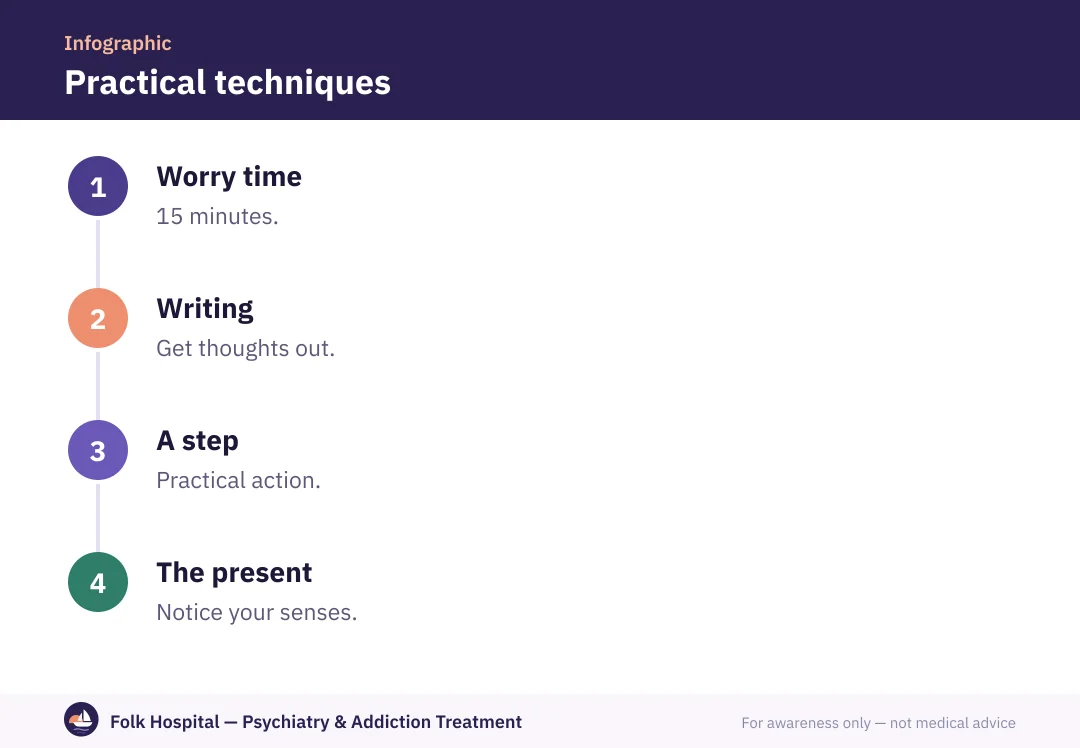
02Practical techniques
- Scheduled worry timeset aside 15 minutes a day for worries, and postpone any thought outside it to that time.
- Writing it downwrite repeated thoughts down instead of turning them over in your head.
- One stepask «can I do something now?» If yes, take a small step; if not, let it go.
- Come back to the momentname 5 things you can see, 4 you can hear and 3 you can touch.
- Movewalking or any physical activity breaks the circling of thoughts.
03Cognitive behavioural therapy
It helps change the beliefs that feed overthinking, such as «if I think more I'll prevent the problem» or «I have to be 100% sure», and teaches accepting some uncertainty. Read about cognitive behavioural therapy.
Overthinking
Problem-solving
- Circles around «what if?» | Starts with «what's the next step?»
- Doesn't end in a decision | Ends in a specific step
- Increases anxiety | Reduces the feeling of helplessness
04When do you need an assessment?
- If it comes with generalised anxiety or depression.
- If the thoughts are intrusive with repeated rituals, it may be OCD.
- If it causes ongoing insomnia or turning to sedatives.
؟Frequently asked questions
Are there medicines for overthinking?
There's no medicine for it alone, but treating accompanying anxiety or depression can reduce it considerably.
How do I stop overthinking before sleep?
Write down your thoughts and tomorrow's tasks an hour before bed, stay away from screens, and if you're not asleep within 20 minutes, get up for a quiet activity and then return.
Is overthinking a mental illness?
It isn't a separate diagnosis, but it's a common feature of generalised anxiety, depression and OCD. If it disrupts your life, an assessment is best.
What's the difference between overthinking and problem-solving?
Problem-solving ends in a decision or a step; overthinking circles the same questions without result and increases anxiety.
Sources and references
- Anxiety Disorders — National Institute of Mental Health (NIMH)
- Psychotherapies — National Institute of Mental Health (NIMH)
- Depression — National Institute of Mental Health (NIMH)
- Anxiety disorders — fact sheet — World Health Organization

A psychiatrist specialising in addiction and mental illness in adults and adolescents, with a focus on dual diagnosis.
For awareness only — not a substitute for medical advice. Editorial policy · View profile