01Symptoms
Mental
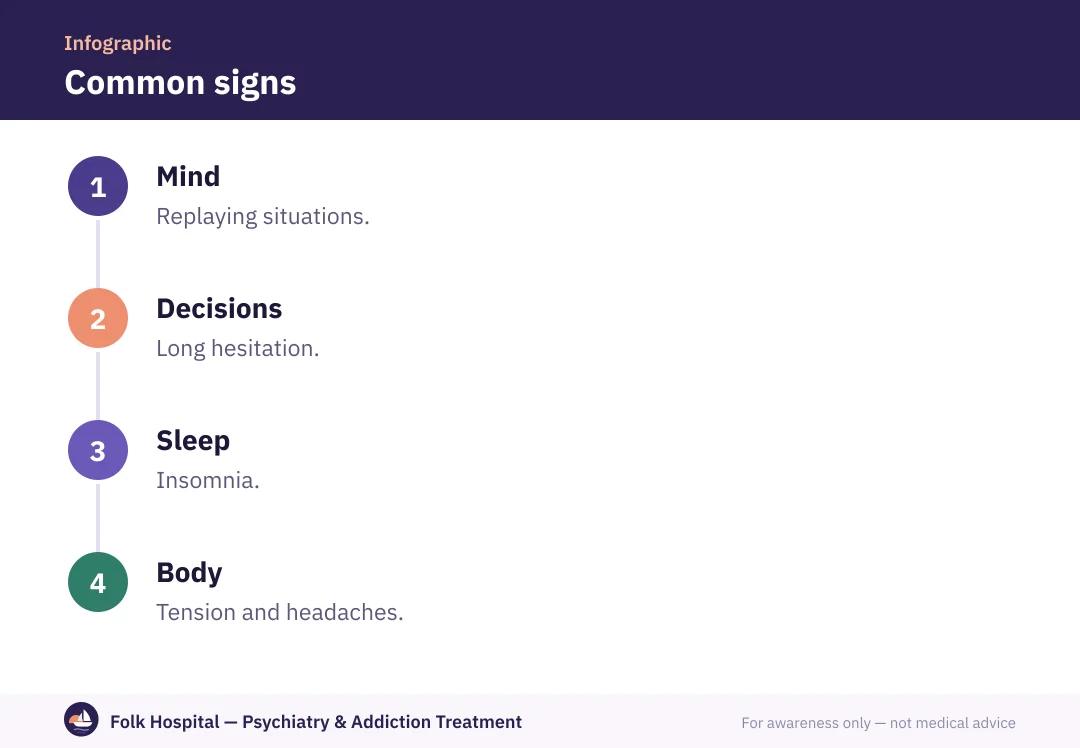
- Replaying conversations and situations.
- Imagining worst-case scenarios.
- Indecision.
- Difficulty concentrating.
Physical and behavioural
- Insomnia and trouble falling asleep.
- Headache and muscle tension.
- Repeated reassurance-seeking.
- Procrastination.
| Ordinary sign | Sign needing attention |
|---|---|
| Thinking before an important decision | Hours of thinking daily |
| Temporary worry | Worry lasting weeks |
| Ends in a decision | Never ends |
Read overthinking, its causes and the anxiety test.
؟Frequently asked questions
What are the symptoms of overthinking?
Replaying situations, imagining the worst, indecision, insomnia, mental fatigue and physical tension.
Does it cause physical symptoms?
Yes, such as headache, muscle tension, stomach upset and exhaustion.
How do I know it's a problem?
If it takes hours daily and affects sleep, work and relationships.
Is indecision a symptom?
Yes. Fear of mistakes makes decisions hard.
Is overthinking at night normal?
Everyone does it sometimes, but daily recurrence needs attention.
When should I seek help?
When it persists for weeks or with signs of depression or severe anxiety.
Sources and references
- Is Overthinking a Mental Illness? — Cleveland Clinic
- Generalised anxiety disorder (GAD) — NHS (UK)
- Anxiety Disorders — National Institute of Mental Health (NIMH)

Written byDr. Mahmoud ElsawyConsultant in psychiatry and addiction treatment
A psychiatrist specialising in addiction and mental illness in adults and adolescents, with a focus on dual diagnosis.
For awareness only — not a substitute for medical advice. Editorial policy · View profile