
01Causes
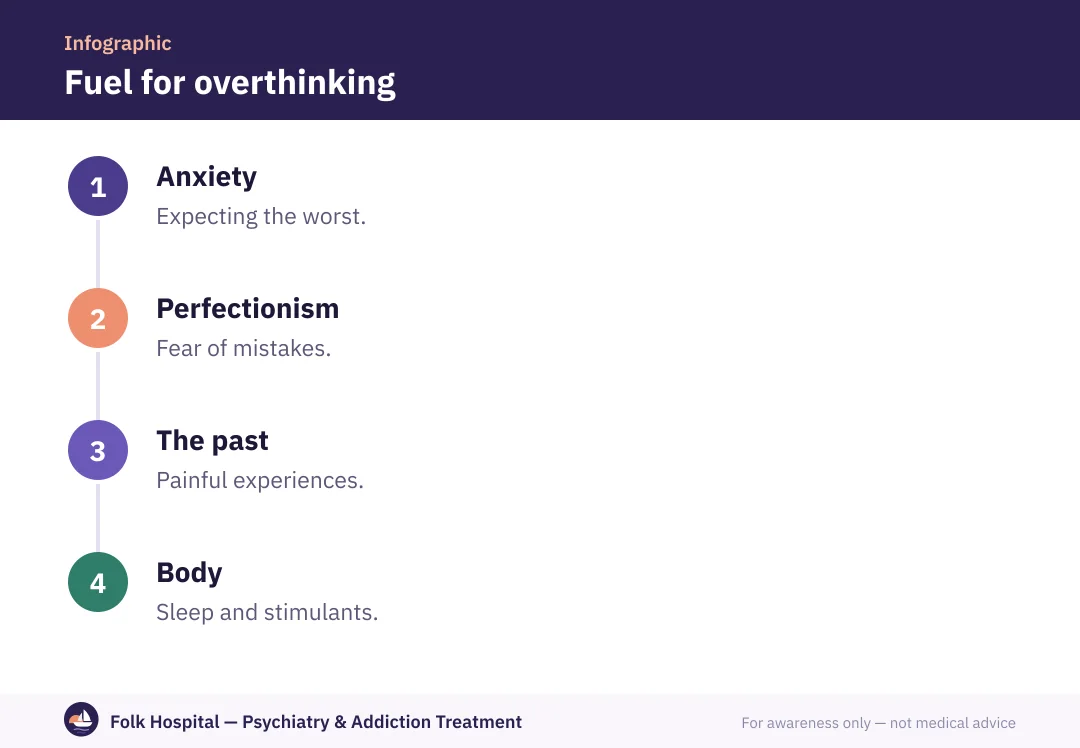
| Type | Examples |
|---|---|
| Psychological | Anxiety, depression, OCD |
| Traits | Perfectionism, fear of mistakes, high sensitivity |
| Experiences | Trauma, past failure |
| Lifestyle | Lack of sleep, screens, caffeine |
| Beliefs | «Worry protects me» |
Belief that feeds thinking
- «If I think more I'll avoid mistakes».
- «Worry is responsibility».
Alternative belief
- «Overthinking doesn't change the outcome».
- «I can cope when needed».
Read overthinking, its symptoms and highly sensitive person.
؟Frequently asked questions
Why do I think so much?
Because of anxiety, depression, perfectionism, stress or a learned mental habit.
Is personality a cause?
Some traits, like perfectionism and high sensitivity, increase the tendency.
Is trauma a cause?
Yes. It can keep the brain on alert, constantly expecting danger.
Does my phone increase overthinking?
Too much content, comparison and lost sleep make it worse.
Does caffeine increase it?
It can increase anxiety in some people.
Can it be overcome?
It can be greatly reduced with CBT and treating the cause.
Sources and references
- Is Overthinking a Mental Illness? — Cleveland Clinic
- Generalised anxiety disorder (GAD) — NHS (UK)
- Anxiety Disorders — National Institute of Mental Health (NIMH)

Written byDr. Mahmoud ElsawyConsultant in psychiatry and addiction treatment
A psychiatrist specialising in addiction and mental illness in adults and adolescents, with a focus on dual diagnosis.
For awareness only — not a substitute for medical advice. Editorial policy · View profile