01Why is treatment difficult?
Antisocial personality disorder involves disregard for others' rights, lying and manipulation, impulsivity, aggression and little sense of guilt. The person rarely seeks treatment themselves; they usually come because of a legal problem, addiction or family pressure. Read about the symptoms of antisocial personality disorder and its causes.
02Realistic treatment goals
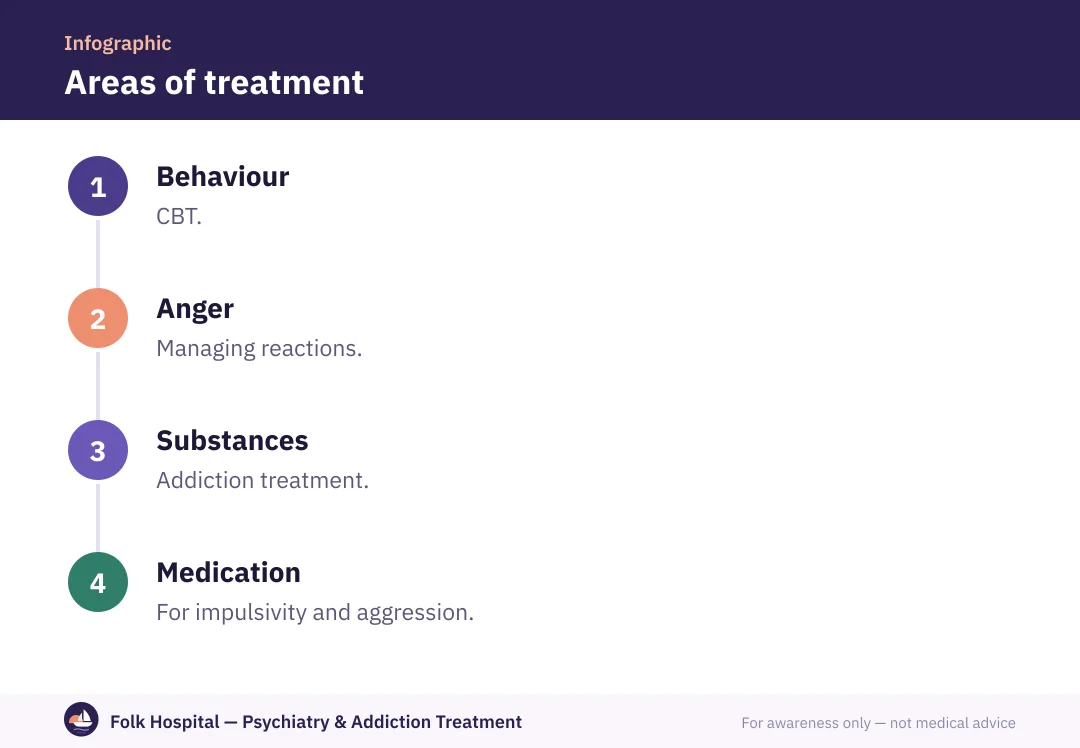
| Goal | Means |
|---|---|
| Reducing aggression | Anger management and cognitive behavioural therapy |
| Reducing impulsivity and risk-taking | Training in thinking before acting and problem-solving |
| Stopping substance use | A structured addiction treatment programme |
| Treating co-existing disorders | Depression, anxiety and ADHD |
| Stability at work and in relationships | Structured programmes with clear boundaries and consequences |
03Structured programmes
Programmes with clear rules and consistent consequences work better than open-ended sessions, because the person responds more to practical outcomes than to talk about feelings. Group therapy and vocational rehabilitation help.
04Accompanying addiction
A large proportion of those affected use drugs or alcohol, and substance use increases violence, crime and risk-taking. So addiction is treated in parallel. Read about antisocial personality disorder and addiction.
05Protecting the family
- Your safety and the children's come first: leave the place and get help. Police 122, ambulance 123.
- Don't cover up wrongdoing or fund substance use.
- Set clear boundaries and stick to them.
- Seek family counselling for yourself.
Read about the harms of antisocial personality disorder and the family guide.
؟Frequently asked questions
Does this disorder improve with age?
Some behaviours become less severe in many people after forty, especially with treatment and stopping substance use.
Is there a medicine for antisocial personality disorder?
There's no medicine for the disorder itself, but some medicines can help with impulsivity and aggression, or with accompanying depression and addiction.
Can the person be forced into treatment?
Treatment usually depends on the person's cooperation. When there's danger to self or others or a severe mental disorder, the doctor may intervene in accordance with the law.
How can the family protect itself?
By setting clear boundaries, not covering up wrongdoing or funding substance use, seeking support, and leaving when there's violence.
Sources and references
- Antisocial personality disorder — NHS (UK)
- Personality disorder — NHS (UK)
- Co-Occurring Disorders and Health Conditions — National Institute on Drug Abuse (NIDA)
- Psychotherapies — National Institute of Mental Health (NIMH)

A psychiatrist specialising in addiction and mental illness in adults and adolescents, with a focus on dual diagnosis.
For awareness only — not a substitute for medical advice. Editorial policy · View profile