01Why are they linked?
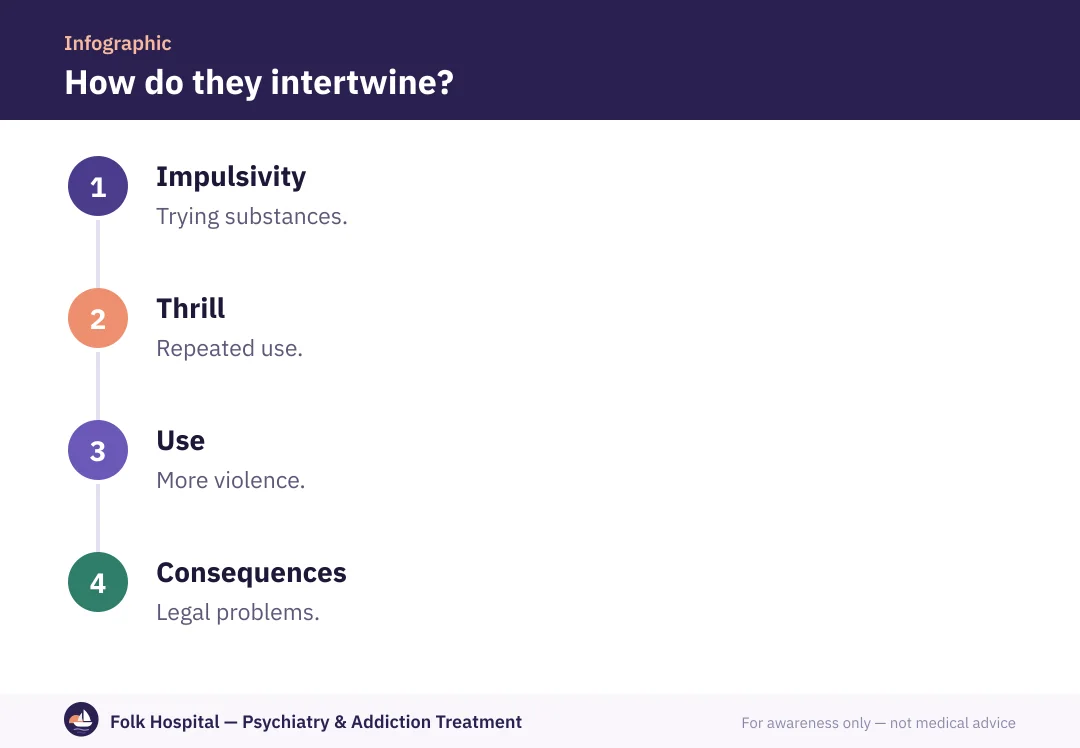
From the disorder to substances
- Impulsivity and thrill-seeking.
- Disregard for consequences.
- A social environment where use is common.
From substances to behaviour
- Alcohol increases aggression.
- Stimulants increase impulsivity and suspicion.
- Needing money leads to crime.
02The diagnostic challenge
| Question | Why it matters |
|---|---|
| Did the behaviour appear before use? | Childhood signs point to the disorder |
| Does it improve with stopping? | Marked improvement suggests an addiction effect |
| Is there remorse? | Remorse is less in the disorder |
03Treatment
- Full assessmentof the disorder, substances and risk.
- Safe detoxif there's dependence.
- A structured programmeclear rules and consistent consequences.
- Cognitive behavioural therapyfor anger, impulsivity and problem-solving.
- Long follow-upwith regular testing.
- Violence or threats under the influence.
- Danger to children.
Police 122; ambulance 123.
Ambulance: 123Read dual diagnosis, antisocial personality and how to convince an addict to get treatment.
؟Frequently asked questions
Why is antisocial personality linked to addiction?
Because of impulsivity, thrill-seeking and disregard for consequences, and the overlap of using environments with law-breaking.
Which substances are most dangerous?
Alcohol and stimulants, which increase violence and impulsivity; all substances raise the risks.
Can addiction cause behaviour resembling the disorder?
Yes. Addiction can cause lying, theft and violence, so the doctor assesses whether symptoms existed before use.
Does the person benefit from addiction treatment?
Yes, especially in structured programmes with clear limits and follow-up; violence and crime decrease with recovery.
What are the treatment challenges?
Low motivation, manipulation and poor adherence, so programmes need firm rules and clear consequences.
What can the family do?
Set limits, not fund use, protect children, encourage treatment, and get support.
Sources and references
- Antisocial personality disorder — NHS (UK)
- Personality disorder — NHS (UK)
- Comorbidity: Substance Use and Other Mental Disorders — National Institute on Drug Abuse (NIDA)

A psychiatrist specialising in addiction and mental illness in adults and adolescents, with a focus on dual diagnosis.
For awareness only — not a substitute for medical advice. Editorial policy · View profile